How to Prepare a Pitch Deck Financial Section That Investors Trust
How to prepare a pitch deck financial section: the five slides, unit economics, use of funds, legal points and common mistakes, with worked examples.

Reviewed on 21 November 2026 · Reading time about 8 minutes
Ananya, a founder in Kondapur, has a beautiful 14-slide deck. The product slides get nods. Then she reaches the financial slide, which shows one big number and an arrow pointing up. The investor asks how much it costs to win a customer. Ananya does not know. The room goes quiet.
A pitch deck financial section needs five slides: traction (what has happened), unit economics (what one customer earns and costs), projections (where the numbers go, with the drivers), the ask and use of funds (what you want and what it buys) and milestones (what the money achieves before the next round). Each slide should carry one message, one chart and numbers that match your financial model.
In plain English
Unit economics means the profit or loss on one customer. CAC is the cost to win a customer. LTV is the total profit you earn from that customer over their life. If LTV is well above CAC and pays back quickly, the business can grow without burning money for no reason.
The five slides
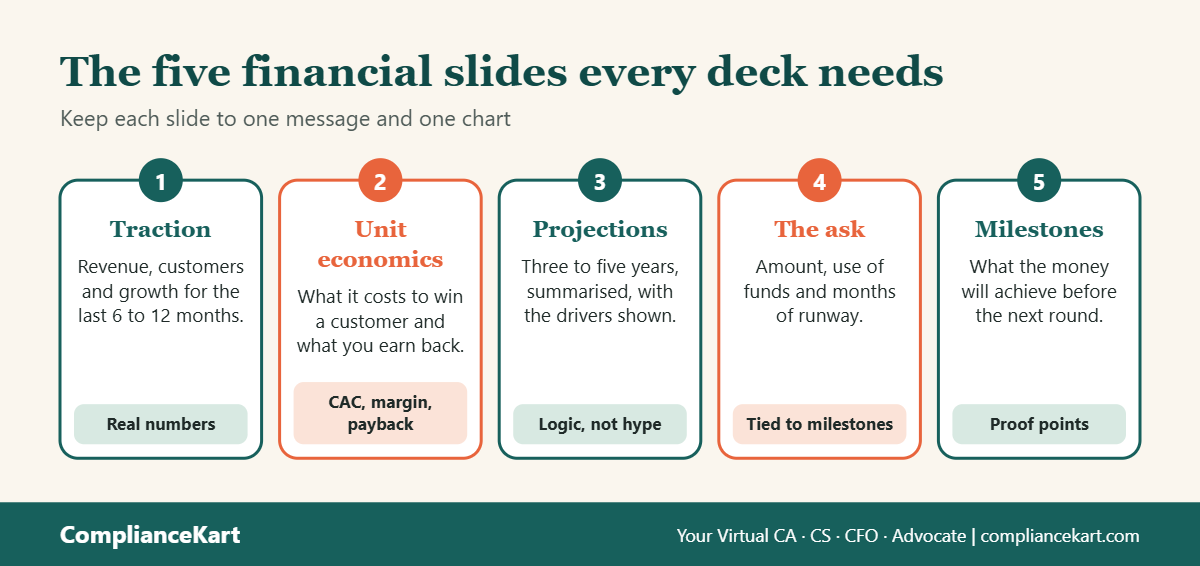
1. Traction
Show the last 6 to 12 months as a simple chart: revenue, customers and growth. Say what the revenue is. Gross merchandise value (GMV), net revenue and bookings are different things, so define the term once and keep it consistent. Revenue should be shown net of GST. If the numbers are management accounts and not audited, say so in a footnote.
2. Unit economics
Simple example
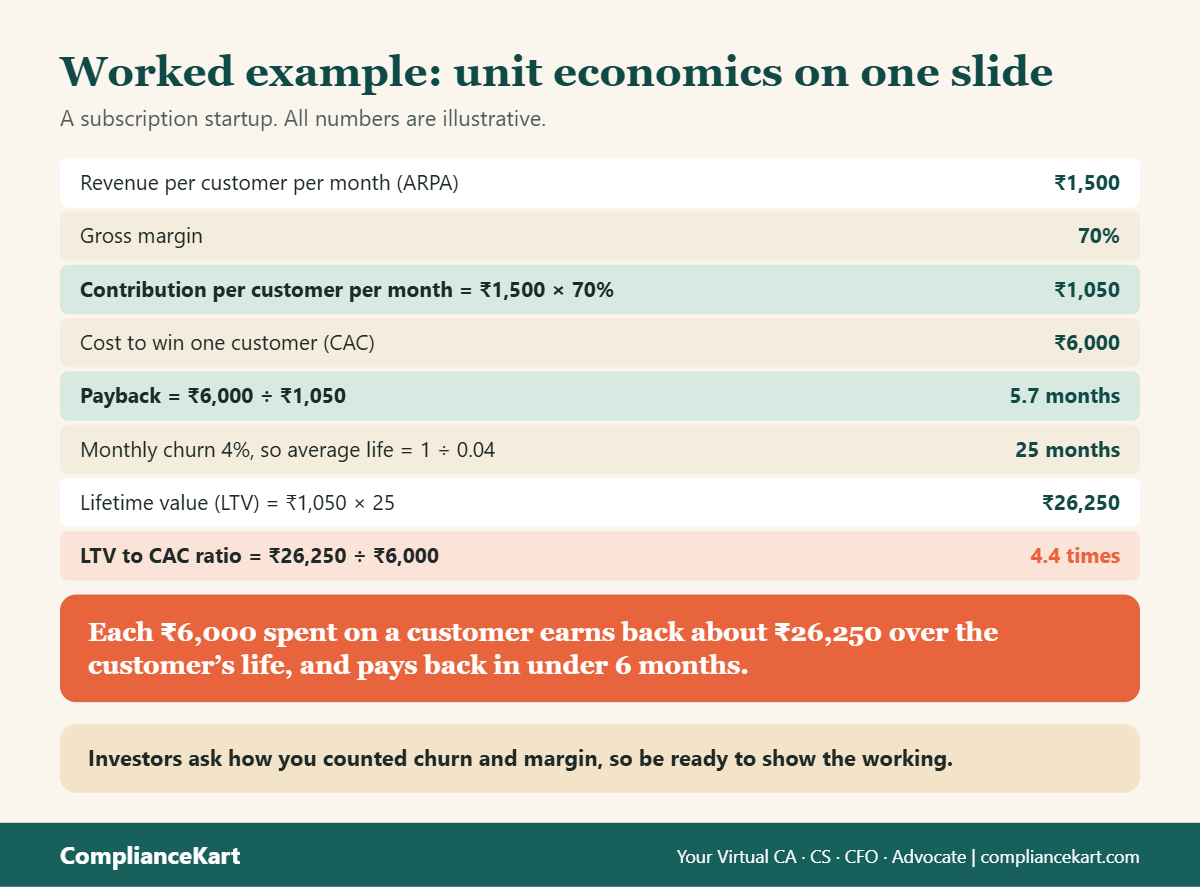
Ananya’s subscription app earns ₹1,500 per customer per month at a 70% gross margin, so contribution is ₹1,050 a month. It costs ₹6,000 to win a customer, so payback is ₹6,000 ÷ ₹1,050 = 5.7 months. Monthly churn is 4%, so the average customer stays 1 ÷ 0.04 = 25 months. Lifetime value is ₹1,050 × 25 = ₹26,250. LTV to CAC is ₹26,250 ÷ ₹6,000 = 4.4 times.
3. Projections
Summarise three to five years on one chart: revenue, gross profit and net burn or profit. Show the two or three drivers that matter most, such as customers added per month and price. Do not paste the whole model. Keep the detail for the appendix and the data room. For how to build the underlying numbers, read how to prepare a financial model for investors.
4. The ask and use of funds
Say how much you want, in which instrument and what it buys. Split the amount into a few buckets and show what each achieves.

At an average net burn of ₹30 lakh a month, ₹5 crore gives about 16.7 months of runway (500 ÷ 30). Many investors like to see 18 to 24 months, so size the ask accordingly. Our guide on burn rate and runway shows how. For instruments and valuation, see convertible notes vs CCPS vs CCD and pre-money vs post-money valuation.
5. Milestones
List what the money will deliver before the next round: revenue target, customers, key hires, product launches. Link each milestone to the budget bucket that funds it.
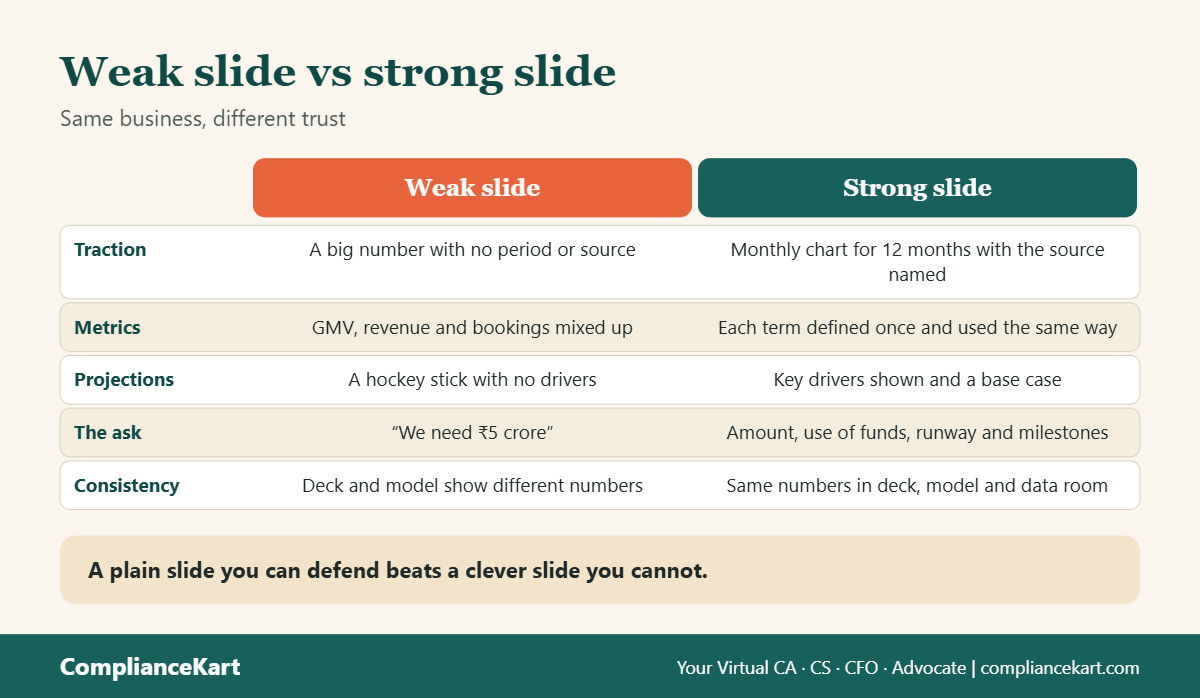
Weak slide vs strong slide
The legal side of a pitch deck
Three legal points are easy to miss.
- Be accurate. Under section 36 of the Companies Act, 2013, knowingly or recklessly making a false or misleading statement, promise or forecast to induce someone to invest is treated as fraud and punished under section 447. Mark projections clearly as estimates and never inflate traction.
- Do not advertise the offer. Section 42 of the Act allows a private placement to identified investors only. The company cannot publicly advertise the offer. Send decks to chosen investors, not to the public. See how to issue shares in a private limited company.
- Protect confidential and personal data. Remove customer names, personal data and sensitive contracts, or share them only under a non-disclosure agreement.
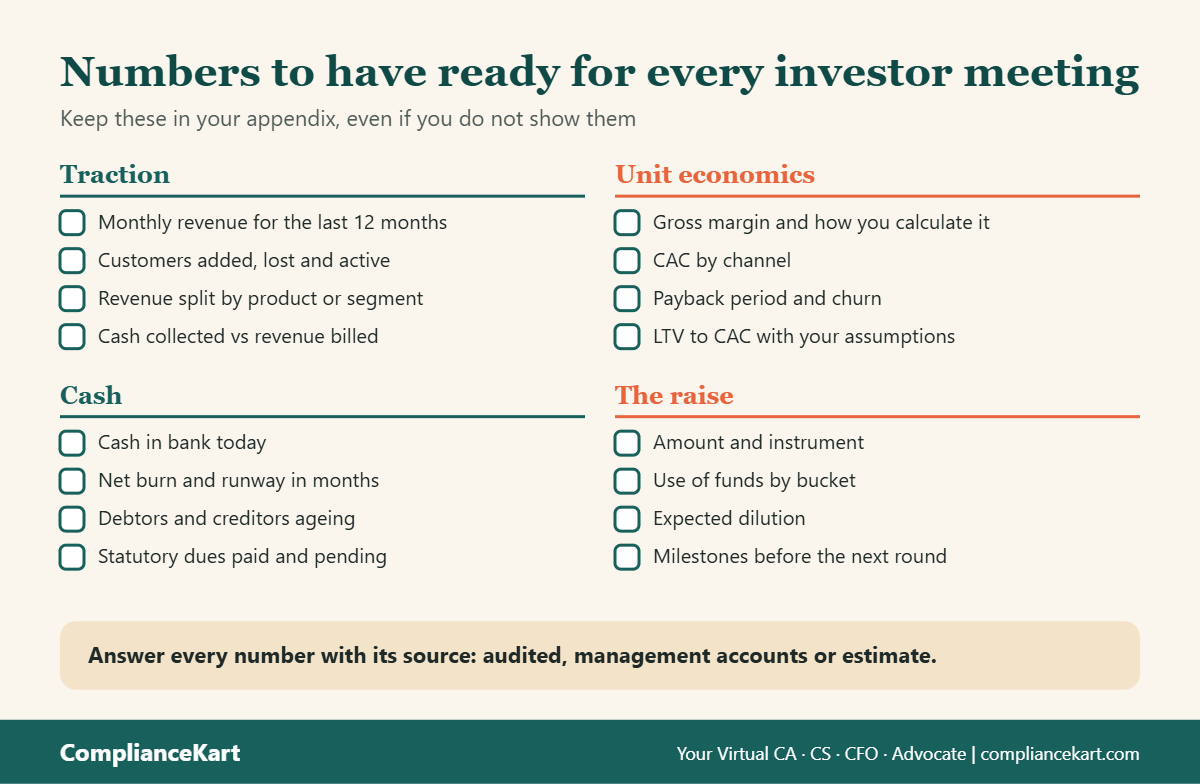
Numbers to keep ready
Common mistakes
- A hockey-stick chart with no drivers behind it.
- Mixing GMV, revenue and bookings.
- Showing revenue including GST.
- A deck that does not match the model.
- Not knowing your own CAC, churn or runway.
Read more in financial mistakes that can kill a startup and prepare for questions with our due diligence checklist.
Hyderabad context
Founders in Kondapur, Hitech City, Gachibowli and the Financial District often pitch to funds in more than one city. Keep one master deck, a one-page numbers summary and a ready data room, so you can respond within a day to any request.
Why work with ComplianceKart
A pitch deck touches finance, tax, company law and contracts. A wrong number on one slide can raise questions about all four.
ComplianceKart is a boutique practice bringing Chartered Accountants, Company Secretaries and advocates under one roof. Think of a multi-speciality hospital: you do not run between separate clinics for the heart, the bones and the blood tests. One team looks at the whole patient, and each specialist knows what the others found. Your business gets the same treatment.
How we can help (scope depends on your case):
- Review of your financial slides against your books, GST and TDS records.
- Unit economics and use-of-funds inputs through our virtual CFO, CS and advocate team.
- Cap table, valuation inputs and share issue steps under our startup compliance service.
- Data room preparation and diligence readiness.
- Review of term sheets and agreements.
Pitching soon? Get your financial slides reviewed before the meeting.
Frequently asked questions
How many financial slides should a pitch deck have?
Three to five is common: traction, unit economics, projections, the ask and use of funds, and milestones. Keep the detail in an appendix.
Should I show projections for five years?
Three to five years is common. Show a base case and the drivers behind it. Investors weigh the first 18 to 24 months most.
What are the key metrics investors ask for?
Revenue, growth, gross margin, burn, runway, CAC, churn, LTV and payback. The right mix depends on your model.
Can I send the deck to many investors at once?
You can send it to identified investors, but you should not advertise a fundraising offer publicly. Section 42 of the Companies Act restricts public advertisement of private placements.
Should numbers be audited?
Show audited numbers where you have them and label management accounts and estimates clearly. Never present an estimate as a final figure.
Related reading
- Angel investor vs venture capitalist
- Startup valuation methods explained
- When should a startup appoint a CFO?
This article is general information as on 21 November 2026 and is not legal, tax or investment advice. Facts differ from case to case, and rules change, so speak to a qualified professional before you act. Examples are illustrations, not real client matters.
Need this done for your business?
Send us one message. A CA, CS or Advocate replies within a working day — no forms, no obligation.