Angel Investor vs Venture Capitalist: Which Is Right for Your Startup?
Angel investor vs venture capitalist explained in plain English: cheque size, control, SEBI rules, dilution maths and the paperwork Indian founders need.
Law stated as on 21 November 2026 · Reading time about 8 minutes
Meera runs a small software startup from a co-working space in Kondapur. In one week she gets two messages. An angel investor offers ₹50 lakh. A venture capital fund wants a call about ₹5 crore. Both sound exciting, so which one should she say yes to?
Short answer on angel investor vs venture capitalist: an angel usually puts in their own money, early, in smaller amounts and with a lighter touch. A venture capitalist invests money pooled from other people, at a bigger and later stage, and asks for a board seat and stronger rights. Neither is better. The right choice depends on your stage, how much you need and how fast you want to grow.
In plain English
An angel is like an experienced neighbour who backs your idea with their own savings. A venture capital (VC) fund is like a professional manager who must show results to the people whose money they handle. That one difference explains almost everything below.
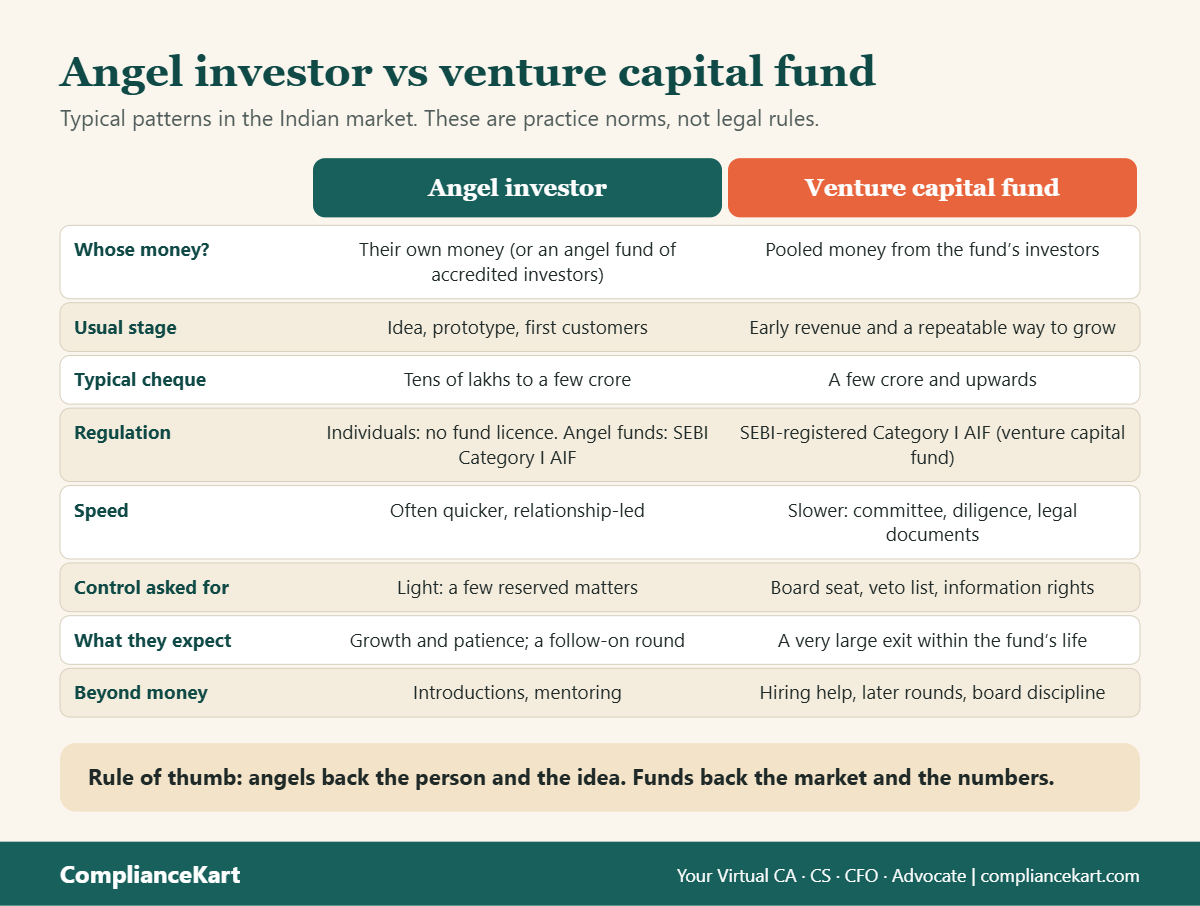
Angel investor vs venture capitalist: the quick comparison
Who is an angel investor?
An angel investor is usually a successful founder, executive or professional who invests personal money in a very young startup. A person investing their own money does not need any fund licence. Angels often join for the person behind the idea, so a good relationship matters more than a perfect spreadsheet.
Angels can also pool money through an angel fund. This is a SEBI-registered Category I Alternative Investment Fund (AIF). After the September 2025 changes to the SEBI AIF rules, angel funds can raise money only from accredited investors. They can invest between ₹10 lakh and ₹25 crore in one startup, and each investment has a one-year lock-in (six months if the fund sells to a third party).
What this means for you
If an angel fund invests, it cannot walk away within the first year. That is useful stability for a young company.
Who is a venture capitalist?
A venture capital fund collects money from many investors, such as family offices, companies and wealthy individuals, and invests it in startups. In India, VC funds register with SEBI as Category I AIFs under the SEBI (Alternative Investment Funds) Regulations, 2012. The basic rules are a minimum corpus of ₹20 crore per scheme and a minimum commitment of ₹1 crore from each investor.
Simple example
Suppose a VC fund has ₹200 crore to invest over its life. It cannot make that money work by backing a few steady businesses that grow slowly. It needs a handful of companies that could become very large. A healthy business that grows to ₹20 crore revenue is a good result for you, but it may not fit that fund’s maths. This is why VCs ask big-market questions early.
Which should you choose?
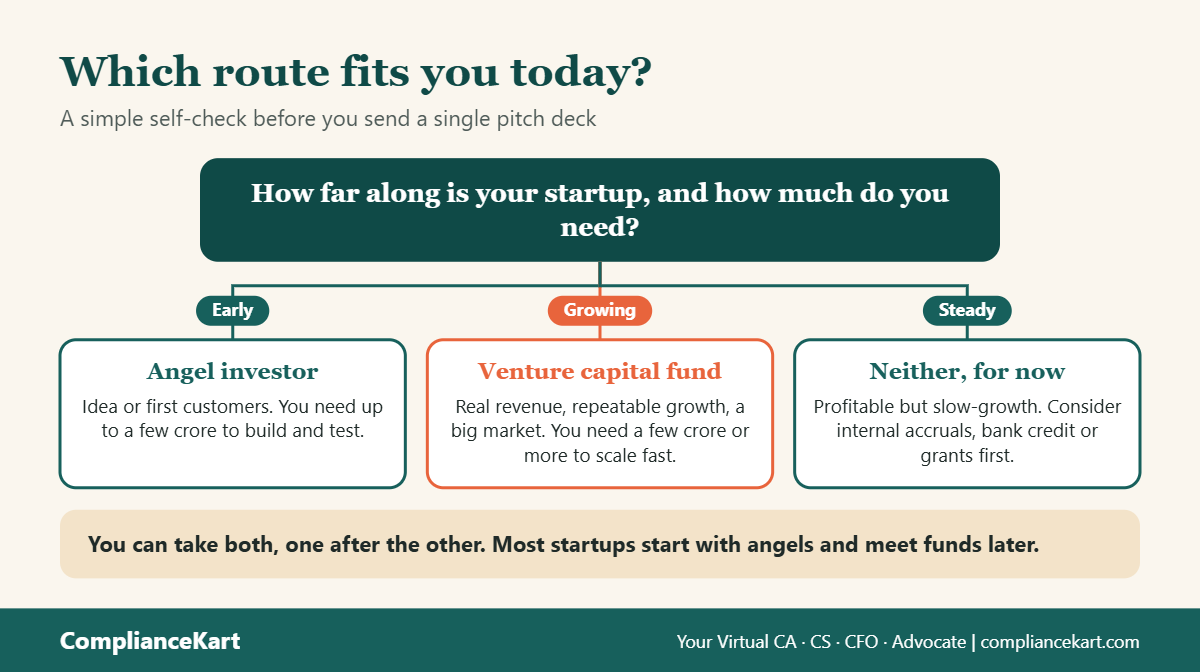
Most startups meet angels first and funds later. The two are not rivals. A VC will happily look at a company that an angel has already backed, because it shows someone credible has done some checking.
What the law says about taking either kind of money
Is the “angel tax” still there?
No. Section 56(2)(viib) of the Income-tax Act, 1961, which taxed a company when it issued shares at a premium above fair value, was removed for all investors from 1 April 2025 by the Finance (No. 2) Act, 2024. Older assessments can still be reopened, so keep your valuation papers safe. Valuation rules under company law and foreign-exchange law still apply, as explained in our guide to startup valuation methods.
How the shares are issued
Most angel and VC rounds are a private placement under Section 42 of the Companies Act, 2013. In simple terms, you offer shares to a small, identified group of investors, not to the public. The usual points are:
| Step | What the law expects |
|---|---|
| Approval | A special resolution of shareholders, filed in Form MGT-14 within 30 days |
| Offer | A private placement offer letter (PAS-4) to identified persons only. No more than 200 persons in a financial year |
| Price | For a preferential allotment, a valuation report from a registered valuer |
| Money | Received through the banking channel, not in cash |
| Allotment | Within 60 days of receiving the money, or refund it within 15 days after that |
| Filing | Return of allotment in Form PAS-3 within 15 days of allotment |
| Foreign investor | FC-GPR reported within 30 days of allotment under FEMA |
Our step-by-step guide on how to issue shares in a private limited company walks through each form.
What if the investor is outside India?
Foreign investment in most startup sectors comes under the automatic route of the FEMA Non-Debt Instruments Rules, 2019, though some sectors need approval. The price must follow the pricing guidelines and the receipt must be reported to the RBI through the FIRMS portal. Our FEMA compliance work covers this reporting.
Do you need DPIIT recognition?
Not to take angel or VC money. But recognition opens some doors, such as issuing a convertible note for investments of ₹25 lakh or more. A company qualifies as a startup for up to 10 years from incorporation, provided its turnover has not crossed ₹200 crore in any year (revised by DPIIT notification G.S.R. 108(E) dated 4 February 2026). Deep tech startups get up to 20 years and a ₹300 crore limit. For choosing between instruments, read convertible notes vs CCPS vs CCD.
From pitch to money: six steps
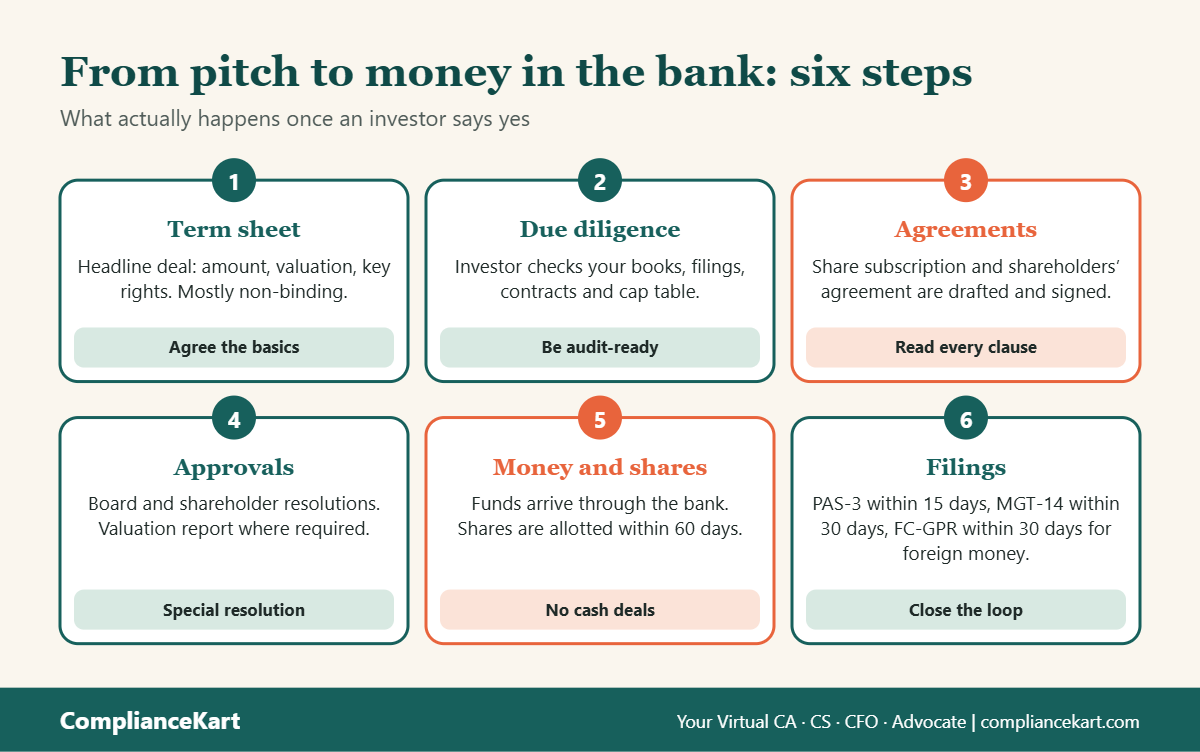
The term sheet is mostly non-binding, apart from clauses such as confidentiality and exclusivity. The real rights sit in the shareholders’ agreement, so read that line by line. Our note on the term sheet and shareholders’ agreement explains the clauses that matter.
A worked example: what each round does to your share
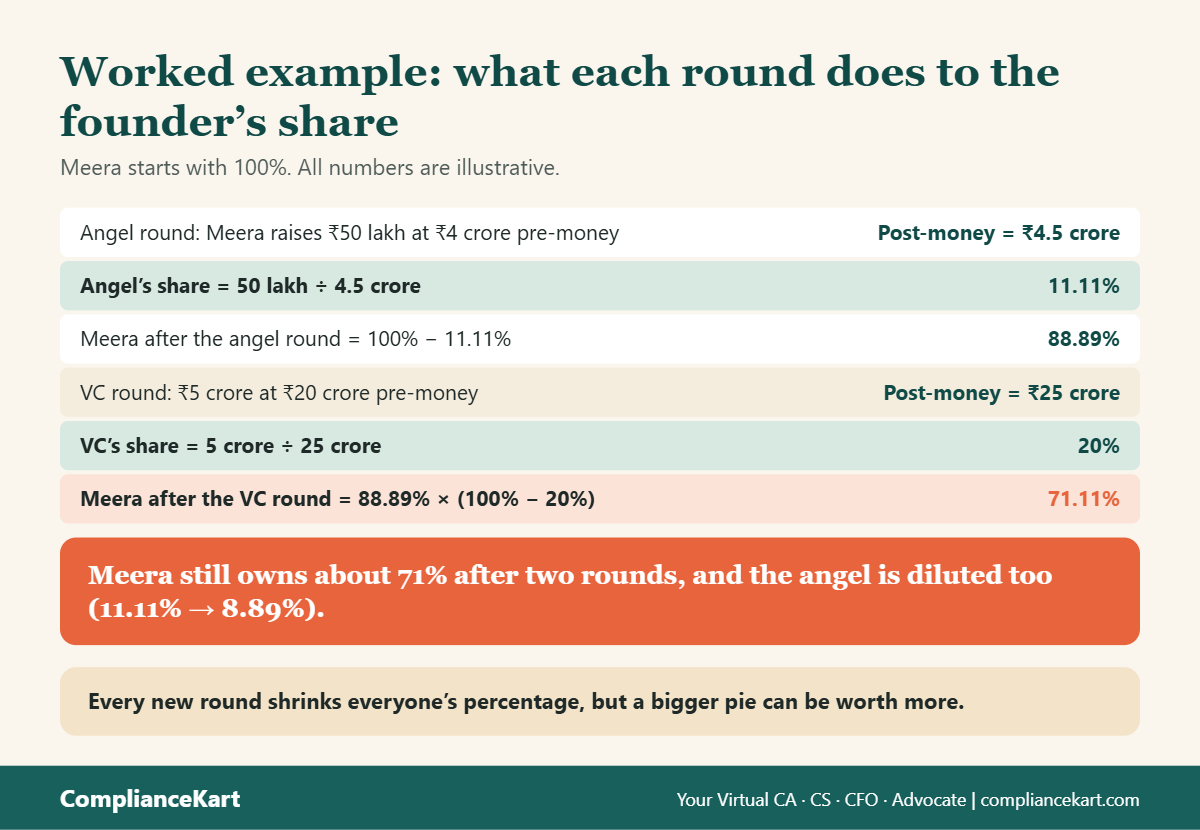
Meera starts with 100%. She first raises ₹50 lakh from an angel at a pre-money valuation of ₹4 crore. Post-money is ₹4.5 crore, so the angel gets 50 lakh ÷ 4.5 crore = 11.11% and Meera falls to 88.89%.
Later a VC invests ₹5 crore at a ₹20 crore pre-money valuation. Post-money is ₹25 crore, so the VC gets 20%. Everyone existing is diluted by that 20%: Meera is 88.89% × 80% = 71.11%, and the angel falls from 11.11% to 8.89%.
If pre-money and post-money are new to you, read pre-money vs post-money valuation first.
Get ready before you meet anyone
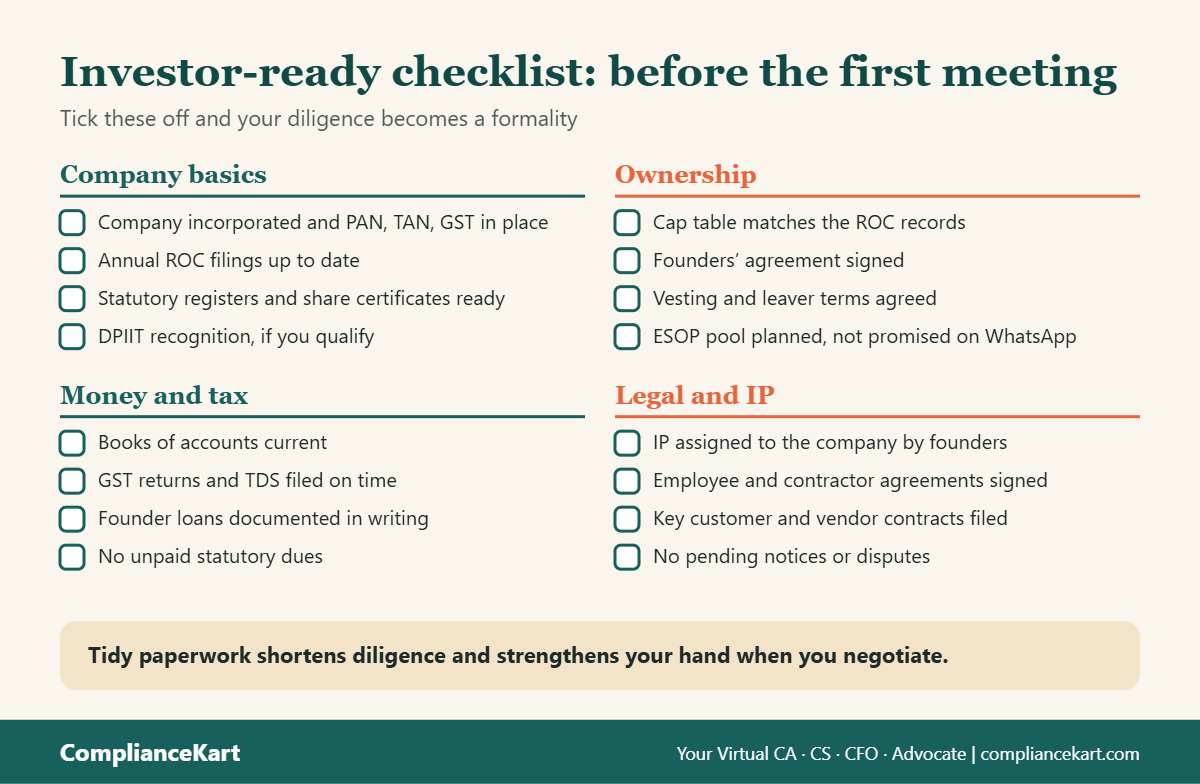
We have a full list in our due diligence checklist before raising funds.
Common mistakes
- Taking money on a handshake. If shares are not allotted within 60 days, the money must go back. Otherwise it can be treated as a loan or deposit with its own compliance.
- Agreeing a price with no valuation report where one is needed for the allotment.
- Signing exclusivity without noticing. It can stop you talking to other investors for weeks.
- Forgetting FC-GPR when the money comes from abroad.
- Promising ESOPs informally. See our ESOP guide before you do.
Hyderabad context
Founders around Hitech City, Gachibowli, Kondapur, the Financial District and Kokapet often meet angels and funds through local networks and demo days. The legal steps do not change by locality. A Hyderabad-based company files its forms with the Registrar of Companies for Telangana, so early filing discipline here saves time during diligence.
Why work with ComplianceKart
Fundraising touches company law, FEMA, tax and contracts all at once, and most problems show up in the gaps between them.
ComplianceKart is a boutique practice bringing Chartered Accountants, Company Secretaries and advocates under one roof. Think of a multi-speciality hospital: you do not run between separate clinics for the heart, the bones and the blood tests. One team looks at the whole patient, and each specialist knows what the others found. Your business gets the same treatment.
How we can help (scope depends on your case):
- Cap table and share issue: resolutions, PAS-4, PAS-3, MGT-14. See our startup compliance service.
- ROC health check before diligence: our ROC annual compliance team.
- FEMA: FC-GPR and FIRMS reporting for foreign angels and funds.
- Valuation inputs, tax mapping and a finance review through our virtual CFO, CS and advocate support.
- Agreement review: shareholders’ agreement and term sheet.
Planning a funding round? Talk to the team before you sign a term sheet.
Frequently asked questions
Do I need an angel or a VC if I can bootstrap?
No. Many good businesses never raise outside money. External funding makes sense when growth needs more cash than the business makes, and when you are comfortable sharing ownership.
Can I take money from both an angel and a VC?
Yes, usually one after the other. Check each agreement for reserved matters, anti-dilution and pre-emption rights so that a new deal does not breach an older one.
Is angel tax still payable on share premium?
No. Section 56(2)(viib) has been removed from 1 April 2025 for all investors. Keep valuation records anyway, because company law and FEMA pricing rules still apply.
Can an NRI or foreign angel invest in my startup?
Yes, generally under the automatic route in most sectors, subject to the NDI Rules, pricing guidelines and reporting to the RBI within 30 days of allotment. Some sectors need government approval.
Is a term sheet legally binding?
Mostly not. Clauses such as confidentiality and exclusivity usually are. The binding rights come from the signed share subscription and shareholders’ agreements.
Related reading
- How to issue shares in a private limited company
- Startup valuation methods explained
- How to structure equity among founders
- Private limited company incorporation
This article is general information as on 21 November 2026 and is not legal, tax or investment advice. Facts differ from case to case, and rules change, so speak to a qualified professional before you act. Examples are illustrations, not real client matters.
Need this done for your business?
Send us one message. A CA, CS or Advocate replies within a working day — no forms, no obligation.