How to Prepare a Financial Model for Investors: A Step-by-Step Guide
How to prepare a financial model for investors in India: assumptions, revenue build, three statements, scenarios and common mistakes, with a worked example.
Reviewed on 21 November 2026 · Reading time about 8 minutes
Vikram, a founder in Financial District, sends an investor a spreadsheet with revenue growing 20% every month for three years. The investor replies with one question: “Where does the 20% come from?” Vikram has no answer, because he typed the number in. The meeting ends early.
To prepare a financial model for investors, build it from drivers, not guesses. Put every input on one assumptions tab. Build revenue from customers, price and churn. Build costs from a hiring plan and fixed and variable costs. Link a profit and loss account, a balance sheet and a cash flow statement. Add base, best and worst cases, and finish with a one-page summary that shows runway, breakeven and margins.
In plain English
A financial model is a spreadsheet that shows how your business makes and spends money in the future. Investors do not expect it to be right. They want to see that you understand what drives your numbers and what could go wrong.
The seven building blocks
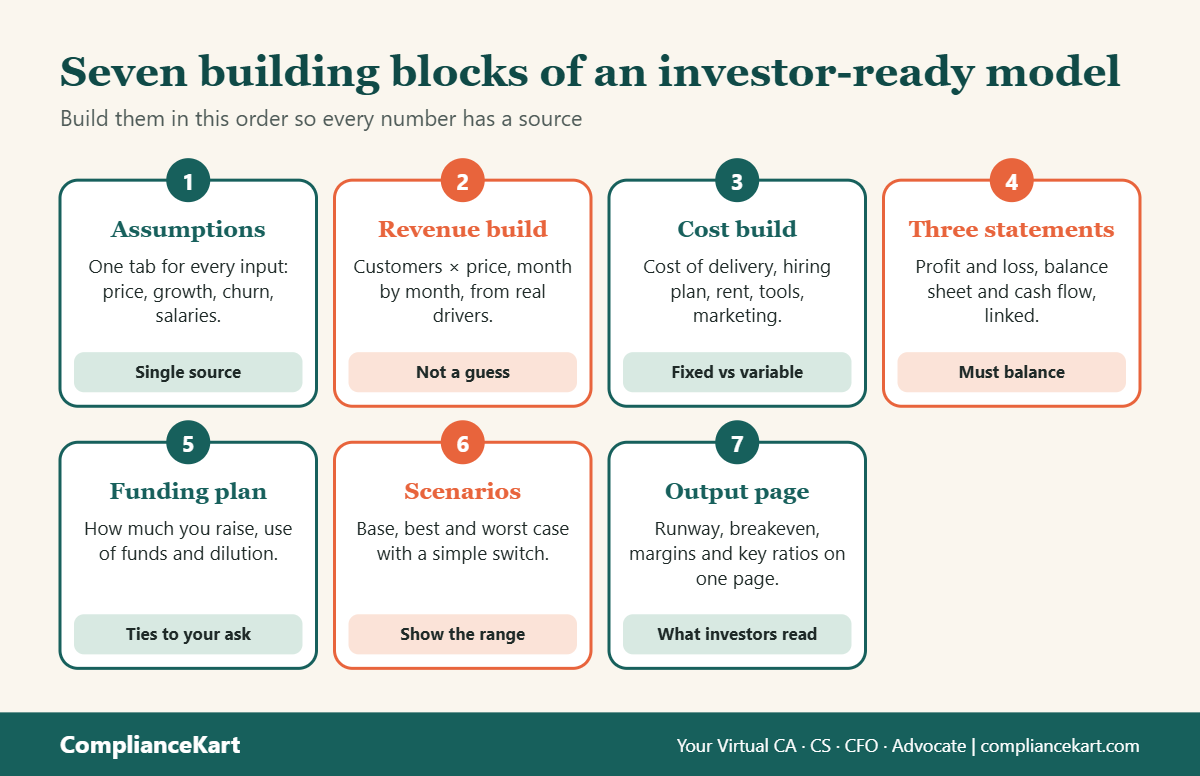
1. Assumptions
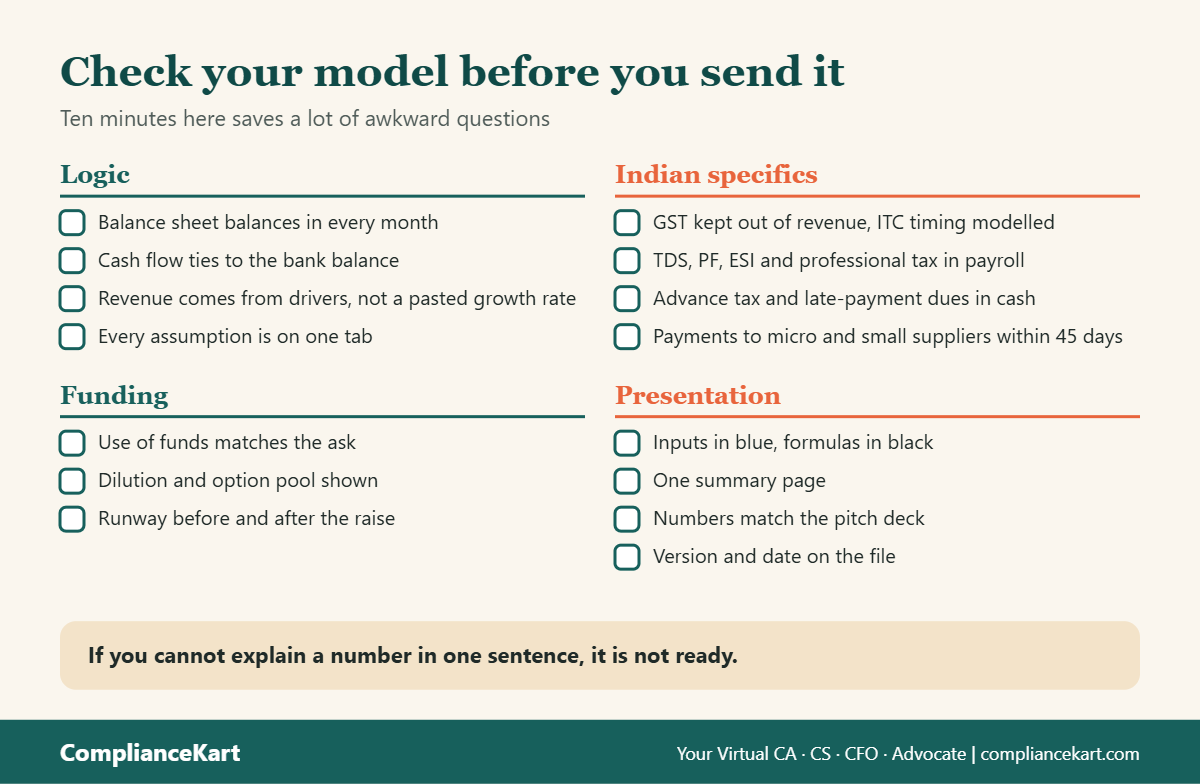
Put every input on one tab: prices, growth rates, churn, salaries, rent, tax rates. Mark inputs in blue and formulas in black, a common convention that helps readers. When an investor asks “what if churn is 8%?” you change one cell and the whole model updates.
2. Revenue build
Revenue should come from drivers. For a software company, that is new customers per month, churn and the monthly price. For a retail brand, it is orders, average order value and repeat rate.
Simple example
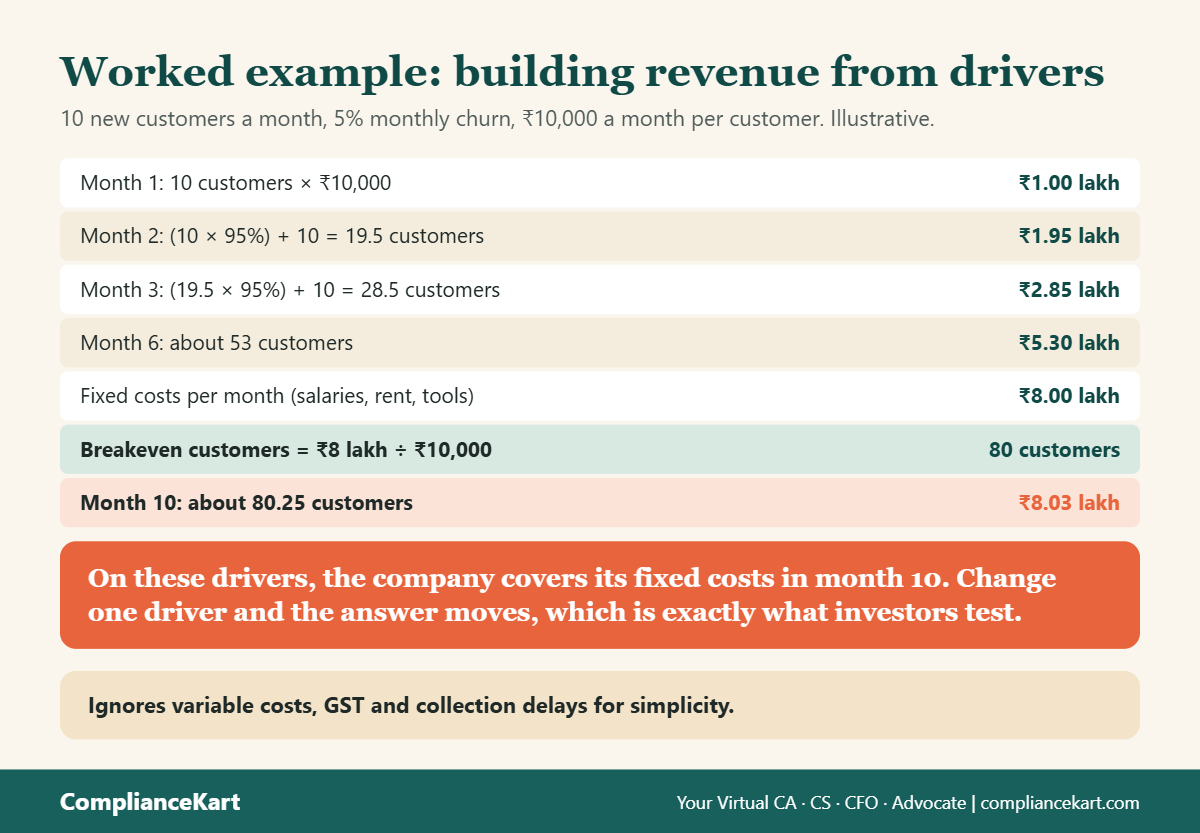
Vikram adds 10 new customers a month at ₹10,000 each and loses 5% of customers every month. Month 1 has 10 customers (₹1 lakh a month). Month 2 has (10 × 95%) + 10 = 19.5 customers (₹1.95 lakh). By month 6 he has about 53 customers (₹5.30 lakh). If fixed costs are ₹8 lakh a month, he needs ₹8 lakh ÷ ₹10,000 = 80 customers to break even. On these drivers, that happens in month 10.
3. Cost build
Separate the cost of delivering your product from overheads. Build payroll from a hiring plan with names, roles and start months. Add employer costs such as PF and ESI and, in Telangana, professional tax. Treat rent, tools and marketing as separate lines, so that investors can see which costs rise with sales and which do not.
4. The three statements
The profit and loss account shows profit. The balance sheet shows what you own and owe. The cash flow statement shows real money moving. They must link: if profit rises but customers pay late, cash falls, and only the cash flow statement shows it. The balance sheet should balance in every month.
Common mistake
Showing GST as part of revenue. GST you collect from customers belongs to the government. Keep it out of revenue, and model input tax credit as a receivable that you recover through the GST returns. Also model your payment terms with suppliers, because delays beyond 45 days to micro and small suppliers can lose you the tax deduction.
5. Funding plan and cap table
Show how much you raise, what you spend it on and how many months it lasts. Show the dilution at your assumed valuation and the option pool. If valuation maths is new to you, read pre-money vs post-money valuation and startup valuation methods.
6. Scenarios
Show a base case you believe in, a better case and a worse case. A simple switch on the assumptions tab can change growth, churn and costs together. Investors trust founders who show downside honestly.
7. The output page
End with one page: revenue, gross margin, net burn, runway, breakeven month and the main ratios. This is the page investors will actually read. See burn rate and runway for how to calculate these.
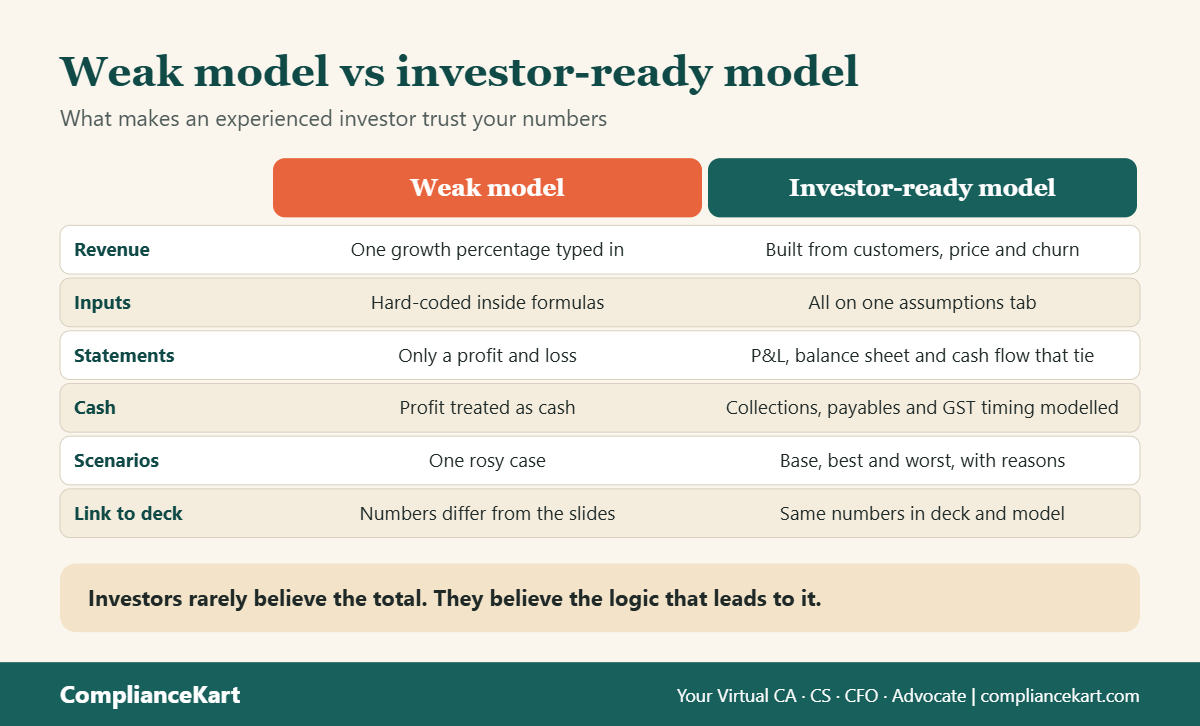
Weak model vs investor-ready model
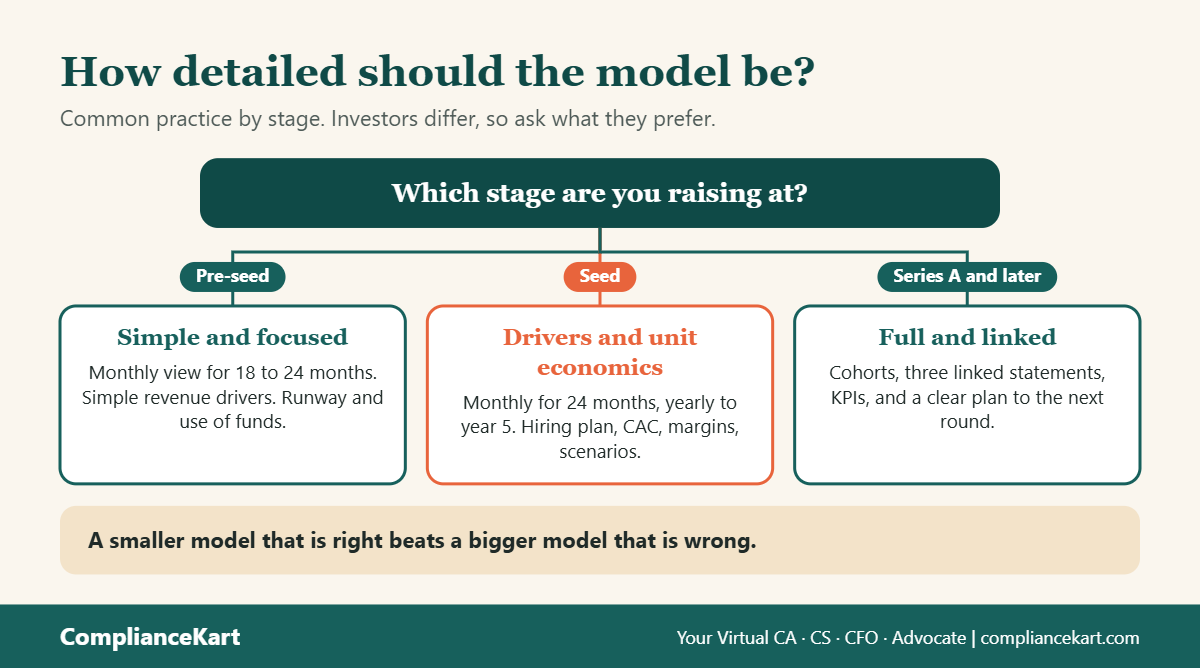
How detailed should it be?
Check it before you send it
The numbers in your model must match your deck. Read our guide on the pitch deck financial section next, and prepare for questions using our due diligence checklist. Avoid the traps in financial mistakes that can kill a startup.
Hyderabad context
Founders in the Financial District, Hitech City, Gachibowli and Kondapur often raise from investors who also back companies in Bengaluru and Mumbai. They compare your model with others, so use standard formats, show Indian tax and payroll costs clearly and keep it easy to audit.
Why work with ComplianceKart
A model touches accounting, tax, company law and the cap table. Errors in one area quietly spoil the others.
ComplianceKart is a boutique practice bringing Chartered Accountants, Company Secretaries and advocates under one roof. Think of a multi-speciality hospital: you do not run between separate clinics for the heart, the bones and the blood tests. One team looks at the whole patient, and each specialist knows what the others found. Your business gets the same treatment.
How we can help (scope depends on your case):
- Review of your model for tax, GST, payroll and compliance costs.
- Cap table and share issue inputs through our startup compliance service.
- Building or reviewing the model with our virtual CFO, CS and advocate support.
- Aligning the model with the pitch deck and the data room.
- Preparing answers for investor questions on numbers.
Want a second pair of eyes on your model? Talk to the team before you send it.
Frequently asked questions
How many years should a startup financial model cover?
Common practice is monthly for 18 to 24 months and yearly for up to five years. Ask the investor, because preferences differ.
Should I use Excel or Google Sheets?
Either works. Use whichever you can keep clean and share easily. Lock formulas, keep inputs separate and keep version history.
Do investors expect my projections to be correct?
No. They expect logic they can test. They will change your assumptions and see whether the business still works.
Do I need audited numbers in the model?
For past years, yes, where available. Use audited or reviewed figures as the base and mark projections clearly as projections.
What is the most common mistake in startup models?
Typing in a growth rate with no driver behind it. The second is treating profit as if it were cash.
Related reading
- How to structure equity among founders
- Angel investor vs venture capitalist
- How to improve profitability without increasing revenue
This article is general information as on 21 November 2026 and is not legal, tax or investment advice. Facts differ from case to case, and rules change, so speak to a qualified professional before you act. Examples are illustrations, not real client matters.
Need this done for your business?
Send us one message. A CA, CS or Advocate replies within a working day — no forms, no obligation.