Financial Mistakes That Can Kill a Startup (and How to Avoid Them)
Financial mistakes that can kill a startup in India: mixed funds, no cash forecast, GST and TDS slips, MSME delays and ROC defaults, with simple fixes.
Law stated as on 21 November 2026 · Reading time about 8 minutes
Neha’s food-delivery startup in Madhapur has happy customers and growing orders. Yet one Friday the salary run bounces. The business was not failing. The money was. Her personal and company spending had blurred, GST and TDS dues had piled up quietly, and nobody had worked out how many months of cash were left. (An illustration, not a real client matter.)
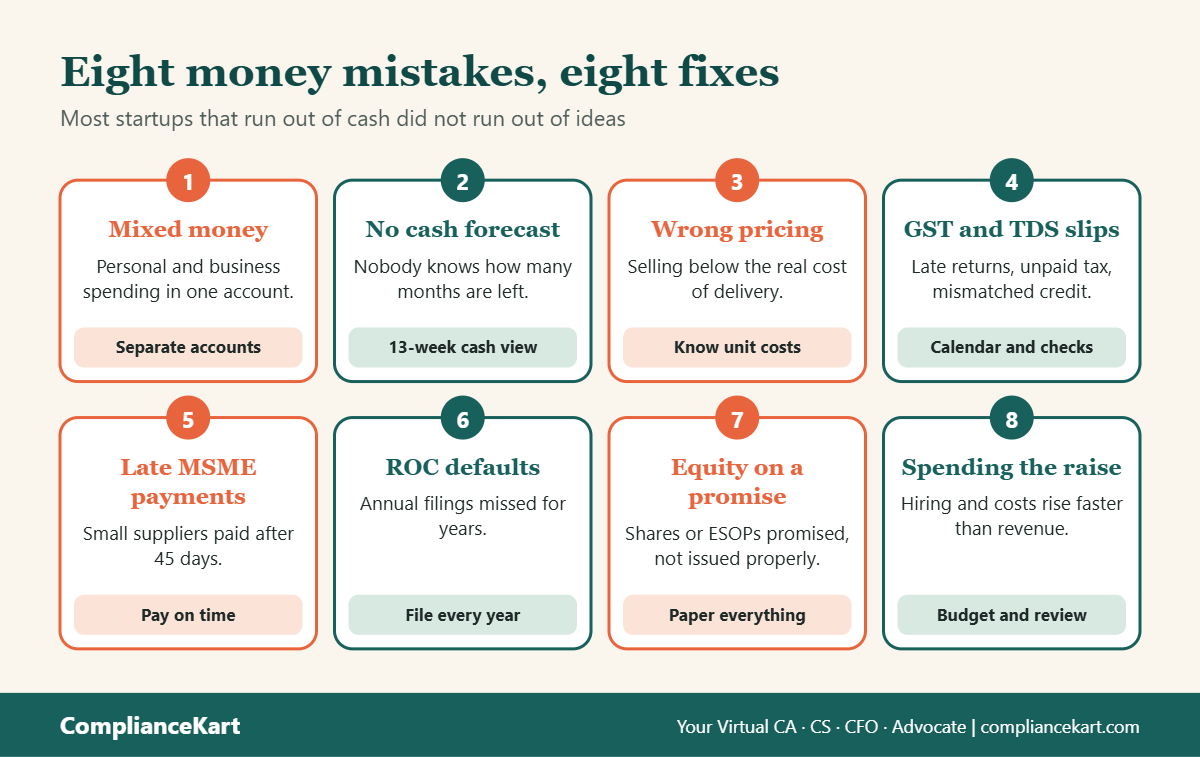
The financial mistakes that can kill a startup are rarely dramatic. They are small, boring habits that compound: mixing money, skipping a cash forecast, pricing too low, missing tax and ROC filings, paying small suppliers late and promising equity on a handshake. Each is easy to fix early and expensive to fix late.
In plain English
A startup does not die when it makes a loss. It dies when it cannot pay its bills on the day they fall due. Cash, not profit, keeps the lights on.
1. Mixing personal and business money
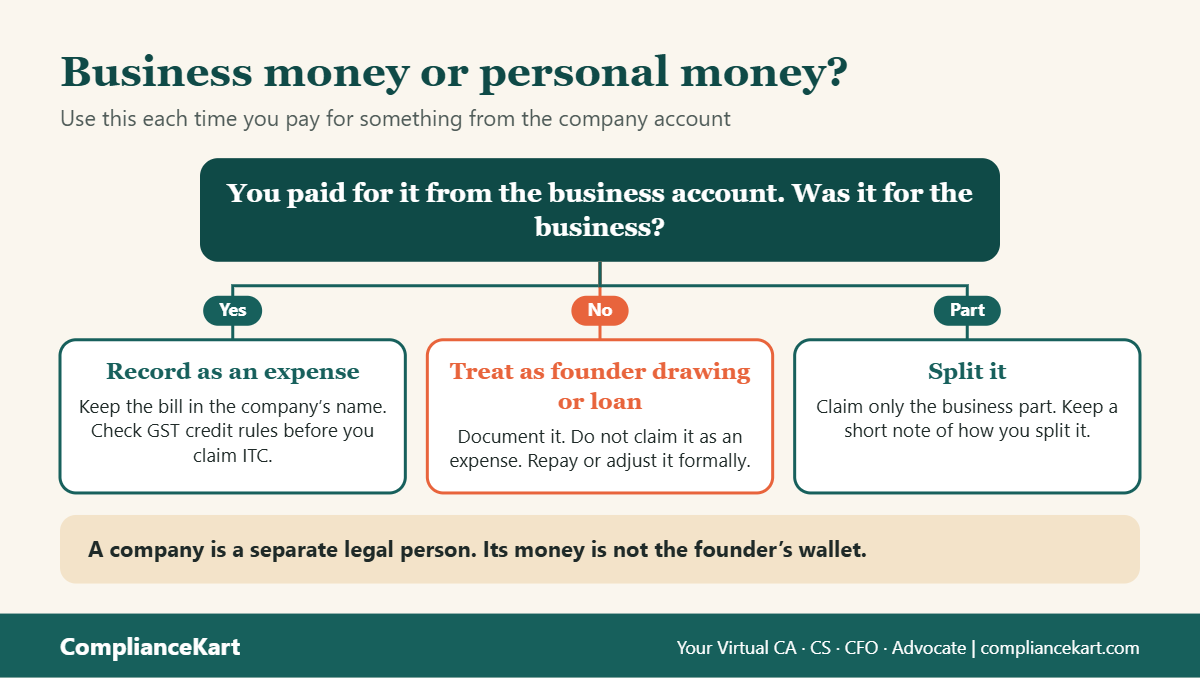
A company is a separate legal person. Its bank account is not the founder’s wallet. When founders pay personal bills from the company account, books become unreliable, tax claims weaken and investors lose confidence. If a founder lends money to the company, write a loan agreement. For a director’s loan to be outside the “deposit” rules, the director must give a written declaration that the money is not borrowed, and the company reports it in the DPT-3 return.
2. No cash forecast
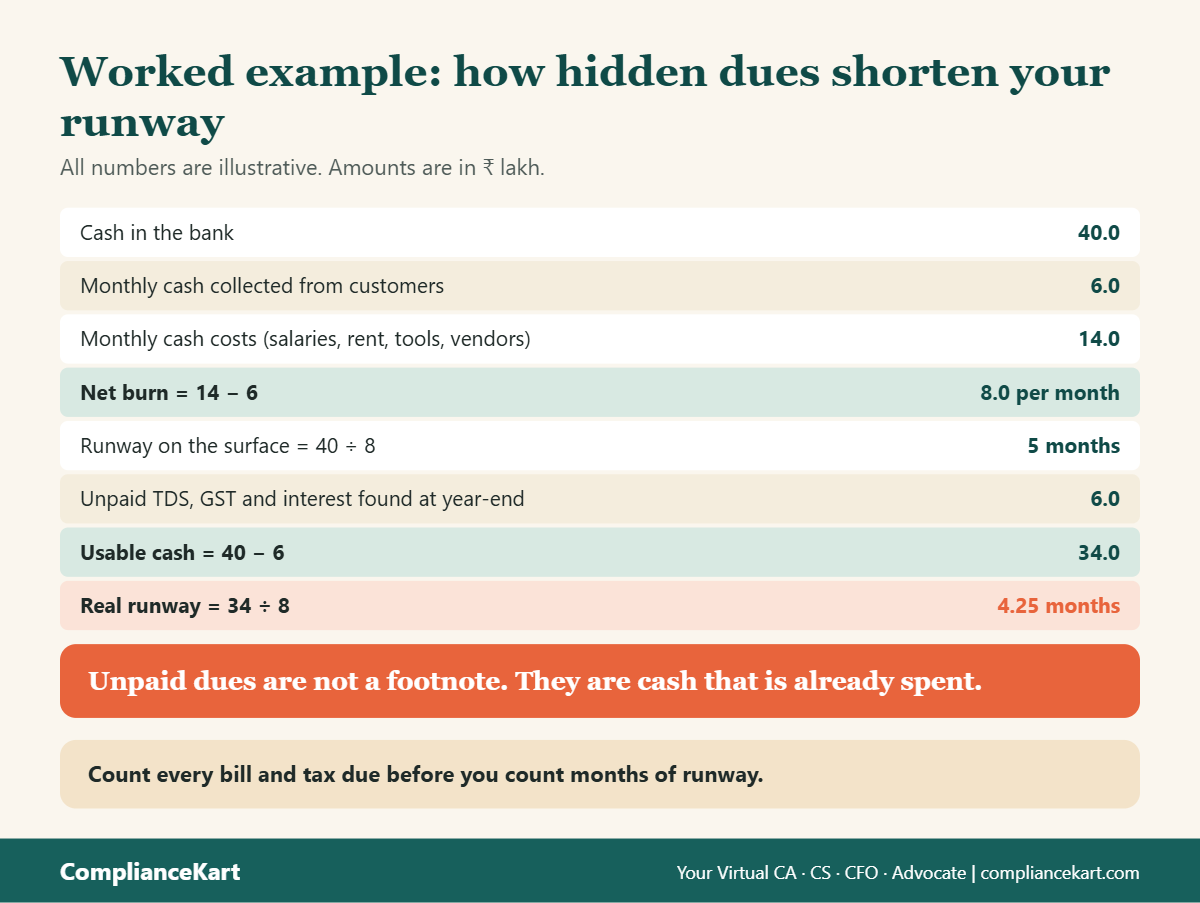
Most founders know revenue and profit. Fewer know how many months of cash remain. A simple 13-week cash view shows when money comes in, when it goes out and when you will run short. Our guide on burn rate and runway shows how to work it out.
Simple example
Neha has ₹40 lakh in the bank. She collects ₹6 lakh a month and spends ₹14 lakh, so her net burn is ₹8 lakh. That is 5 months of runway on paper. But ₹6 lakh of TDS, GST and interest is overdue. Her usable cash is ₹34 lakh, so her real runway is 34 ÷ 8 = 4.25 months.
3. Pricing without knowing unit costs
Growth that loses money on every order only grows the loss. Work out the full cost of one sale: product, delivery, payment fees, support and the GST position. If the price does not cover that cost, discounts will not fix it. See how to improve profitability without increasing revenue.
4. GST and TDS slips
Late GST returns attract late fees and interest at 18% a year on tax paid late. Input tax credit that does not match your supplier’s filings in GSTR-2B can be denied and pulled back with interest. TDS that is deducted but not deposited is treated seriously, with interest, penalties and in some cases prosecution. These are cash drains and also red flags in investor diligence. Our GST return filing work and the GST due date calendar can help you keep dates.
5. Paying small suppliers late
Under the MSMED Act, 2006, a buyer must pay a micro or small enterprise within the agreed time, and never beyond 45 days. Delay attracts compound interest at three times the RBI bank rate. For tax, section 43B(h) of the Income-tax Act, 1961 (section 37(2)(g) of the Income-tax Act, 2025) allows the deduction only when you actually pay, if payment goes beyond that limit. Dues beyond 45 days are also reported in Form MSME-1.
6. Ignoring ROC filings
Missed annual filings carry late fees, but the real risk is bigger. Under section 164(2) of the Companies Act, 2013, if a company does not file its financial statements or annual returns for three continuous financial years, its directors can be disqualified from being appointed as directors for five years. A disqualified founder can lose their seat in more than one company. Our ROC annual compliance team handles these filings.
7. Promising equity or ESOPs without paperwork
“You will get 2% when we raise” is not ownership. Shares must be allotted, recorded and filed. Employees who were promised options informally often leave angry or sue. Read ESOPs in India and how to structure equity among founders before you promise anything.
8. Spending the raise too fast
After a funding round, hiring and rent often rise faster than revenue. Set a budget per quarter, review it monthly and decide in advance what you will cut if sales slow. A good rule of thumb is to count runway from today’s costs, not from next year’s plan.
Common mistake
Treating investor money as income. Share capital is not revenue. It has to be used for the company’s purposes, and it must be shown correctly in the books and in the share records.
A money routine that prevents most of this
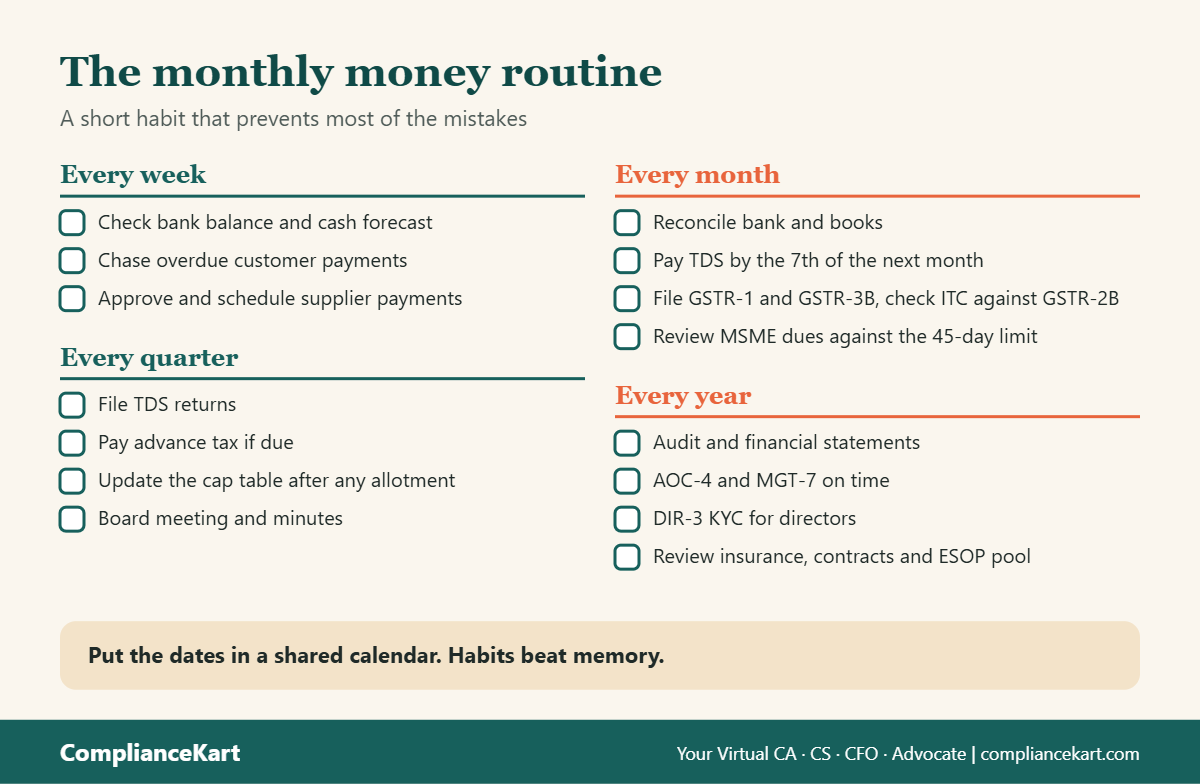
This is the kind of routine a part-time or virtual CFO sets up in the first month. If you are raising soon, also run through our due diligence checklist.
Hyderabad context
Many startups in Madhapur, Hitech City, Kondapur and Gachibowli run lean teams with outsourced accounting. That works, as long as one person owns the monthly money routine and reviews the numbers. A rented desk saves cost. A missed filing costs far more.
Why work with ComplianceKart
Money problems sit across tax, company law and contracts, and a gap in one area soon spills into the others.
ComplianceKart is a boutique practice bringing Chartered Accountants, Company Secretaries and advocates under one roof. Think of a multi-speciality hospital: you do not run between separate clinics for the heart, the bones and the blood tests. One team looks at the whole patient, and each specialist knows what the others found. Your business gets the same treatment.
How we can help (scope depends on your case):
- Monthly bookkeeping review, GST reconciliation and TDS checks.
- Catch-up filings and annual compliance through our startup compliance service.
- Cash forecasting, budgeting and finance reviews with our virtual CFO, CS and advocate team.
- Documenting founder loans, related-party transactions and share issues.
- Notice replies and litigation support if a dispute arises.
Not sure where your money leaks are? Ask for a quick health check.
Frequently asked questions
What is the most common reason startups run out of cash?
Spending ahead of revenue without a cash forecast. Hidden dues such as unpaid tax add to the problem.
Can a director lend money to the company?
Yes. Get a written declaration that the money is not borrowed, sign a loan agreement and report it in the annual DPT-3 return.
What happens if I miss ROC filings for three years?
Directors can be disqualified for five years under section 164(2) of the Companies Act, 2013. Catch up early to avoid it.
Do I need to pay MSME suppliers within 45 days?
Yes, if the supplier is a micro or small enterprise registered under the MSMED Act. Late payment attracts interest and can delay your tax deduction.
Is it safe to run accounts without a finance lead?
For a very early team, an outsourced accountant plus a monthly review can be enough. As complexity grows, add a part-time finance leader.
Related reading
- Startup burn rate and runway explained
- How to prepare a financial model for investors
- Startup compliance calendar and health check
This article is general information as on 21 November 2026 and is not legal, tax or investment advice. Facts differ from case to case, and rules change, so speak to a qualified professional before you act. Examples are illustrations, not real client matters.
Need this done for your business?
Send us one message. A CA, CS or Advocate replies within a working day — no forms, no obligation.