Convertible Notes vs CCPS vs CCD: Which Is Right for Your Startup?
Convertible notes vs CCPS vs CCD for Indian startups: how each instrument works, the Companies Act, FEMA and tax points, and how to choose.
Law stated as on 21 November 2026 · Reading time about 9 minutes
Rohan runs a SaaS startup out of Hitech City. A friend from Singapore offers him ₹60 lakh. The friend says, “Let us not argue about valuation now. Just give me a convertible note.” Rohan’s lawyer friend says CCPS is safer. A CA friend says CCD is cleaner. Who is right?
Convertible notes vs CCPS vs CCD in short: all three are ways to take money now and give equity later. A convertible note is debt that turns into shares and is only open to DPIIT-recognised startups. CCPS (compulsorily convertible preference shares) are shares with preference rights that must convert to equity. CCD (compulsorily convertible debentures) are loan-style paper that must convert to equity. The right pick depends on whether the valuation is settled, who the investor is and what rights they want.
In plain English
Think of all three as a “shares-later” promise. The note says, “Hold my money now, we will fix the price when a bigger investor comes.” CCPS and CCD say, “We agree the terms now. The money turns into equity on a set date or event.”
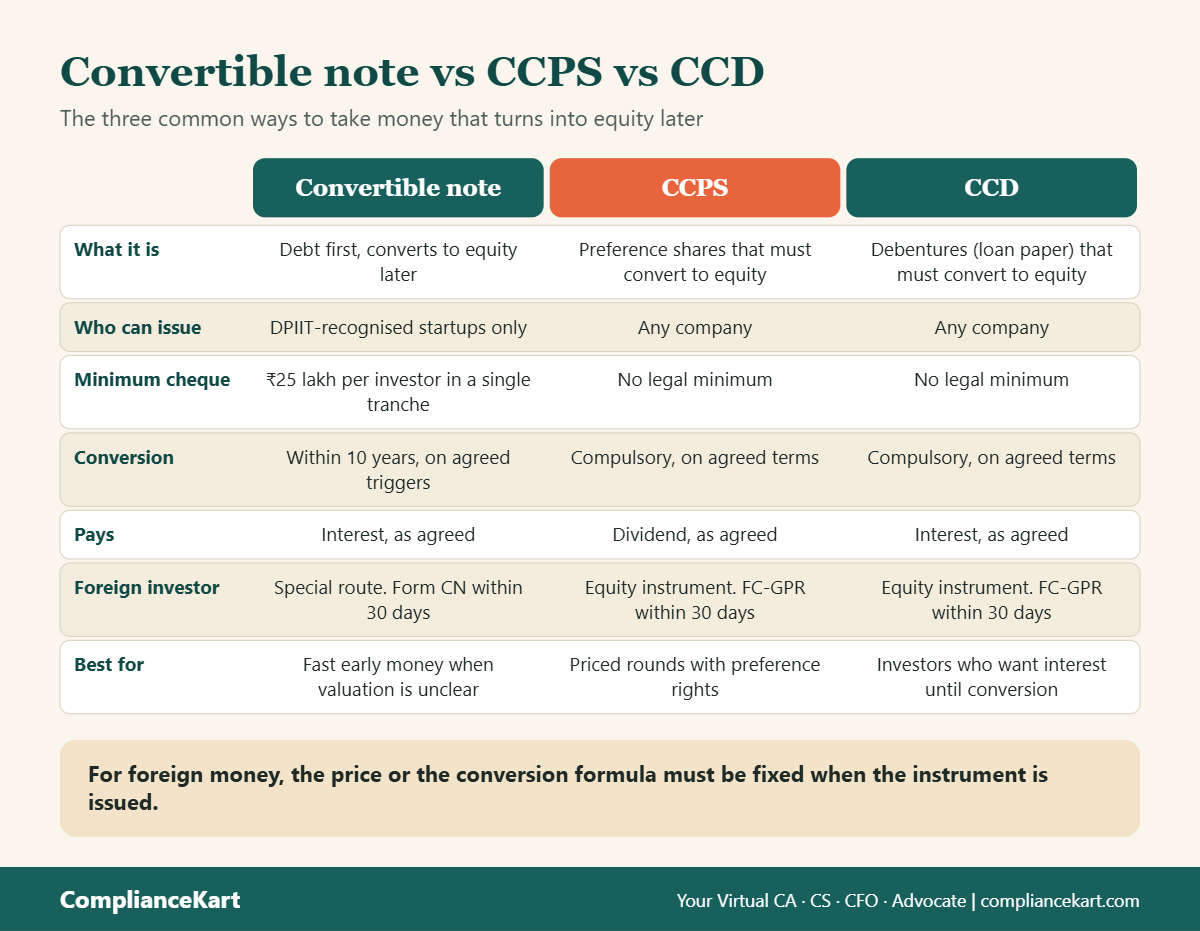
Convertible notes vs CCPS vs CCD at a glance
Convertible note: debt first, equity later
Under the Companies (Acceptance of Deposits) Rules, 2014, a convertible note is an instrument that records money received first as debt. It is either repayable at the holder’s option or convertible into equity shares within a set period, which is now up to 10 years from issue. Only a DPIIT-recognised startup can issue it. The investor must put in at least ₹25 lakh in a single tranche. If the note does not meet these tests, the money may be treated as a “deposit”, which brings its own compliance and penalties.
A startup counts for up to 10 years from incorporation, with turnover not above ₹200 crore in any year, under the DPIIT notification dated 4 February 2026 (deep tech startups get 20 years and ₹300 crore).
How a note converts: cap and discount
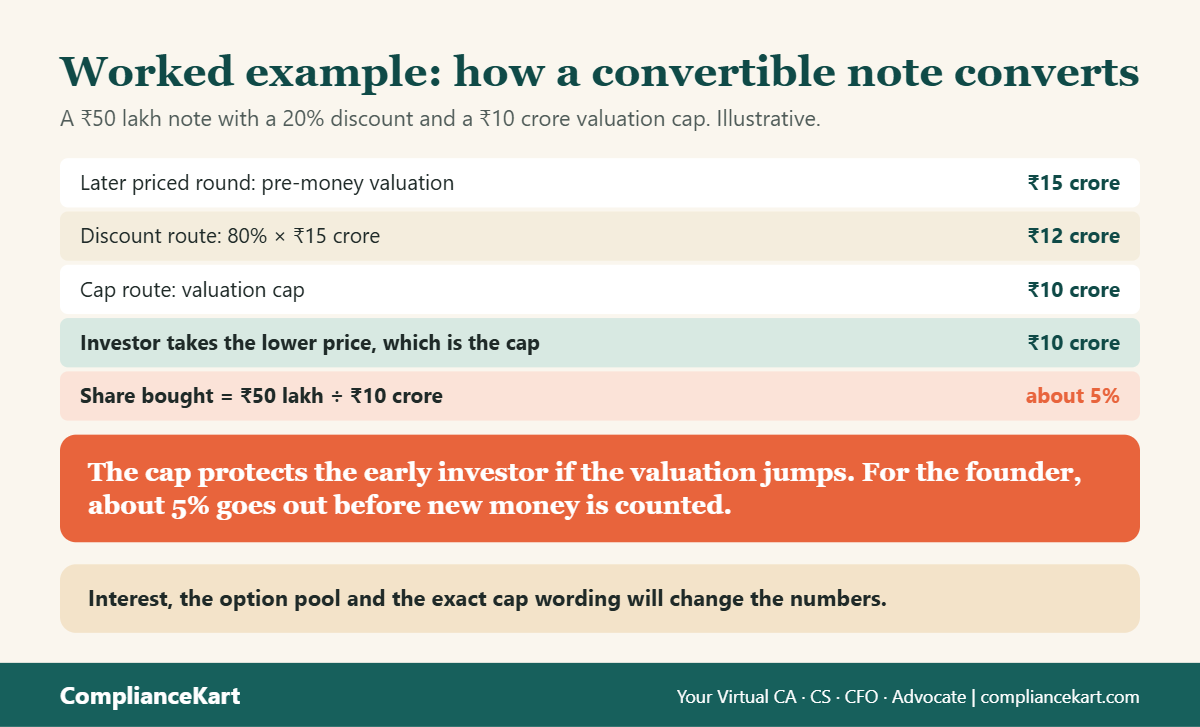
Because no price is fixed, notes usually carry a discount (say 20% off the next round’s price) and a valuation cap (a ceiling on the valuation used for conversion). The investor gets whichever gives the lower price.
Simple example
Rohan’s friend puts in ₹50 lakh on a note with a 20% discount and a ₹10 crore cap. Later a fund invests at a ₹15 crore pre-money valuation. The discount route gives ₹12 crore (80% of ₹15 crore). The cap gives ₹10 crore. The investor takes the lower one, so the note converts as if the company were worth ₹10 crore. ₹50 lakh ÷ ₹10 crore is about 5% of the company.
Foreign investors. Under the FEMA Non-Debt Instruments Rules, 2019, a DPIIT-recognised startup in an automatic-route sector can issue a convertible note to a non-resident, subject to the ₹25 lakh tranche rule and the 10-year limit. The issue is reported to the RBI in Form CN within 30 days. Conversion into equity must follow the pricing guidelines, and a later FC-GPR report is needed.
CCPS: preference shares that must convert
CCPS are preference shares under Section 55 of the Companies Act, 2013. “Compulsorily convertible” means the investor cannot ask for the money back. The shares must turn into equity on the agreed date or event. Until then the investor usually gets a fixed dividend, a first claim on exit money and some protective rights. Preference shareholders generally vote only on matters that directly affect their own rights.
For FEMA, CCPS are an “equity instrument”, so foreign investors can subscribe under the automatic route in most sectors. The price, or the conversion formula, must be fixed upfront when the shares are issued. The price at conversion cannot be lower than the fair value worked out at issue. The issue is reported in Form FC-GPR within 30 days of allotment.
CCD: loan paper that must convert
A debenture is a company’s loan certificate. A CCD pays interest and must convert into shares. Under Section 71 of the Companies Act, 2013, debentures with a conversion option need a special resolution. Interest is a business expense for the company, and tax must be deducted at source when it is paid. Because it is a debenture, check that the issue fits within the deposit rules.
Common mistake: “optionally convertible”
Under FEMA, only instruments that are compulsorily and mandatorily convertible count as equity. If the investor can choose to take the money back instead of converting, a foreign investor’s money may be treated as a loan, which brings external borrowing rules. Check the word “compulsorily” in the document, not just the title.
Tax on conversion
Under income-tax law, converting debentures or preference shares into equity of the same company is generally not treated as a transfer, so conversion alone does not create capital gains. The investor’s cost and holding period carry over to the new shares. Interest on notes and CCDs is taxable income for the investor, and TDS applies when it is paid. Because the Income-tax Act, 2025 came into force on 1 April 2026, check the section that applies to your tax year.
Which should you choose?
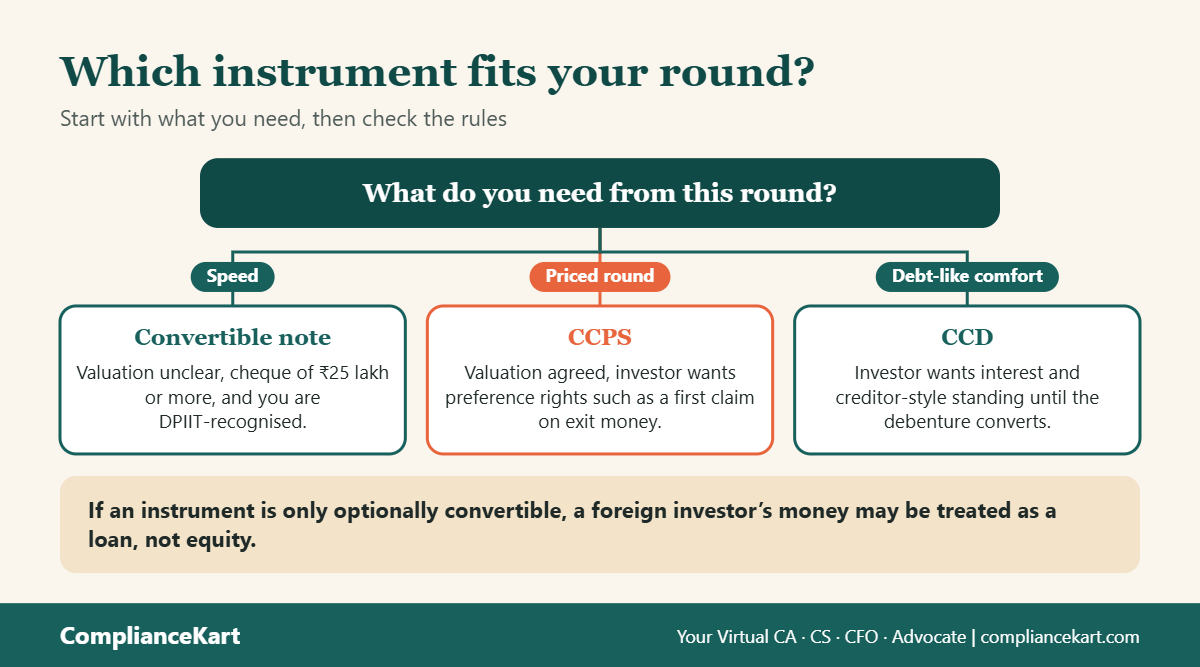
Many startups start with a note, then move to CCPS when a lead investor sets a price. The steps for each instrument are similar, as shown below. Read startup valuation methods and pre-money vs post-money valuation before you negotiate a cap.
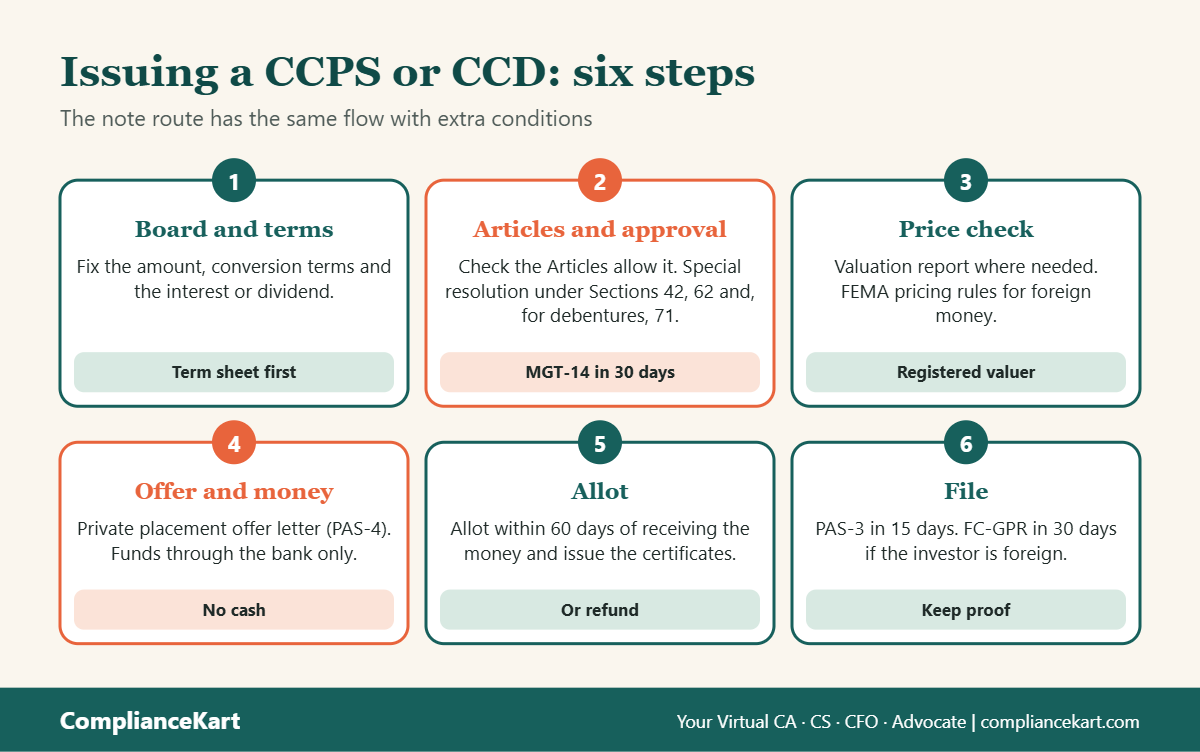
Our guide on how to issue shares in a private limited company explains the forms in detail. For a wider view of investor types, read angel investor vs venture capitalist.
Hyderabad context
Early-stage software and health-tech founders around Hitech City, Gachibowli and the Financial District often raise first money from overseas friends, family and angels. That makes the FEMA side, such as the Form CN, FC-GPR and the pricing rules, just as important as the Companies Act side.
Why work with ComplianceKart
Convertible instruments sit between company law, FEMA and tax. A gap in one can make the whole round harder to close.
ComplianceKart is a boutique practice bringing Chartered Accountants, Company Secretaries and advocates under one roof. Think of a multi-speciality hospital: you do not run between separate clinics for the heart, the bones and the blood tests. One team looks at the whole patient, and each specialist knows what the others found. Your business gets the same treatment.
How we can help (scope depends on your case):
- Choosing and drafting inputs for a note, CCPS or CCD, and the board and shareholder resolutions.
- ROC filings: PAS-4, PAS-3 and MGT-14 under our startup compliance service.
- FEMA reporting: Form CN, FC-GPR and FIRMS, through our FEMA compliance team.
- Valuation inputs, interest and TDS, and conversion tax mapping with our virtual CFO, CS and advocate support.
- Review of investor term sheets and agreements.
Not sure which instrument to use? Talk to us before you sign.
Frequently asked questions
Is a convertible note debt or equity?
It starts as debt and turns into equity later. Until it converts, the holder is a lender, not a shareholder. That is why interest, repayment rights and the deposit rules matter.
Can a private limited company that is not DPIIT-recognised issue a convertible note?
The special deposit relief and the FEMA route are for DPIIT-recognised startups. A company that is not recognised should choose CCPS or CCD, or take specific advice.
What happens if a note is not converted in 10 years?
It must be repaid, as the rules require conversion or repayment within that period. Plan the maturity terms so the company is not caught short.
Is dividend on CCPS compulsory?
Not by law. It follows the terms of the issue. Preference dividends may be fixed and cumulative if the terms say so, and they can only be paid out of profits as the Companies Act allows.
Is interest on CCD tax-deductible?
Generally yes as a business expense, subject to conditions, and the company must deduct TDS on it. Interest paid to a foreign lender has extra rules, so check before agreeing a rate.
Related reading
- Due diligence checklist before raising funds
- How to structure equity among founders
- ESOPs in India: complete guide
This article is general information as on 21 November 2026 and is not legal, tax or investment advice. Facts differ from case to case, and rules change, so speak to a qualified professional before you act. Examples are illustrations, not real client matters.
Need this done for your business?
Send us one message. A CA, CS or Advocate replies within a working day — no forms, no obligation.