How to Structure Equity Among Founders: A Fair and Practical Guide
How to structure equity among founders in India: fair splits, vesting and cliffs, sweat equity and the legal paperwork, with worked examples.
Law stated as on 21 November 2026 · Reading time about 9 minutes
Arjun, Sana and Kiran start a food-tech company from a rented floor in Gachibowli. They shake hands on 33% each “because it is fair”. Eight months later Kiran takes a full-time job elsewhere and works on the startup only on weekends. He still owns a third of the company, and the other two feel cheated.
How to structure equity among founders, in short: decide the split by contribution and risk, not by friendship. Put every founder’s shares on a vesting schedule so that shares are earned over time. Record the deal in a founders’ agreement and mirror it in the Articles. Then issue the shares properly and keep a live cap table. Do these four things and most founder fights never start.
In plain English
Equity means ownership. Vesting means you earn your shares over time instead of owning them all on day one. A cliff is a waiting period at the start, during which you earn nothing if you leave.
Step 1: Decide how to structure equity among founders
There is no magic formula. There are three common approaches.
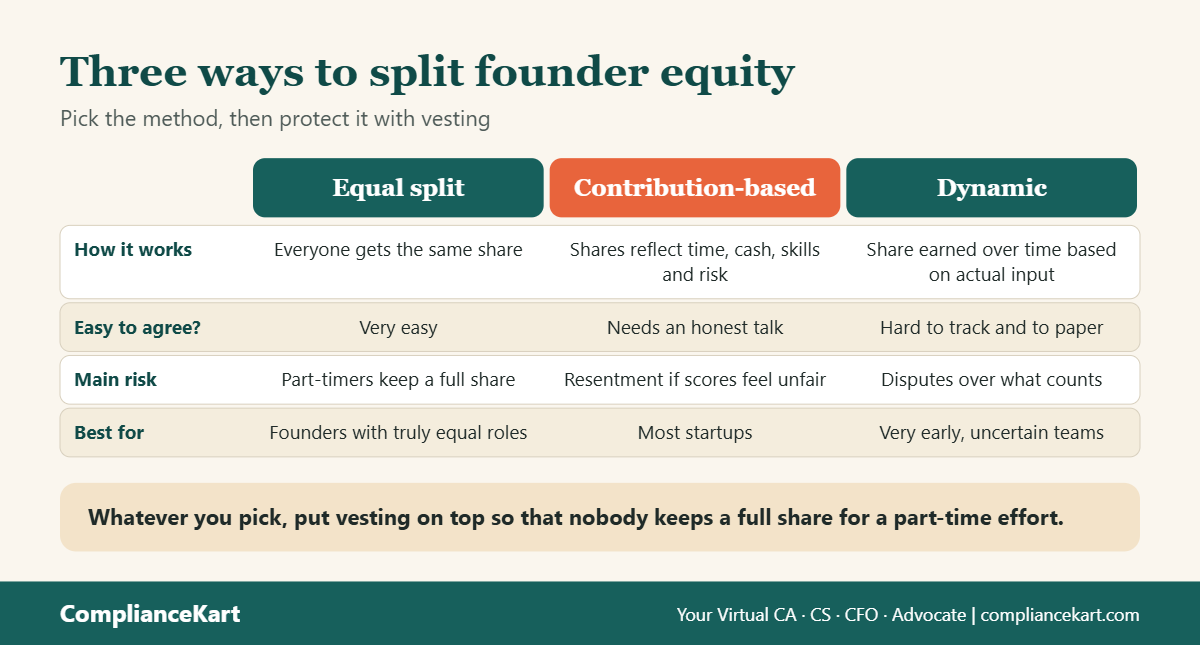
Whatever method you choose, ask each founder the same questions. Who works full-time? Who brings cash? Who owns the original idea or code? Who has the skills the business needs most? Who will carry the biggest risk if it fails?
Simple example: a scoring sheet
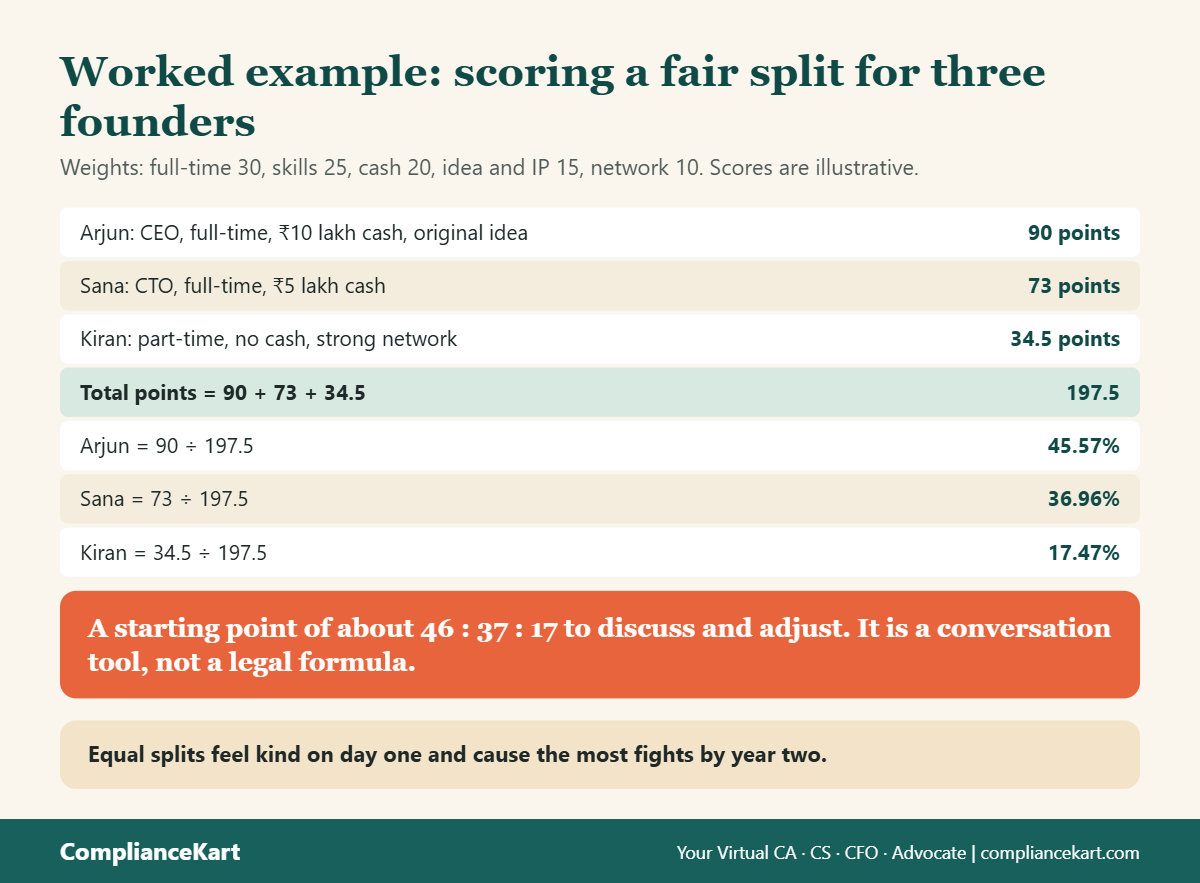
Give each factor a weight and score each founder out of 10. Arjun (full-time CEO, ₹10 lakh cash, original idea) scores 90 points. Sana (full-time CTO, ₹5 lakh) scores 73. Kiran (part-time, no cash, strong network) scores 34.5. Total is 197.5, so the starting split is 45.57%, 36.96% and 17.47%.
Step 2: Put vesting on every founder’s shares
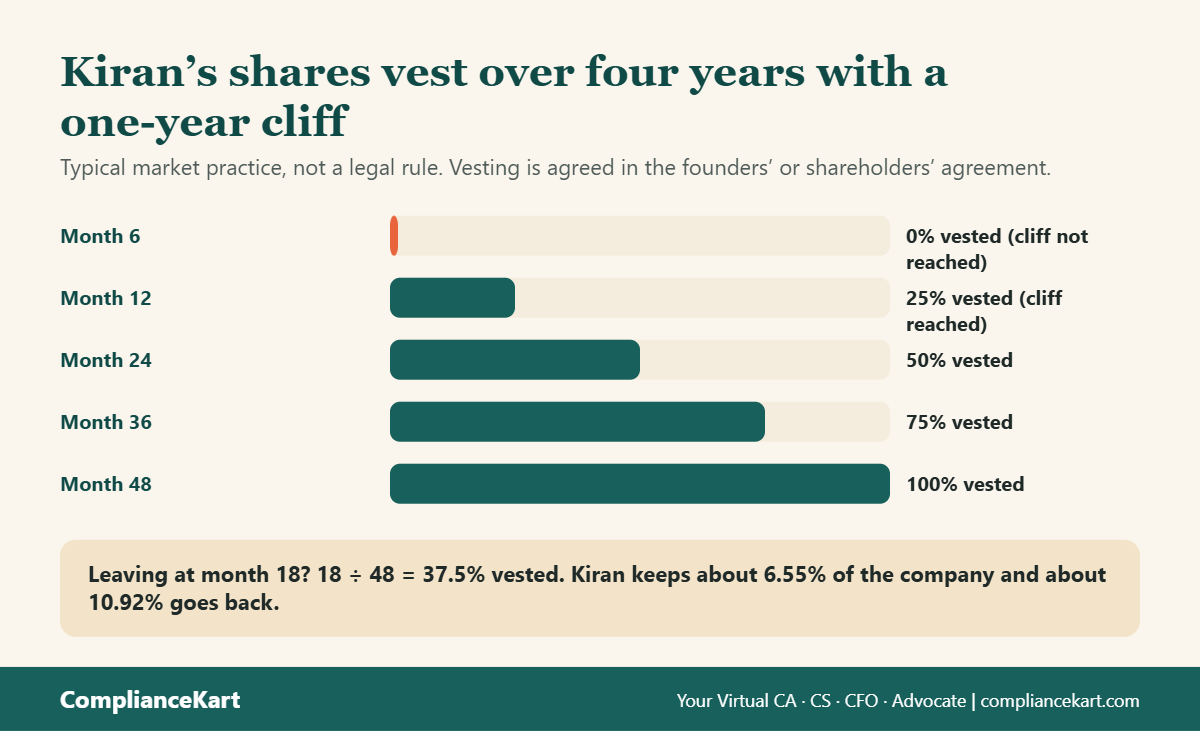
Investors almost always ask for vesting, and it protects you as well. A common market pattern is four years with a one-year cliff. Nothing vests before month 12. At month 12, 25% vests. After that, shares vest monthly until month 48. This is a market practice, not a legal rule, so you can agree something different.
Simple example: Kiran leaves at month 18
Kiran holds 17.47%. At month 18, 18 ÷ 48 = 37.5% has vested. That is about 6.55% of the company. The other 10.92% is unvested and goes back to the other founders or to the company at face value, as the agreement says. Had he left at month 8, he would have kept nothing.
How vesting works in India
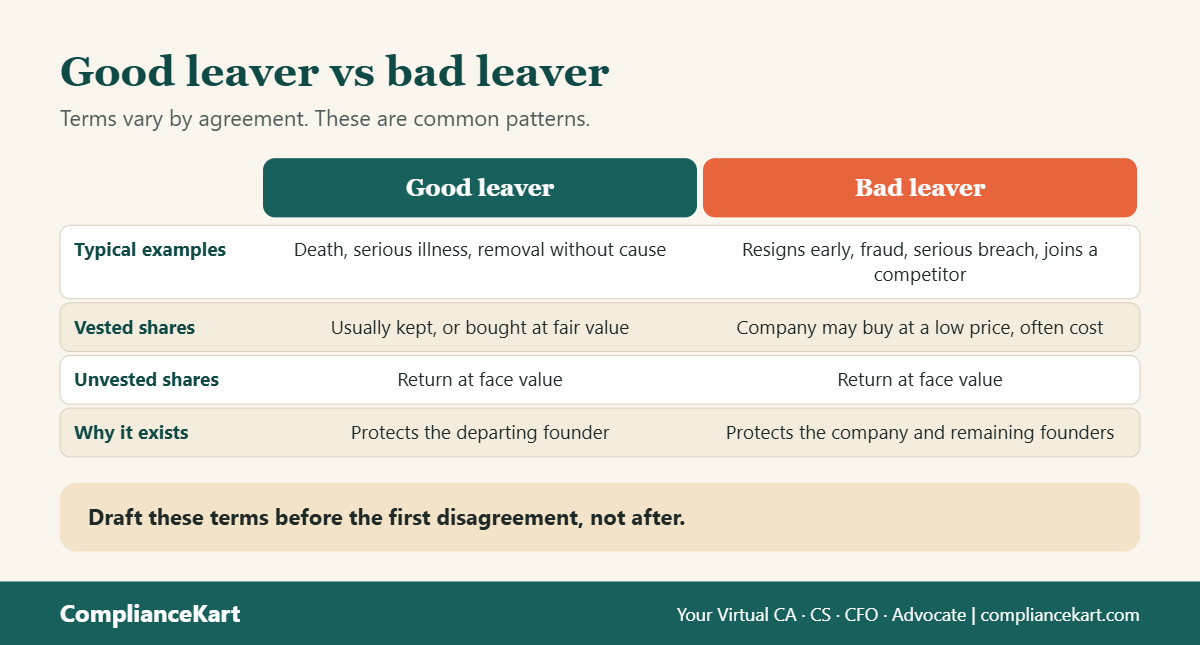
Founders usually receive all their shares at the start, when they subscribe to the company’s Memorandum of Association. So Indian deals use reverse vesting. The shares are issued upfront but the company or the other founders get a right to take back the unvested shares if a founder leaves. This sits in the founders’ or shareholders’ agreement, and the Articles should support it. A private company must restrict share transfers in its Articles, so the two documents need to agree.
Taking shares back through a company buy-back under Section 68 of the Companies Act, 2013 has conditions: the Articles must allow it, the limits on size and debt-equity ratio must be met, and the shareholders must approve it. Many startups therefore transfer the shares to the other founders or to a trust instead. If shares move at a price below fair value, the buyer can face tax on the difference under the income-tax rules on property received for inadequate consideration, so take advice before you draft the price.
Good leaver and bad leaver
Step 3: Know your sweat equity option
Sometimes a founder brings know-how or intellectual property instead of cash. A company can reward this by issuing sweat equity shares under Section 54 of the Companies Act, 2013 and Rule 8 of the Companies (Share Capital and Debentures) Rules, 2014. These are the main rules:
| Point | Rule |
|---|---|
| Who can get them | Directors and permanent employees |
| Approval | Special resolution, and a valuation by a registered valuer |
| Limit for a DPIIT-recognised startup | Up to 50% of paid-up capital, for up to 10 years from incorporation |
| Limit for other companies | 15% of paid-up equity capital or ₹5 crore (whichever is higher) in a year, and 25% overall |
| Lock-in | Three years |
| Tax | The value above what the founder pays is generally taxed as a perquisite |
Common mistake
Treating a promise of “equity later” as sweat equity. Unless shares are actually allotted through the correct process, the founder has only a claim, not ownership.
Step 4: Do the paperwork properly
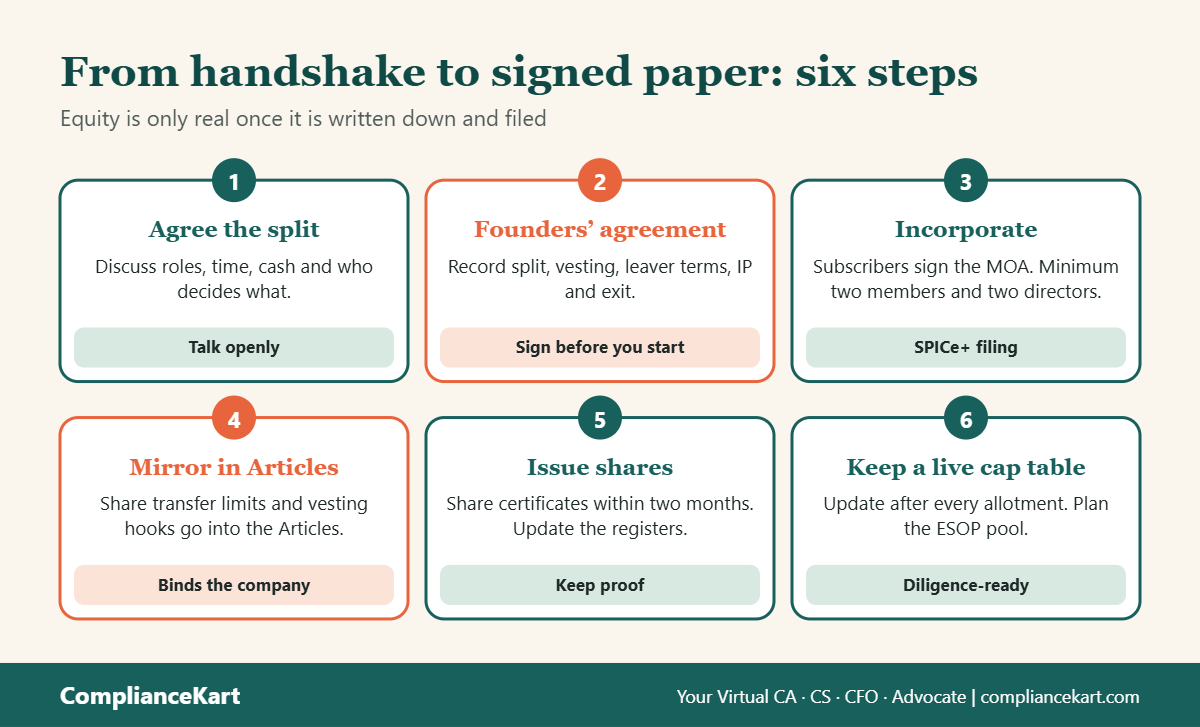
A private company needs at least two members and two directors. Share certificates should be issued within two months of allotment and the register of members kept up to date. For later shares, follow the process in our guide on how to issue shares in a private limited company. Choose the entity carefully: our note on Pvt Ltd vs LLP will help.
Plan ahead: the option pool and future rounds
Investors often ask founders to set aside a pool of shares for future hires before a round, commonly around 10 to 15% (a market pattern). That pool dilutes the founders, not the investors, so plan for it. Read our ESOP guide and pre-money vs post-money valuation to see how it works. Our angel vs venture capital article shows how each round changes the founder’s share.
Mistakes that start founder fights
- A 50:50 split with no tie-break or deadlock clause.
- No vesting, so a departed founder keeps a full share.
- Verbal promises of equity that never reach the cap table.
- Cash put in as equity by one founder and as a loan by another, without paper.
- No assignment of IP to the company.
- Changes agreed on WhatsApp but never filed with the ROC.
Our note on important clauses in a founders’ agreement covers the rest.
Hyderabad context
Many early teams in Gachibowli, Kondapur, Hitech City and Kokapet start as friends from the same college or workplace. That is a strength, but it is also why written terms matter. A founders’ agreement signed before incorporation saves the most pain, and it keeps your later diligence simple. See what founders should get right from day one.
Why work with ComplianceKart
Founder equity touches company law, tax and contracts together, and a gap in one can undo the other two.
ComplianceKart is a boutique practice bringing Chartered Accountants, Company Secretaries and advocates under one roof. Think of a multi-speciality hospital: you do not run between separate clinics for the heart, the bones and the blood tests. One team looks at the whole patient, and each specialist knows what the others found. Your business gets the same treatment.
How we can help (scope depends on your case):
- Founders’ agreement inputs: split, vesting, leaver, IP and exit terms.
- Incorporation, share allotment, certificates and registers through our company incorporation and startup compliance services.
- Sweat equity process: valuation inputs, resolutions and filings.
- Tax mapping for share transfers and perquisites, with finance support from our virtual CFO, CS and advocate team.
- Cap table clean-up before a funding round.
Setting up a founding team? Get the equity paperwork right on day one.
Frequently asked questions
Can founders hold unequal shares?
Yes. The law does not require equal shares. Unequal shares that reflect real contribution are common and often fairer.
Is vesting required by law?
No. It is a contract term agreed between founders and investors. But most investors expect it, and it protects the team.
Is a 50:50 split a bad idea?
Not always, but it needs a tie-break, such as a casting vote, a mediator or a buy-sell clause. Without one, a disagreement can freeze the company.
Can a founder receive sweat equity?
Yes, if the founder is a director or permanent employee and the company follows Section 54 and Rule 8, including the special resolution, valuation and three-year lock-in.
Do founders pay tax when they receive shares at incorporation?
Shares paid for at face value on subscription generally do not create tax at that point. Shares issued later below fair value, or as sweat equity, can attract tax, so check before issuing.
Related reading
- Startup valuation methods explained
- Fundraising, term sheets and shareholders’ agreements
- Due diligence checklist before raising funds
This article is general information as on 21 November 2026 and is not legal, tax or investment advice. Facts differ from case to case, and rules change, so speak to a qualified professional before you act. Examples are illustrations, not real client matters.
Need this done for your business?
Send us one message. A CA, CS or Advocate replies within a working day — no forms, no obligation.