Due Diligence Checklist Before Raising Funds: What Indian Investors Check
A due diligence checklist before raising funds: corporate, ROC, tax, GST, finance, legal and IP items Indian investors check, plus red flags and fixes.
Law stated as on 21 November 2026 · Reading time about 9 minutes
Priya runs a direct-to-consumer brand from Kokapet. She signs a term sheet with a fund and feels the hard part is over. Then the fund sends a request list with more than 100 items. She finds that an angel’s shares were allotted a year ago but the return was never filed with the ROC. The closing slips by six weeks. (This is an illustration, not a real client matter.)
The due diligence checklist before raising funds, in short: investors check five things. Is the company properly set up and filed? Are the tax and GST positions clean? Do the books tell a true story? Do the people and contracts hold together? Does the company really own its IP? If you check these yourself first, diligence becomes a formality instead of a shock.
In plain English
Due diligence is the investor’s homework. Before they wire money, they check that the company is what you said it is. A data room is simply an online folder where you keep all the documents in an organised way.
The master checklist
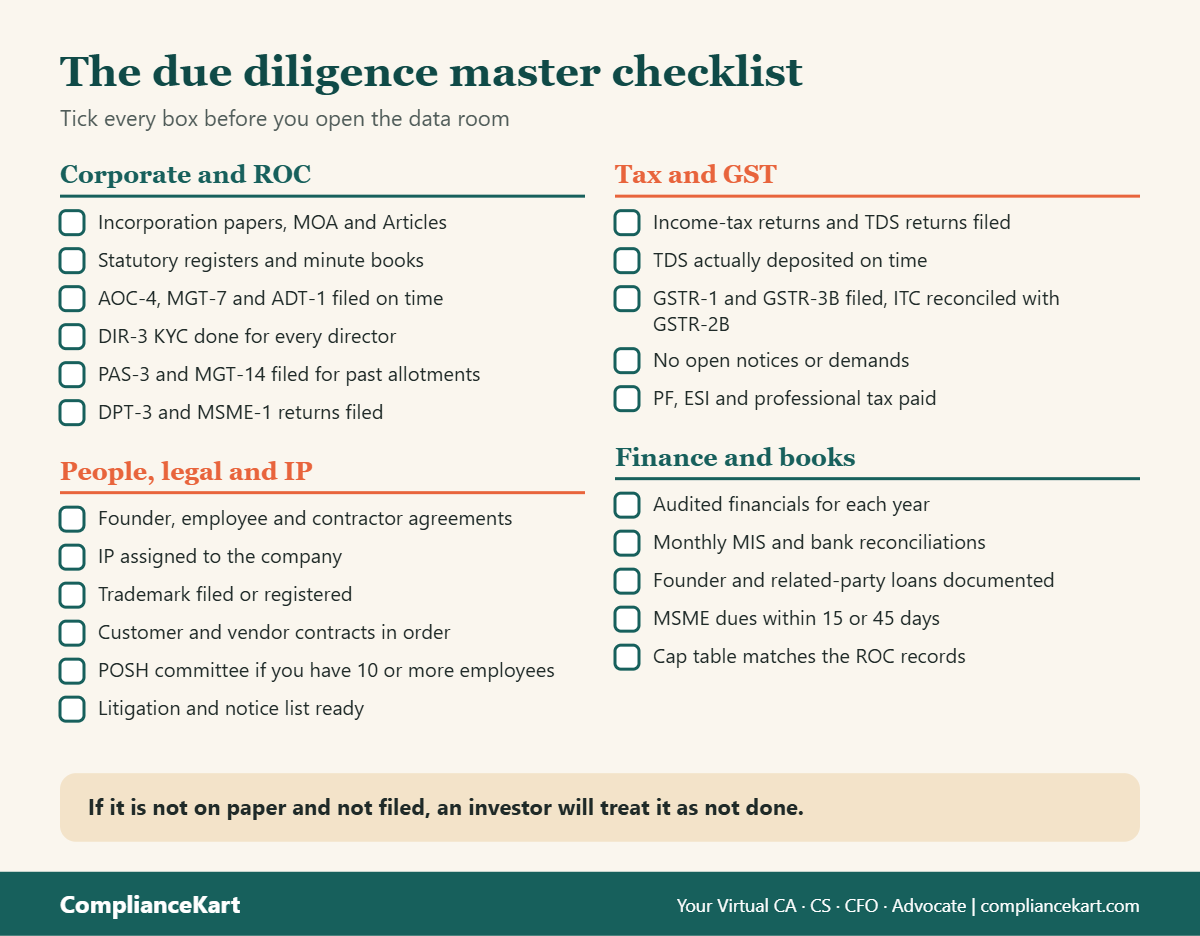
1. Corporate and ROC records
Investors begin with the basics: who owns the company and is it filed properly? They ask for the certificate of incorporation, Memorandum and Articles, registers of members and directors, and board and shareholder minutes. They check the annual filings: financial statements in Form AOC-4 within 30 days of the AGM, the annual return in Form MGT-7 within 60 days of the AGM, and the auditor’s appointment in Form ADT-1. Every director needs DIR-3 KYC.
Past share issues matter most. Each allotment needs its Form PAS-3, and the resolutions need Form MGT-14. Money taken from directors or others may need the DPT-3 return, and dues to micro and small suppliers beyond 45 days are reported in Form MSME-1. For how a clean allotment looks, read how to issue shares in a private limited company.
Simple example
The register of members shows Arjun with 60% and Sana with 40%. The cap table in the pitch deck shows an angel with 8% as well. If the angel’s allotment was never recorded, the three documents tell three different stories. The investor will want it corrected before closing.
2. Tax and GST
Expect questions on income-tax returns, TDS returns and, above all, whether the TDS was actually deposited. For GST, the investor compares the sales in GSTR-1 with the tax paid in GSTR-3B and checks that input tax credit matches GSTR-2B. Open notices, demands and refund claims are listed in the report. Payroll dues such as PF, ESI and professional tax are checked too. If you have foreign investment, the annual FLA return to the RBI is also asked for.
3. Finance and books
Investors want audited financials for each year, monthly management accounts and bank reconciliations. They look at founder and related-party loans, and whether they are written down as loans or as equity. They also check payments to micro and small suppliers, because under section 43B(h) of the Income-tax Act, 1961 (carried into section 37(2)(g) of the Income-tax Act, 2025) a deduction is lost if these payments run beyond the 15 or 45 day limit. A clean model helps, so read our guide on how to prepare a financial model for investors.
4. People, legal and IP
Employment documents, contractor agreements, PF and ESI registrations and the POSH internal committee (needed once you have 10 or more employees) will be checked. See our note on POSH compliance and the internal committee. For IP, the investor wants proof that every founder and developer has assigned their work to the company, and that trademarks are filed. A list of litigation and notices rounds off the pack. Your founders’ agreement should be signed and consistent with the Articles.
How due diligence runs
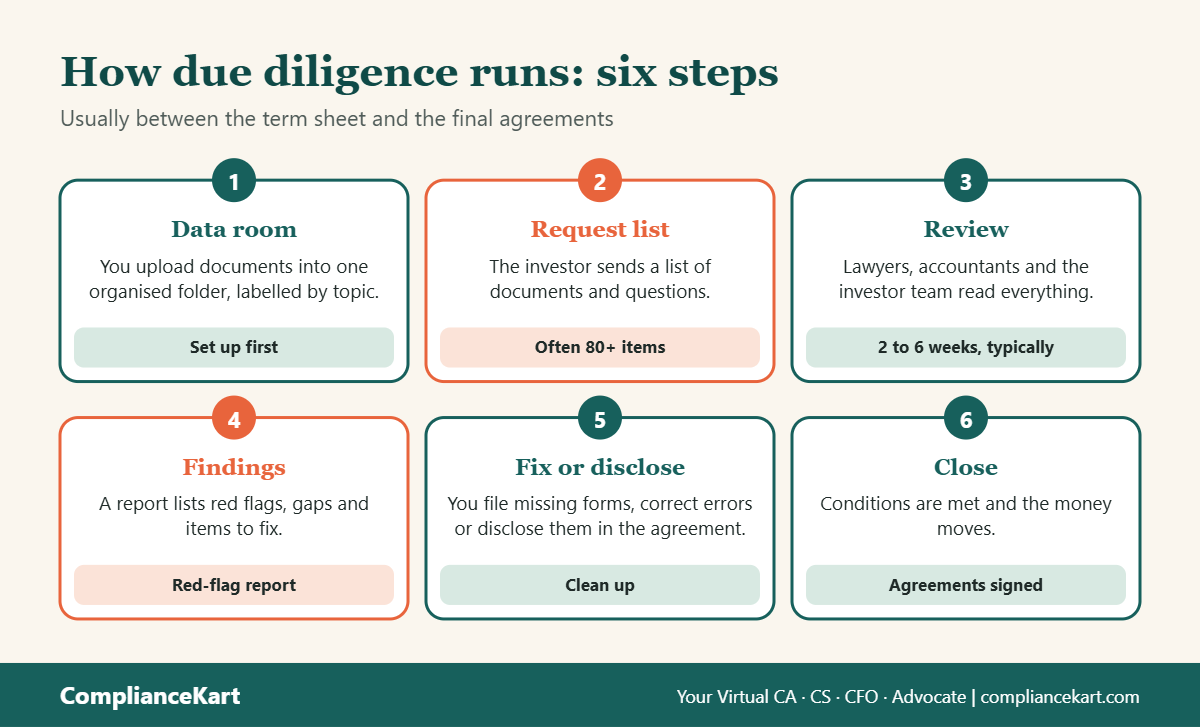
Set up the data room before the term sheet, not after. Label the folders the way the checklist is arranged and keep a log of what has been shared.
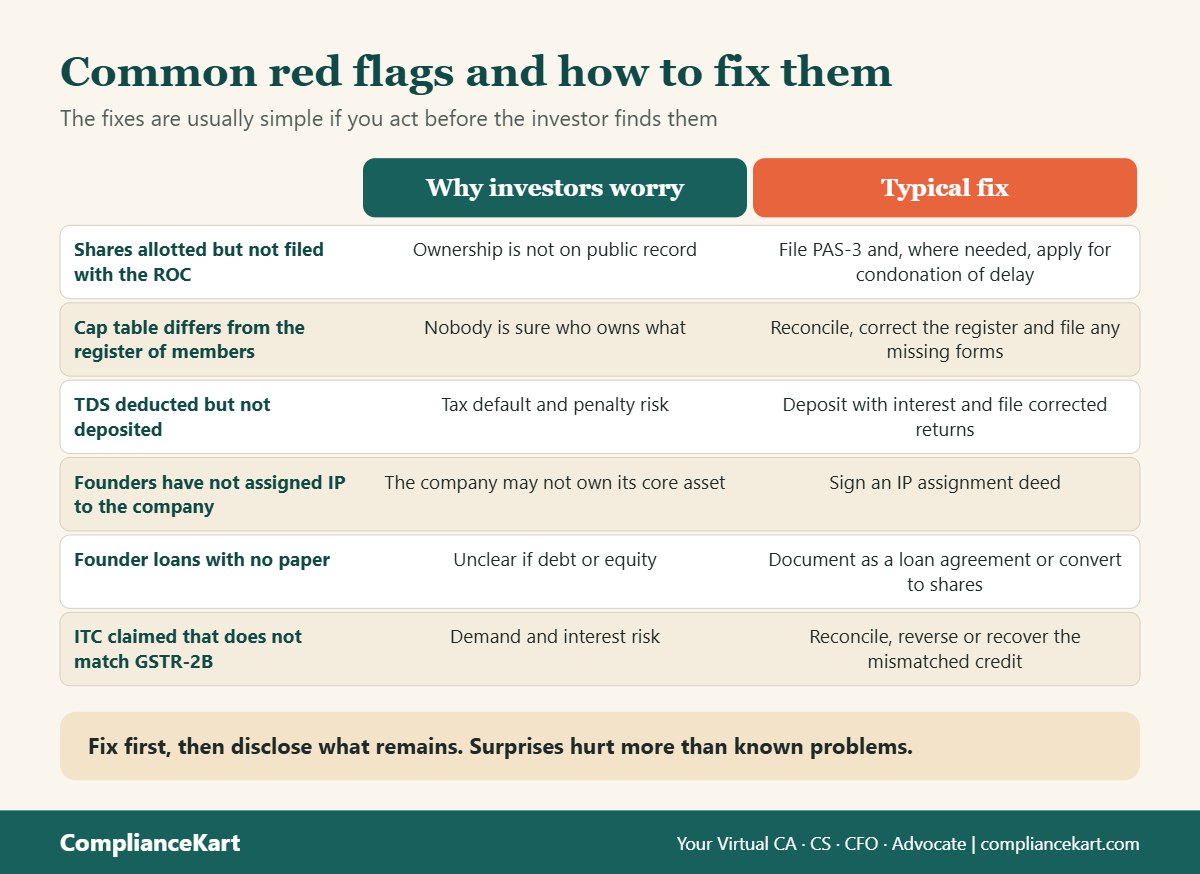
Red flags and how to fix them
Common mistakes
- Hiding a known problem. Investors usually find it, and then trust drops.
- Keeping documents in WhatsApp and personal email.
- Fixing issues after the term sheet, when you have no time left.
- Giving the cap table from memory instead of from the registers.
A simple self-score
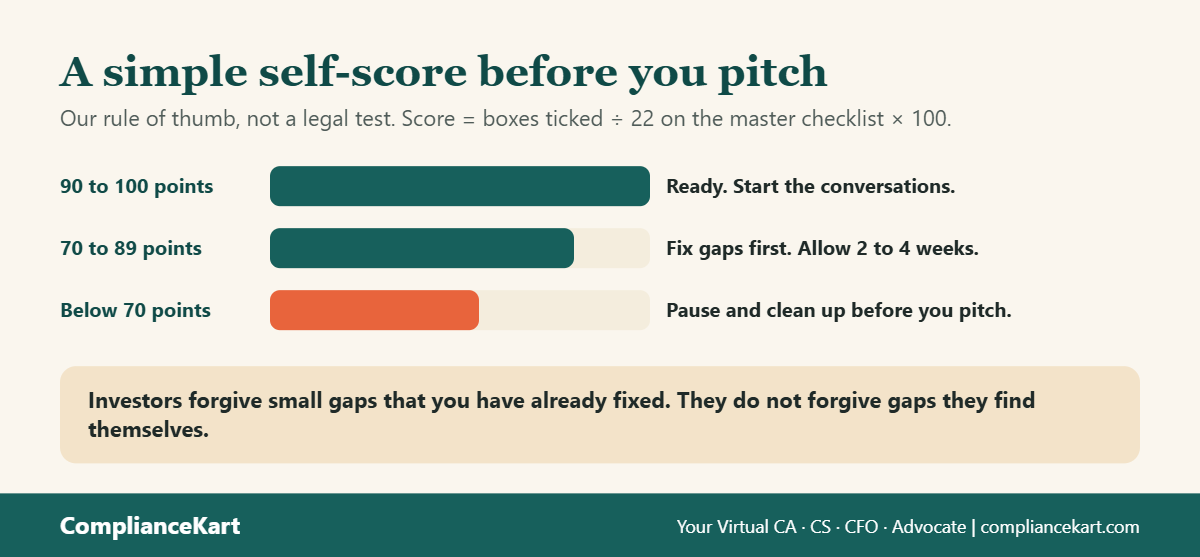
This is our rule of thumb, not a legal test. If you land in the middle band, spend two to four weeks on the gaps before you start pitching. Our compliance calendar and health check shows what a healthy year of filings looks like.
Hyderabad context
Funds and angels look at Telangana companies through the same lens as anywhere else in India. What helps is speed: founders in Kokapet, Gachibowli, Hitech City and Kondapur who keep their ROC and tax filings current can open a data room in days, not weeks.
Why work with ComplianceKart
Diligence touches company law, tax, FEMA and contracts together. A gap in one area often hides inside another.
ComplianceKart is a boutique practice bringing Chartered Accountants, Company Secretaries and advocates under one roof. Think of a multi-speciality hospital: you do not run between separate clinics for the heart, the bones and the blood tests. One team looks at the whole patient, and each specialist knows what the others found. Your business gets the same treatment.
How we can help (scope depends on your case):
- A pre-diligence health check across ROC, tax, GST and contracts.
- Catching up pending forms through our ROC annual compliance team.
- GST reconciliation and notice support through GST return filing.
- Cap table clean-up, resolutions and share issue records with our startup compliance service.
- Data room structuring and finance review through our virtual CFO, CS and advocate support.
Want to know what an investor will find? Get a readiness check first.
Frequently asked questions
When should I start preparing for due diligence?
Before you pitch. Fixing small gaps takes days when you do it early and weeks when you do it under a deadline.
Who pays for due diligence?
Usually the investor pays its own lawyers and accountants. You bear the cost of your own time and the clean-up work.
What if diligence finds a problem?
Fix what you can, disclose what remains and negotiate how it will be handled. Many deals proceed with a clear fix plan, often as a condition before closing.
Do I need an audit before raising funds?
Companies must have their accounts audited under the Companies Act. Investors also expect audited statements for each year, so catch up on any missing years early.
Is a data room mandatory?
No, but it keeps the process fast and shows you are organised. A shared, well-labelled folder is enough for early rounds.
Related reading
- Startup valuation methods explained
- Angel investor vs venture capitalist
- Convertible notes vs CCPS vs CCD
- How to structure equity among founders
This article is general information as on 21 November 2026 and is not legal, tax or investment advice. Facts differ from case to case, and rules change, so speak to a qualified professional before you act. Examples are illustrations, not real client matters.
Need this done for your business?
Send us one message. A CA, CS or Advocate replies within a working day — no forms, no obligation.