Inverted Duty Refund Under GST: Rule 89(5), Pharma Rate Cuts & the 57th Council Update
Inverted duty refund under GST explained: Section 54(3)(ii), Rule 89(5) formula with example, pharma rate cuts and 57th GST Council changes for input services.
A formulations manufacturer near Jeedimetla buys active pharmaceutical ingredients (APIs) at 18% GST and sells finished medicines at 5%. Every month it pays more tax on purchases than it collects on sales, and the unused credit has nowhere to go. Until the Government legislates otherwise, the only door to that cash is the inverted-duty refund. The door is narrower than most people think.
The statute and what it excludes
| Element | Position | Provision |
|---|---|---|
| Core condition | Credit accumulated because tax rate on inputs is higher than on outputs | s.54(3)(ii) |
| Credit covered | Inputs only. Input services and capital goods are outside the refund | s.54(3)(ii); Union of India v. VKC Footsteps India Pvt. Ltd. (Supreme Court, 2021) verify |
| Outputs excluded | Nil-rated and fully exempt supplies | s.54(3)(ii) |
| Goods excluded by notification | Certain goods, for example edible oils (Chapter 15) and coal (Chapter 27) for applications from 18 July 2022 | Notification 9/2022-Central Tax (Rate) verify |
| Relevant date | End of the financial year in which the claim arises | Expl. (2)(e) to s.54 |
| Interim relief | 90% provisional sanction for low-risk inverted-duty claims filed on or after 1 Oct 2025 | Instruction 06/2025-GST verify |
Rule 89(5) with a worked example
The maximum refund is computed as:
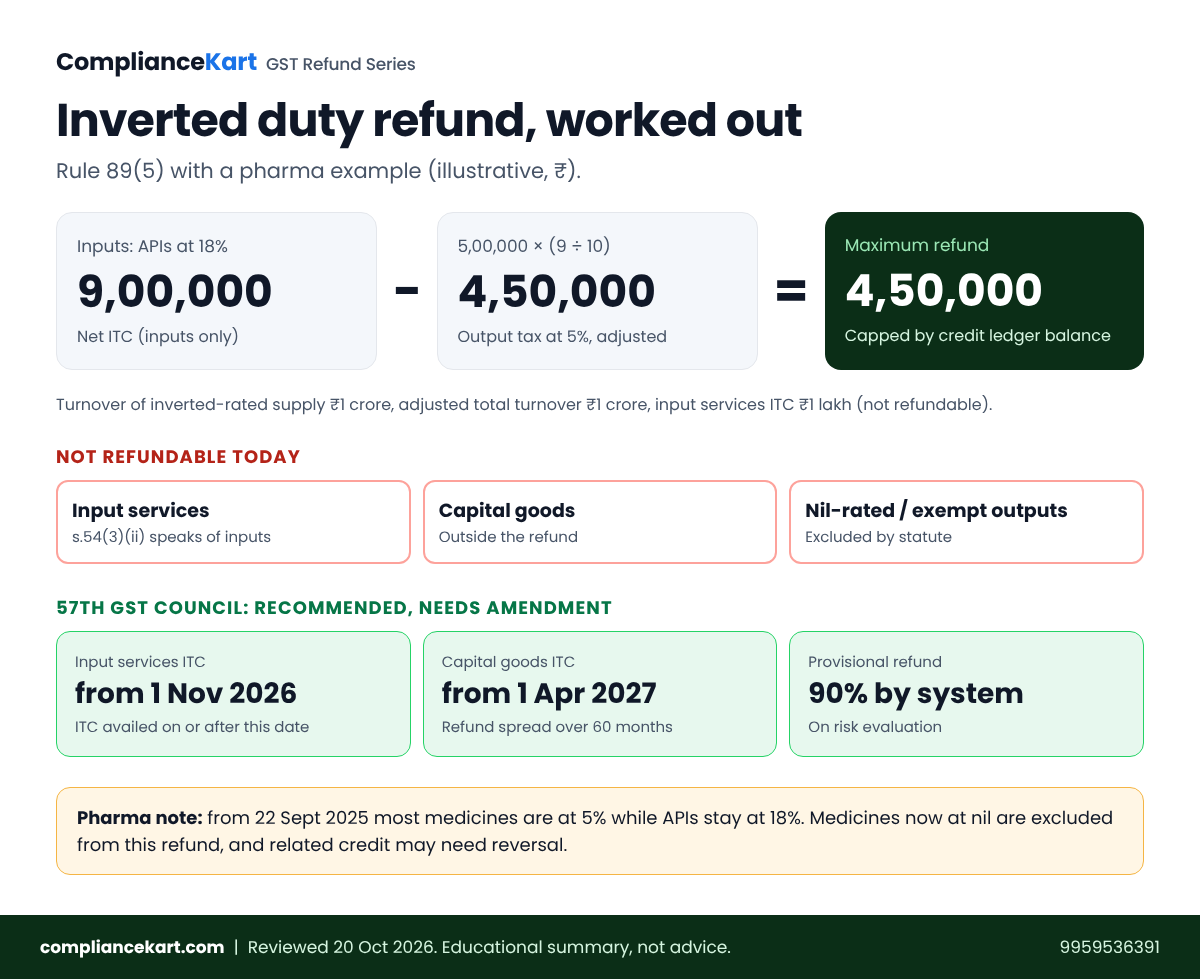
Maximum refund = [ (Turnover of inverted-rated supply ÷ Adjusted Total Turnover) × Net ITC ] − [ Tax payable on inverted-rated supply × (Net ITC ÷ ITC availed on inputs and input services) ]
Here, Net ITC is the ITC availed on inputs in the relevant period. The refund is also capped by the balance available in the electronic credit ledger. Check the current text of the sub-rule before filing, since it was amended by Notification 14/2022-Central Tax (5 July 2022) verify.
| Illustration (assumed, in ₹) | Amount |
|---|---|
| Turnover of inverted-rated supply (all outputs at 5%) | 1,00,00,000 |
| Adjusted total turnover | 1,00,00,000 |
| ITC on inputs (APIs at 18%): Net ITC | 9,00,000 |
| ITC on input services (not refundable) | 1,00,000 |
| ITC on inputs and input services | 10,00,000 |
| Tax payable on inverted-rated supply (5%) | 5,00,000 |
| Refund = 9,00,000 − 5,00,000 × (9,00,000 ÷ 10,00,000) | 4,50,000 |
Pharma after 22 September 2025
The 56th GST Council rationalised rates effective 22 September 2025. As reported, most medicines moved from 12% to 5%, 33 specified life-saving drugs moved to nil, and a few critical drugs moved from 5% to nil. APIs stayed at 18%, and job work on pharmaceutical products moved from 12% to 5% verify. Two consequences follow for a Hyderabad pharma unit.
- The inversion widens, but only for the taxable part. Medicines at 5% remain in the refund. Outputs that are now nil-rated are expressly excluded by Section 54(3)(ii), so the credit attributable to them is not refundable and may call for reversal under Section 17(2) with Rules 42 and 43 verify.
- Input services remain outside the refund, even though they form part of the denominator in the formula. Quantify the cost of that gap; it is the main reason for the 57th Council recommendation below.
Contested positions and risk
| Issue | Our primary position | Departmental view | Risk |
|---|---|---|---|
| Does the 2022 change to the Rule 89(5) formula apply to claims for earlier periods? | Yes, it is curative. The Gujarat High Court (Ascent Meditech) took that view, and the Supreme Court dismissed the Union’s SLP; the Gujarat High Court followed it in Pranav Overseas LLP v. Union of India (2 July 2026), quashing deficiency memos for FY 2017-18 and 2018-19 and directing reprocessing within 12 weeks verify | Circular 181/13/2022-GST (10 Nov 2022) applies the amended formula to applications filed on or after 5 July 2022 | Moderate; the SLP dismissal is not a declaration of law |
| Refund of ITC on input services in inverted-duty claims | Only on the prescribed legal footing after amendment | VKC Footsteps and the text of s.54(3)(ii) confine it to inputs | High for past periods |
| Refund of nil-rated or exempt output credit | Not claimable; segregate | Excluded by statute | High |
| Accumulation from a rate cut where input and output are the same goods (for example traders) | Arguable on the statute’s wording; several High Courts have favoured taxpayers | Circular 135/05/2020-GST takes a narrower view verify | Moderate to high; the matter is litigative |
Safest course: file within time on the department’s formula, record the alternative formula in the cover letter, and challenge any deficiency memo by writ where an authority such as Ascent Meditech applies. Do not wait for the litigation to settle, because the two-year limit continues to run.
What the 57th GST Council recommended for inverted duty
- Input services: accumulated ITC to be refundable for ITC availed on input services on or after 1 November 2026.
- Capital goods: refundable, spread over 60 months, for ITC availed on or after 1 April 2027.
- 90% provisional sanction by the system on risk evaluation, with no scanned document uploads.
- Implementation requires amendment of the proviso to Section 54(3)(ii) and the CGST Rules.
The recommended dates run from when the ITC is availed, not from when the refund is filed. Keep your credit ledger tagged by category (inputs, input services, capital goods) and by availment date now, so the claim can be built the day the amendment is notified. Until then, existing law applies, including the exclusion of input services. The Finance Act, 2026 has also amended Section 54 to bring inverted-duty claims into the 90% provisional framework, from a date to be notified verify. Our note on the 57th Council refund recommendations will be updated when the notification arrives.
How to claim
- Fix the period. Claims are made for a tax period or a consecutive set of periods within a financial year.
- Reconcile. GSTR-1, GSTR-3B and GSTR-2B must support the turnover and ITC in the statement.
- Segregate ITC. Inputs vs input services vs capital goods; taxable vs nil-rated/exempt outputs.
- File RFD-01 with the inverted-duty statement and invoices, before the two-year limit expires.
- Respond to RFD-03 or RFD-08 within the time allowed; part 5 explains this.
Hyderabad context
Bulk-drug and formulation units in Jeedimetla, Patancheru, Bollaram and the Genome Valley belt are the most exposed to API-driven inversion. Startups in electronics, EVs, footwear or textiles around Hyderabad can face the same structure when inputs carry a higher rate than the finished product. IT and SaaS firms rarely do, because services have no comparable inversion.
Why work with ComplianceKart
An inverted-duty claim is a GST computation, a books-to-returns reconciliation and, often, an appeal. ComplianceKart is a boutique practice that brings Chartered Accountants, Company Secretaries and advocates under one roof, like a multi-speciality hospital where the specialist who diagnoses the problem works alongside the one who treats it. We prepare the Rule 89(5) working, test it against the points above and, if a deficiency memo or rejection follows, take the matter through reply, appeal and writ options. We cannot guarantee any refund or its timing.
Frequently asked questions
What is inverted duty structure under GST?
It is a situation where the GST rate on inputs is higher than the rate on the output supplies, so that input tax credit accumulates. Section 54(3)(ii) of the CGST Act allows a refund of that accumulation, subject to exclusions and the Rule 89(5) formula.
Can I claim inverted duty refund on input services?
Under the current law, no. Section 54(3)(ii) speaks of inputs, and the Supreme Court in VKC Footsteps upheld the position. The 57th GST Council has recommended refund of ITC on input services availed on or after 1 November 2026, which needs an amendment before it applies.
Is capital goods ITC refundable under inverted duty?
Not at present. The 57th GST Council has recommended refund of capital goods ITC spread over 60 months for ITC availed on or after 1 April 2027, subject to amendment of the Act and Rules.
Do the September 2025 GST rate cuts on medicines help pharma companies claim refund?
They can widen the inversion for medicines now taxed at 5% while APIs remain at 18%. But nil-rated medicines are excluded from the refund, and credit attributable to them may need to be reversed. Examine the product mix before claiming.
What is the time limit for inverted duty refund?
Two years from the end of the financial year in which the claim arises, under Explanation (2)(e) to Section 54.
Is 90% provisional refund available for inverted duty claims?
CBIC Instruction 06/2025-GST provides for 90% provisional sanction for low-risk inverted-duty claims filed on or after 1 October 2025 as an interim step, and the Finance Act, 2026 and the 57th Council point to a statutory framework. Check the current notification and instruction for conditions.
Sitting on accumulated input tax credit?
Send us the ledger balance, the rates on inputs and outputs, and the period. We will tell you whether a Section 54(3)(ii) claim is available and how to compute it.
WhatsApp usEmailCall 9959536391GST notice & litigation supportContinue the series
Disclaimer. This article is for general information on Indian GST law as at 20 October 2026 and is not advice on any specific case. Refund eligibility depends on facts, period and documents. Items marked verify should be checked against the current official text before reliance. Contact: team@compliancekart.com · 9959536391 · compliancekart.com.
Need this done for your business?
Send us one message. A CA, CS or Advocate replies within a working day — no forms, no obligation.