Aspects Founders Should Keep Right From Day 1
Aspects founders should keep right from day 1: a founders agreement, timely first filings and clean books. A practical guide for Hyderabad startups.
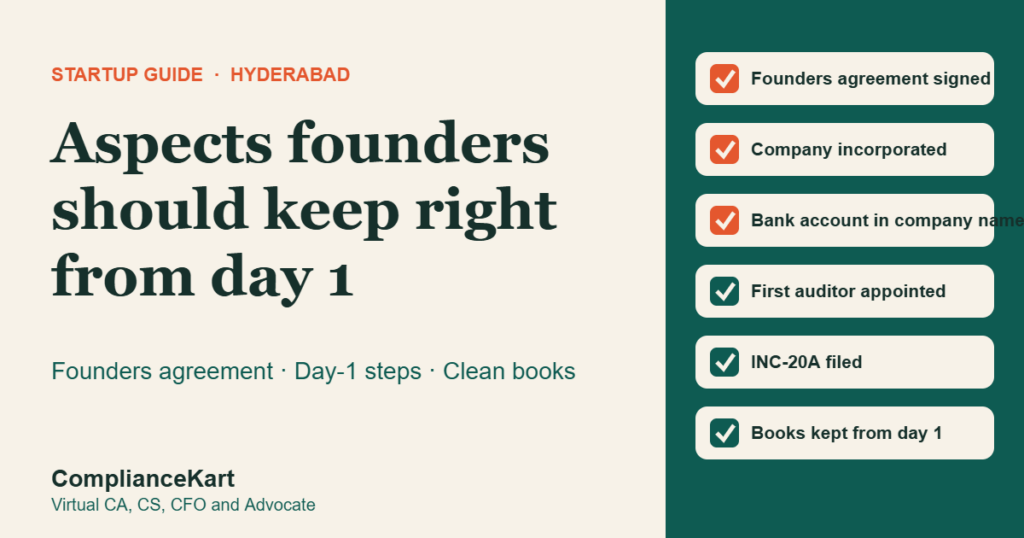
Two friends leave their jobs, rent a desk near Hitech City, and start building. Funds come into one founder’s personal account. Equity is “fifty-fifty, we trust each other.” The incorporation is “on the to-do list.” Eighteen months later, one founder wants out, an investor wants a clean cap table, and nobody can say who owns the code or what the company actually spent.
The short answer: from day one, a founder should have (1) a written founders’ agreement, (2) a properly incorporated company with its own bank account, (3) the early post-incorporation filings completed on time, and (4) books of account that are accurate, current and visible to every co-founder. Each of these is cheap on day one and expensive to repair later.
This guide covers all four, with the statutory deadlines that catch new companies out. If you are still choosing a structure, start with our comparison of Private Limited Company vs LLP.
1. Founders’ / co-founders’ agreement: what it is and why it matters
A founders’ agreement (also called a co-founders’ agreement) is a private contract between the founders that records who does what, who owns what, and what happens when things change. It is different from the company’s Articles of Association (AoA), which govern the company and are filed with the Registrar of Companies. Once investors come in, a shareholders’ agreement (SHA) usually builds on it; see our guide to fundraising, term sheets and the SHA.
| Document | Between whom | Purpose |
|---|---|---|
| Founders’ agreement | Founders | Roles, equity, vesting, IP, exits, decision-making |
| Articles of Association | Company and its members | Internal rules of the company; public record |
| Shareholders’ agreement | Shareholders (often including investors) | Investor rights, transfer restrictions, reserved matters |
A contract between shareholders does not bind the company unless its terms are reflected in the Articles. So key protections, such as transfer restrictions or board composition, should be mirrored in the AoA. A lawyer should confirm how this works for your structure.
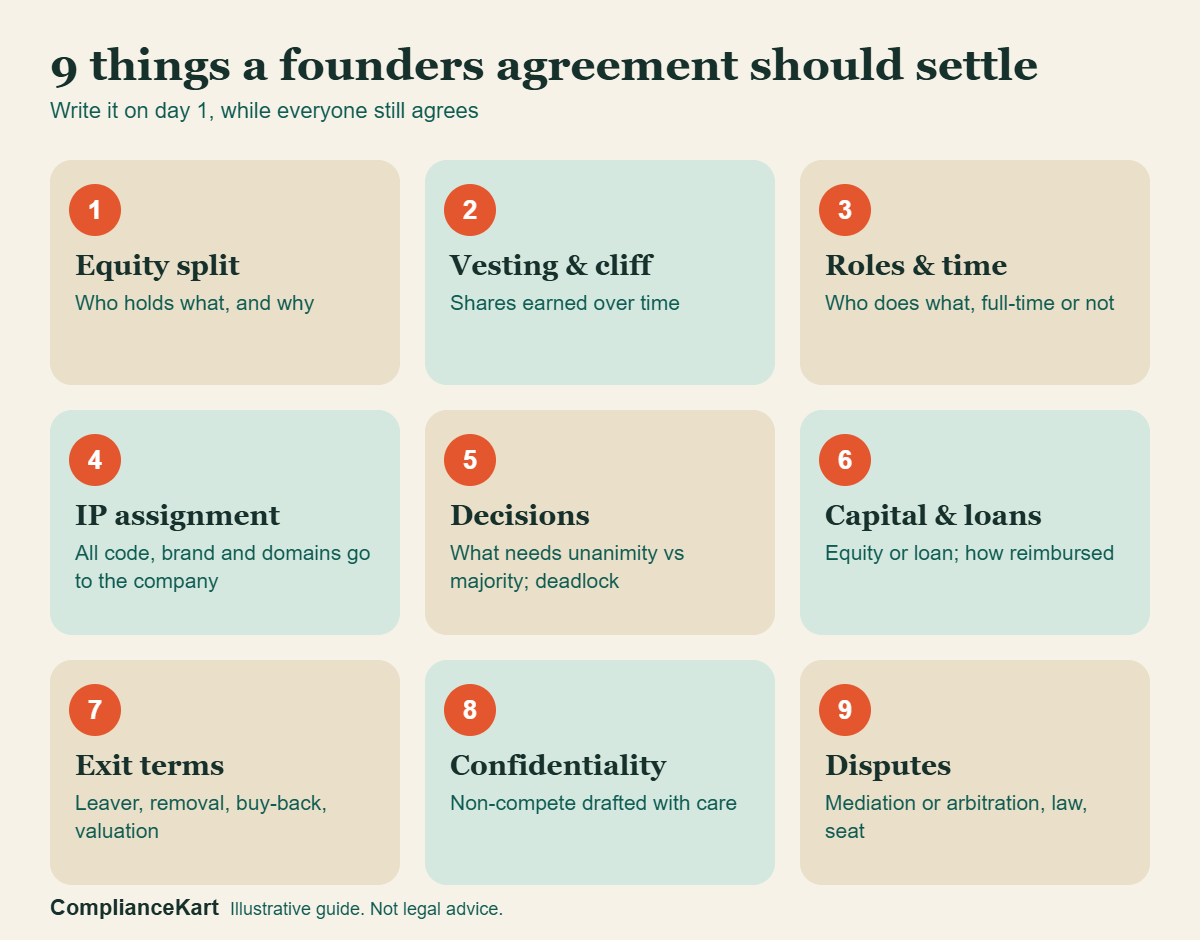
Clauses a founders’ agreement should cover
- Equity split and rationale. Record who holds what and why. Equal splits are fine if intended; they should not be a default to avoid a hard conversation.
- Vesting and cliff. Founder shares that vest over time (commonly four years with a one-year cliff) protect the team if a founder leaves early. Vesting is a commercial term, not a statutory requirement.
- Roles and time commitment. Who is CEO, who owns product, and whether founders can hold other jobs.
- Intellectual property assignment. Every founder should assign to the company all IP created for the business, including code, designs, domain names and brand assets. Without an assignment, the company may not own what it is built on.
- Decision-making and deadlock. Which decisions need unanimity, which need a majority, and what happens when founders are split.
- Capital contributions and founder loans. What each founder puts in, in what form (equity or loan), and how reimbursements work.
- Exit, leaver and buy-back terms. What happens if a founder quits, is removed or becomes unavailable, and how their shares are valued and bought.
- Confidentiality and non-compete. Restrictions during the term are generally easier to enforce. Restraints after a founder leaves are often unenforceable in India under Section 27 of the Indian Contract Act, 1872, so draft them carefully rather than relying on broad language.
- Dispute resolution. Arbitration or mediation, seat and governing law.
Stamp duty: agreements must be stamped as required by the applicable stamp law. Rates and the correct article differ by state and instrument, so confirm the Telangana position before signing. An insufficiently stamped agreement can face admissibility problems as evidence.
2. Steps founders should take from day one
The law does not expect a company to be perfect on day one, but it does set clocks that start running at incorporation. Our Private Limited Company incorporation page explains the process, and the series starting with company law for startups: incorporation goes deeper.
- Choose the right structure. Private Limited, LLP or OPC, depending on investor plans, liability and the number of founders. If you expect external equity funding, a Private Limited Company is the usual route.
- Incorporate before you earn or spend. Trading through a personal account blurs liability and tax. Complete incorporation first, then PAN/TAN and a current account in the company’s name.
- Bring subscription money into the company account. Founders’ share capital should move from the founder’s bank account to the company’s bank account, with a clear paper trail.
- Verify the registered office (Form INC-22). A new company must notify the Registrar of its registered office address within a prescribed period after incorporation, currently 30 days. Check the latest timeline and form on the MCA portal.
- Appoint the first auditor within 30 days. Under Section 139(6) of the Companies Act, 2013, the Board must appoint the first auditor within 30 days of registration. If the Board fails to do so, the members must appoint one at an extraordinary general meeting within 90 days.
- File the declaration of commencement of business (Form INC-20A) within 180 days. Under Section 10A, a company with share capital incorporated on or after 2 November 2018 cannot commence business or exercise borrowing powers until this declaration is filed. Delay can attract penalties on the company and its officers and can be an additional ground for striking off.
- Check GST registration early. Whether you must register depends on turnover, the nature of supply and state-specific thresholds. Some situations, such as certain interstate supplies, can require registration regardless of turnover. Check this before your first invoice; see our GST registration and return filing page.
- Consider DPIIT recognition. If your business meets the Startup India criteria, recognition may unlock certain benefits. Eligibility is conditional and should be checked against current notifications.
- Set up a compliance calendar. Board meetings, annual filings, income tax, TDS, ROC and GST due dates should sit on one calendar with an owner for each. See ROC annual compliance.
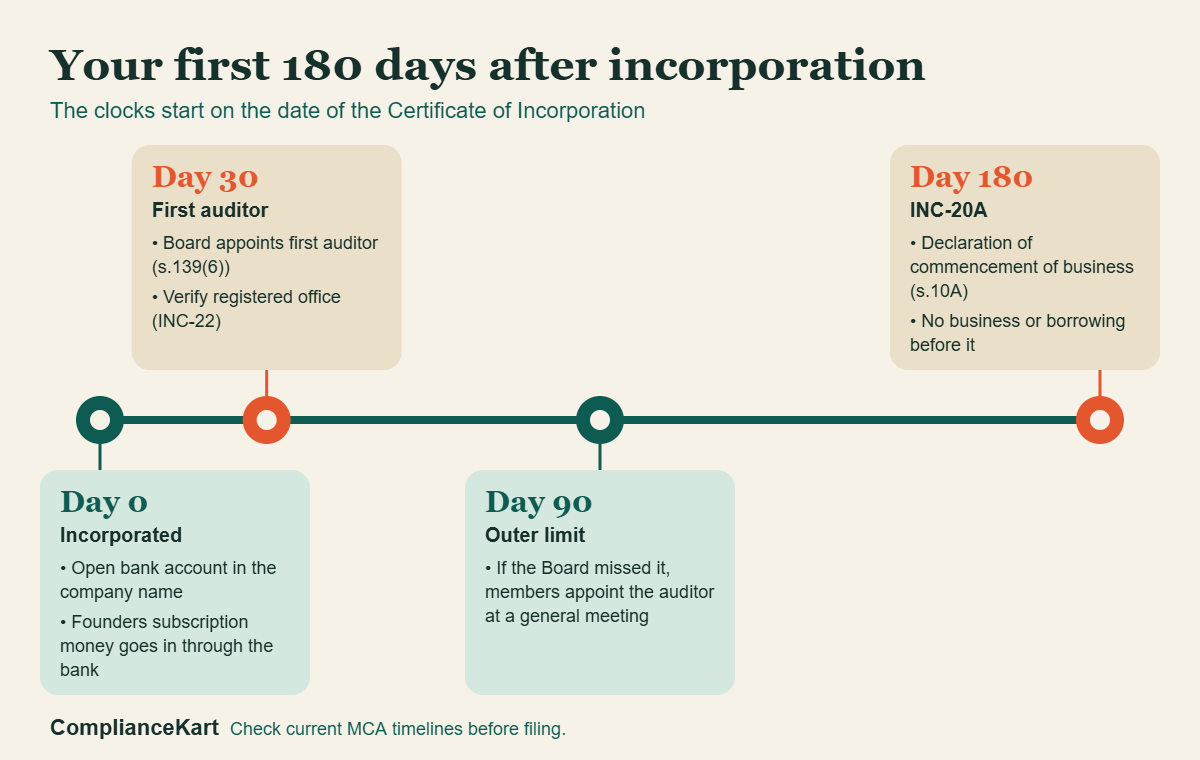
Tip: the Certificate of Incorporation does not mean the company is ready to trade. Sections 10A and 139(6) both run from the incorporation date.
3. Why bookkeeping and transparency matter from day one
Bad books are rarely a dramatic scandal. They are small shortcuts that compound: a personal card used for a vendor, salaries paid in cash, receipts lost in WhatsApp chats. Then comes a fundraise, an audit, a GST notice or a founder exit, and the company has to reconstruct its history.
What the law expects
- Proper books of account. The Companies Act, 2013 requires a company to keep books of account that give a true and fair view of its affairs, on the accrual basis and double-entry system (Section 128 read with Section 2(13)).
- Audit trail in accounting software. For financial years commencing on or after 1 April 2023, a company that uses accounting software to maintain its books must use software that records an audit trail (edit log) of each change, with the trail not capable of being disabled (proviso to Rule 3(1), Companies (Accounts) Rules, 2014). If you rely on spreadsheets alone, review your set-up with your professional adviser.
Practical habits for founders
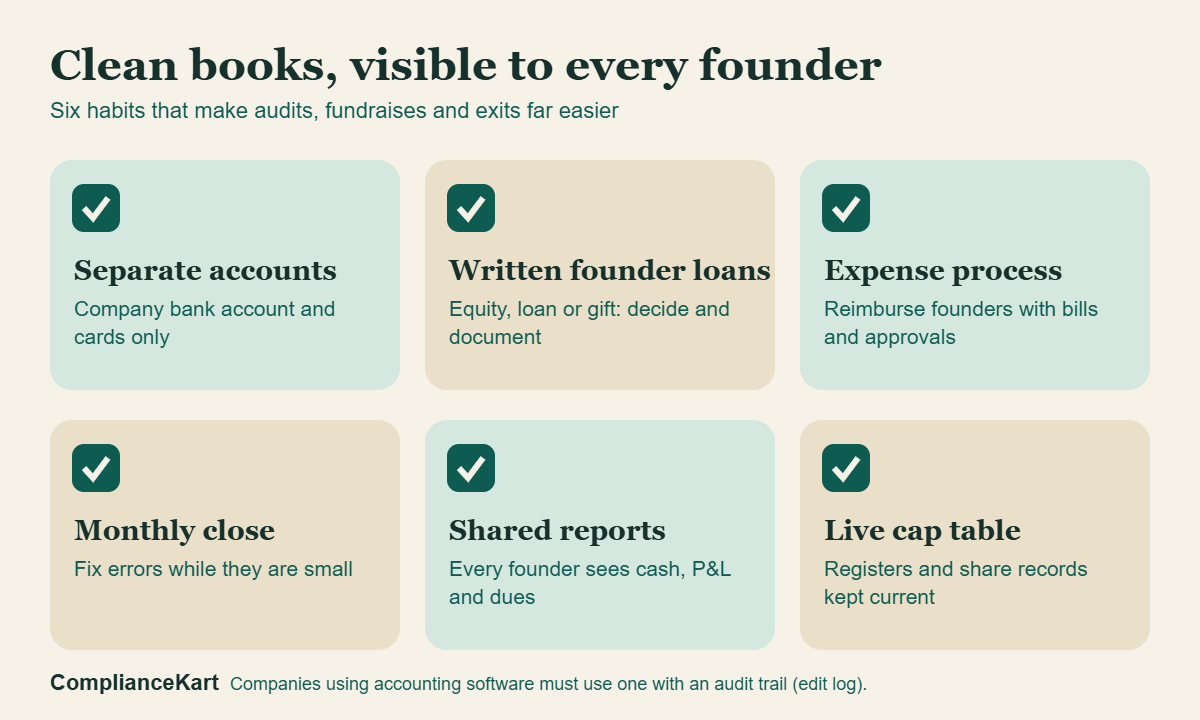
| Habit | Why it matters |
|---|---|
| Separate company bank account and cards | Keeps liability, tax and audit clean |
| Record every founder loan or advance in writing | Prevents later disputes over whether it was equity, loan or gift |
| Reimburse founder expenses through a documented process | Supports deduction claims and audit |
| Monthly bookkeeping close | Catches errors while they are small |
| Shared access to management reports for all founders | Transparency prevents mistrust |
| Keep valuation and fundraising paperwork | Needed for due diligence and for Companies Act and FEMA purposes, even though angel tax under Section 56(2)(viib) has been abolished |
| Maintain a live cap table and statutory registers | Investors ask for these on day one of diligence |
Transparency among co-founders
A simple rule works: every co-founder should be able to see the bank balance, the monthly profit and loss, outstanding statutory dues and a list of signed contracts at any time, without asking. Many founder disputes begin as information gaps, not as disagreements about strategy. A regular review of your startup compliance position keeps everyone looking at the same numbers.
4. Hyderabad context
Founders working from Hitech City, Kondapur, Gachibowli or the Financial District often use co-working spaces or rented offices. If your registered office is a co-working address, hold documents (such as a rent or licence agreement and a utility bill or authorisation, as applicable) that satisfy the registered-office verification requirements, and make sure the address on the incorporation papers matches the one used for GST and bank records. Local pages: Hitech City, Kondapur, Gachibowli.
5. Common mistakes to avoid
- Splitting equity verbally and “documenting it later.”
- Receiving customer payments in a personal account before incorporation.
- Missing the 30-day auditor appointment and the 180-day INC-20A window.
- Not assigning IP from founders to the company.
- Mixing personal and business expenses.
- Treating bookkeeping as a year-end task for the auditor.
Why work with ComplianceKart
ComplianceKart is a boutique practice bringing Chartered Accountants, Company Secretaries and advocates under one roof. Early-stage companies rarely have a single-discipline problem: a founders’ agreement is a legal document, the ROC filings are a corporate-law task, and the books and GST sit with accounting and tax. Think of a multi-speciality hospital, where the physician, the specialist and the diagnostics team work from one patient file instead of the patient carrying reports between clinics. Coordinated support works the same way for a company: the agreement, the filings and the books are prepared with each other in mind.
We do not promise approvals, savings or outcomes. We help you understand what the law requires and set up the process to meet it. Explore our virtual CFO, CS and advocate support or contact us.
Talk to us about company incorporation, founders’ agreement review, post-incorporation filings, GST registration and bookkeeping set-up:
- WhatsApp: Message us
- Email: team@compliancekart.com
- Phone: 9959536391
FAQs
Is a founders’ agreement legally mandatory in India?
No statute requires one. Without it, disputes are decided under the Articles, the Companies Act and general contract law, none of which address vesting, IP assignment or founder exits the way a tailored agreement does.
What is the difference between a founders’ agreement and a shareholders’ agreement?
A founders’ agreement records the arrangement between the founders at the start. A shareholders’ agreement typically comes later, with investors, and covers investor rights, transfer restrictions and reserved matters. Important terms should also be reflected in the Articles of Association.
When must a new company appoint its first auditor?
Under Section 139(6) of the Companies Act, 2013, the Board appoints the first auditor within 30 days of registration. If it does not, the members must appoint one at a general meeting within 90 days.
Can I start business as soon as I receive the Certificate of Incorporation?
For a company with share capital incorporated on or after 2 November 2018, Section 10A requires a declaration of commencement of business (Form INC-20A), filed within 180 days of incorporation, before the company commences business or exercises borrowing powers.
Do I need accounting software with an audit trail?
If a company uses accounting software to maintain its books, the software must record an audit trail for financial years commencing on or after 1 April 2023 (proviso to Rule 3(1), Companies (Accounts) Rules, 2014).
A founders’ agreement, a clean incorporation and honest books are not paperwork for its own sake. They are what lets founders raise money, take a holiday, or part ways without the company breaking. This article is for general information and is not legal advice.
Need this done for your business?
Send us one message. A CA, CS or Advocate replies within a working day — no forms, no obligation.