Commercial Property in Hyderabad: The End-to-End Legal, Tax and Compliance Guide
Buying, building or leasing commercial property in Hyderabad? Title checks, approvals, RERA, GST, stamp duty, TDS and lease risks explained end to end.

Picture this: a software company signs for 40,000 sq ft in the Financial District, pays a three-month deposit and starts fit-outs. Six months later its lender asks for the building’s occupancy certificate. There isn’t one for the top two floors, because they were never in the sanctioned plan. The fit-out money is now sunk into space the company may have to leave.
Commercial property in Hyderabad goes wrong in exactly this way: not through one dramatic fraud, but through a document nobody asked for at the right time. This guide walks through the whole life of a commercial building, from land and title to approvals, RERA, GST, stamp duty, income tax, leases and exit, and points out where the legal risk sits at each stage.
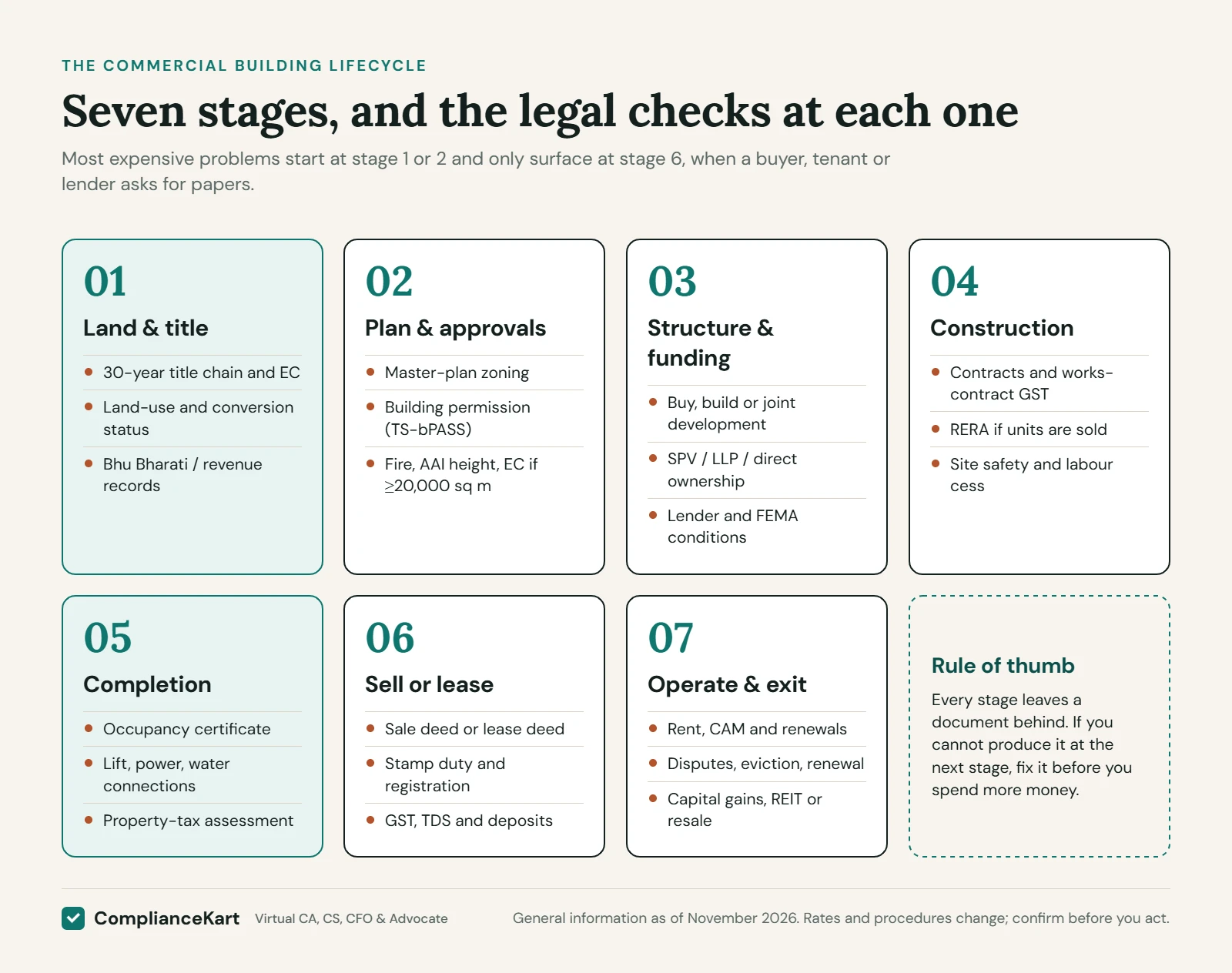
What counts as a commercial building, and why the label matters
A commercial building is one used for business rather than as a home: offices, shops, showrooms, warehouses, hotels, hospitals, co-working centres and mixed-use towers. The label is not cosmetic. It changes:
- Zoning and approvals: the master plan must permit commercial use on that land, and fire and parking norms are stricter.
- GST: renting a “residential dwelling for use as residence” is largely exempt; renting anything else is taxable at 18%.
- Property tax and utilities: commercial tariffs are higher than residential ones.
- Lease law: commercial leases are usually negotiated contracts, with fewer statutory protections for the occupant.
A residential flat used as an office does not become “commercial” for zoning just because a business runs from it. Using residential premises for a business can breach the sanctioned use, and GST, property tax and the society’s bye-laws may all treat it differently.
Three ways to own a commercial building
| Route | How it works | Main legal risk |
|---|---|---|
| Buy a completed building or unit | Sale deed after the occupancy certificate (OC) is issued | Title defects, deviations from the sanctioned plan, existing tenants |
| Buy an under-construction unit | Agreement for sale with a developer; sale deed on completion | Delay, change in plans, developer insolvency; RERA protection applies if the project is registered |
| Build on your own land | You obtain approvals and hire contractors | Approvals, construction cost overruns, GST on construction that cannot be recovered as credit |
| Joint development (JDA) | Landowner contributes land; developer builds and the two share built-up area or revenue | Disputes over share and timelines; GST and capital-gains timing for both parties |
Stage 1: Land and title due diligence
Under the Transfer of Property Act, 1882, a sale of immovable property worth ₹100 or more must be made by a registered instrument. Registration, however, only proves that a document was registered, not that the seller had good title. That is the buyer’s job to check.
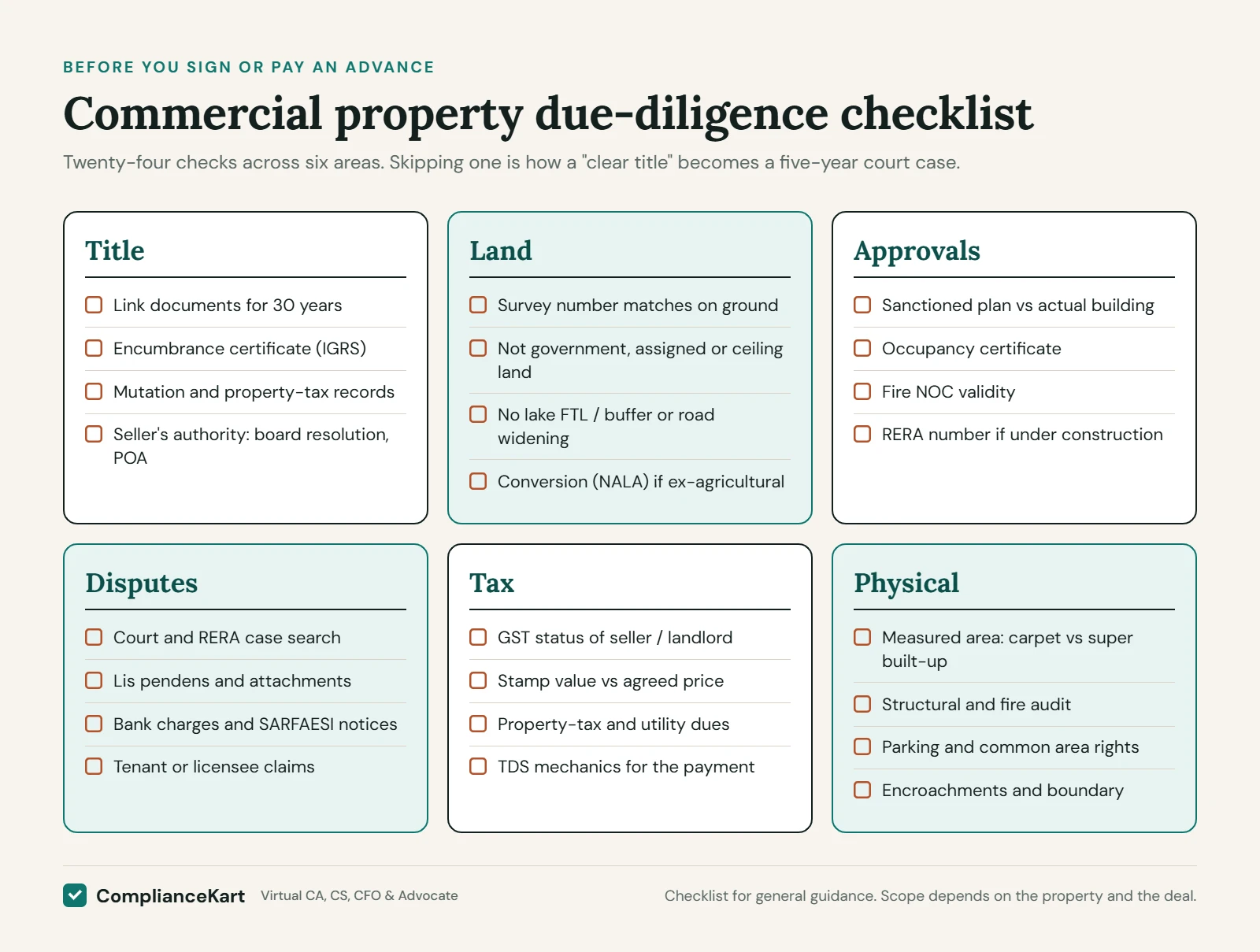
A proper title search for a commercial asset covers:
- The chain of title for at least 30 years: every sale, gift, partition, inheritance and release that links the original owner to today’s seller.
- Encumbrance certificate (EC): from IGRS Telangana for the same period, showing mortgages, agreements and attachments on record.
- Revenue records: the land records on Telangana’s Bhu Bharati portal (which replaced Dharani), and municipal mutation and property-tax records for the building.
- Land character: confirm the survey number is not government, assigned, endowment, Wakf or ceiling-surplus land, and is outside lake full-tank-level (FTL) and buffer zones and road-widening lines.
- Conversion: if the land was agricultural, check that conversion for non-agricultural use (NALA) was obtained.
- Seller’s authority: for a company seller, the board resolution and charge search on the MCA portal; for a power-of-attorney holder, whether the POA is registered, specific and still valid.
- Litigation: searches in civil courts, the High Court, RERA and the debt recovery tribunal. A property sold while a suit about it is pending is taken subject to the outcome of that suit (the doctrine of lis pendens).
Stage 2: Zoning and building approvals in Telangana
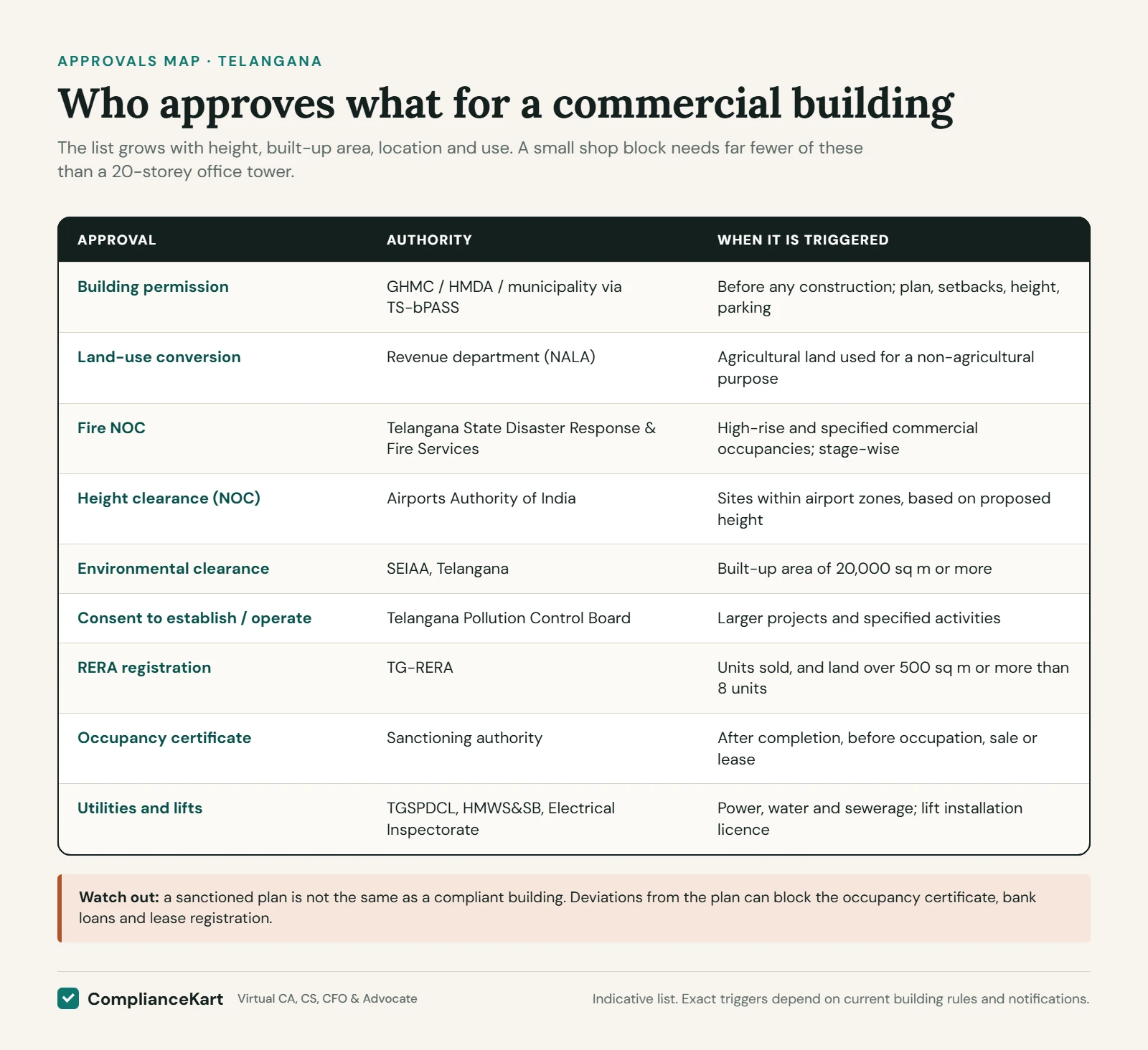
The building must be lawful in two senses: the land use must permit it, and the structure must match what was sanctioned. In the Hyderabad region, building permission is issued by GHMC, HMDA or the local municipality, applied for through the TS-bPASS single-window system. Larger and taller commercial buildings typically also need:
- Fire NOC from the Telangana State Disaster Response & Fire Services Department for high-rise and specified occupancies, issued at the plan stage and again before occupation.
- Height clearance from the Airports Authority of India where the site falls within an airport’s height-restricted zone.
- Environmental clearance from the State Environment Impact Assessment Authority (SEIAA) where the built-up area is 20,000 sq m or more.
- Consent to establish and consent to operate from the Telangana Pollution Control Board, where applicable.
- Occupancy certificate once construction is complete, confirming the building was built as sanctioned.
Why the occupancy certificate matters so much: without it, banks hesitate to lend, lease registration can be questioned, utility connections may be temporary, and insurers may contest claims. Unauthorised floors or setback violations can lead to penalties, sealing or demolition. Regularisation schemes have been offered from time to time, but they are not guaranteed and have been the subject of litigation. Never price a deviation on the assumption that it will be regularised.
Stage 3: Choosing the ownership structure
Who should hold the building is a tax and liability question, not a formality.
- In an individual’s name: simplest, but rent and gains are taxed in that person’s hands, and succession can split ownership.
- Through a company or LLP: separates the asset from personal liability, helps with joint ownership among investors and makes later exit through a share sale possible. Rent may be taxed as business income or as income from house property depending on the facts. If you are setting up a holding vehicle, see our guide to private limited company incorporation.
- NRIs and foreign money: NRIs and OCIs can buy commercial property in India, but payment must come through permitted banking channels, and repatriating sale proceeds has its own limits. Foreign direct investment in construction-development projects and completed assets such as malls and business centres has its own conditions. Read NRI property: buying, renting, selling and repatriation before you commit.
- Exit through REITs: owners of large rent-generating office or retail assets can monetise them through Real Estate Investment Trusts under SEBI’s REIT regulations, including the smaller SM REIT framework for fractional ownership.
Stage 4: Construction and RERA
The Real Estate (Regulation and Development) Act, 2016 (RERA) applies to commercial projects too, not just housing. In Telangana, a promoter selling units must register the project with TG-RERA where the land exceeds 500 sq m or the project has more than eight units across all phases, and cannot advertise or sell before registration. Registration brings:
- A dedicated bank account into which 70% of buyer money must go, to be used only for that project’s land and construction.
- Quarterly progress updates on the TG-RERA website.
- No change to the sanctioned plan without the consent required under the Act.
- A right for the buyer to a refund with interest, or interest for every month of delay, if possession is not handed over as agreed.
If you are a developer, our RERA registration guide for Hyderabad covers the process. If you are a buyer, check the RERA number on the TG-RERA portal before signing anything.
For the person building, construction contracts (works contracts) generally attract GST at 18%. Labour welfare cess and site safety obligations also apply.
GST on commercial property: sale, construction and rent
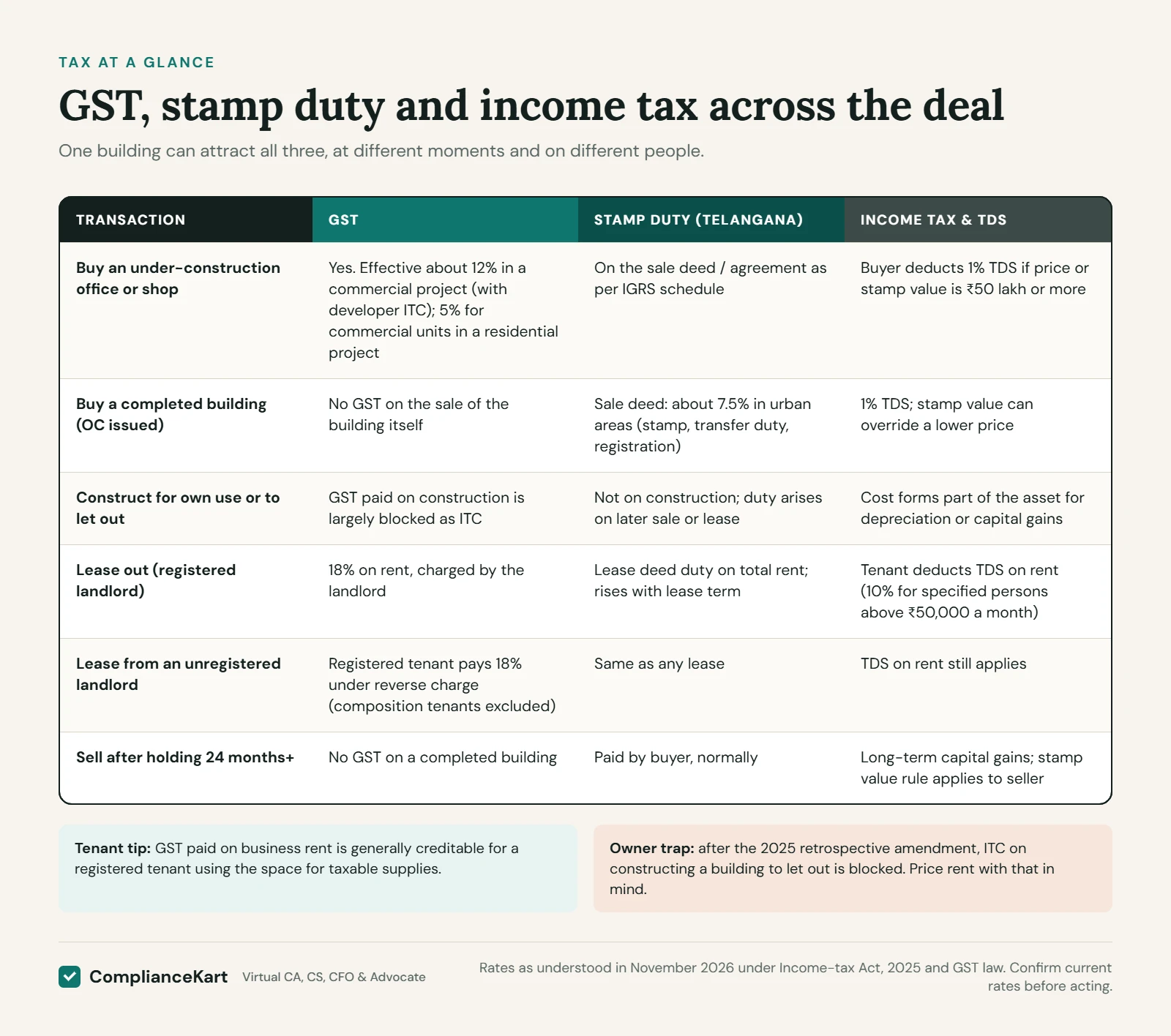
GST is where commercial property differs most from residential. The key positions as of November 2026:
| Transaction | GST position |
|---|---|
| Sale of an under-construction office or shop in a commercial project | Taxable. 18% applies to the agreement value after a deemed one-third deduction for land, which works out to an effective 12%. The developer can claim input tax credit (ITC). |
| Commercial unit in a residential project (commercial area up to 15%) | Effective 5%, without ITC to the developer |
| Sale of a completed building after the OC is issued | Not a supply under GST, so no GST on the building itself |
| Renting by a GST-registered landlord | 18% charged by the landlord |
| Renting by an unregistered landlord to a registered tenant | Tenant pays 18% under reverse charge (since 10 October 2024). Composition taxpayers have been excluded from this since 16 January 2025. |
| Maintenance and common-area charges | Generally taxable at 18% when charged by a registered supplier |
The ITC trap for owners who build to lease. Section 17(5)(c) and (d) of the CGST Act block input tax credit on goods and services used to construct immovable property on your own account, other than plant and machinery. In October 2024, the Supreme Court in Safari Retreats held that a building could qualify as a “plant” on a functionality test, which opened the door to credit for malls and leased buildings. The Finance Act, 2025 then amended clause (d) retrospectively from 1 July 2017, replacing “plant or machinery” with “plant and machinery”, to override that reading. The practical result: budget GST on construction as a cost, not a credit. Challenges to the retrospective amendment may still be argued, but planning on the basis of credit is risky.
For tenants, the picture is better. GST paid on rent for business premises is generally available as credit to a registered tenant making taxable supplies. A landlord whose rental income crosses the GST registration threshold (₹20 lakh a year for services in Telangana) must register and charge GST. For more detail, see our guide to GST on real estate in Hyderabad.
Stamp duty and registration in Telangana
Stamp duty is charged on the higher of the agreed price and the government’s market value for the property.
- Sale deed (urban areas): roughly 7.5% of the value in total, made up of stamp duty, transfer duty and registration fee. Rates for gram panchayat areas differ.
- Lease deeds: duty is charged mainly on the total rent payable over the term (plus any premium), and the rate rises with the length of the lease. Commercial leases attract a higher rate than residential ones.
- Registration is compulsory for leases from year to year or for any term exceeding one year (Registration Act, 1908). An unregistered lease that required registration cannot be relied on in court to prove its terms, except for limited collateral purposes. This is why so many leases are written for 11 months, which works for short occupancy but leaves both sides exposed on a multi-year commitment.
Check the current rates and market value on IGRS Telangana before executing any document. Rates and guideline values are revised from time to time.
Income tax and TDS under the Income-tax Act, 2025
The Income-tax Act, 2025 replaced the 1961 Act from 1 April 2026. The substance of most property rules carried over, but the section numbers changed. The key points:
- TDS on purchase: the buyer deducts 1% from payments to a resident seller where the price or the stamp duty value is ₹50 lakh or more, under section 393(1) [Table Sl. No. 3(i)], formerly section 194-IA. A non-resident seller attracts a different, higher withholding regime.
- TDS on rent: tenants who are “specified persons” (companies, firms and others liable to deduct) deduct 10% on rent for land or buildings above ₹50,000 a month. Individuals and HUFs not liable to tax audit deduct 2% above the same threshold. These sit in section 393(1) [Table Sl. No. 2], replacing sections 194-I and 194-IB.
- Stamp value rule: if the agreed price is lower than the stamp duty value by more than the permitted 10% tolerance, the seller is taxed as if sold at stamp value, and the buyer may be taxed on the difference as income.
- Rental income: where letting is not itself your business, rent is taxed as income from house property, after municipal taxes paid and a standard deduction of 30%. Where the building is let with substantial services, or letting is the business of a company, the income may be business income instead. This is fact-specific and often disputed.
- Capital gains: a building held for more than 24 months gives rise to long-term capital gains, generally taxed at 12.5% without indexation. Reinvestment reliefs, for example in a residential house or specified bonds, are available subject to conditions and caps.
- Cash limits: advances or deposits of ₹20,000 or more in cash for a property transfer are prohibited and attract penalties. Use banking channels for every payment.
Commercial leases: the clauses that decide disputes
Most commercial occupiers in Hyderabad lease rather than buy. The lease is where risk is allocated, so read it as carefully as a sale deed.
- Lease or leave and licence: a lease transfers an interest in the property; a licence only permits use. The label in the document does not decide this; the actual rights do.
- Term and lock-in: who can exit, when, and what it costs. A long lock-in protects the landlord’s fit-out investment; a tenant needs exit triggers such as an OC problem or loss of utilities.
- Rent escalation and CAM: fix the escalation percentage and frequency, and define what common-area maintenance includes and how it is audited.
- Security deposit: amount, refund timeline, interest on delayed refund, and what can be deducted.
- Tax clauses: who bears GST, who deducts TDS and when, and who pays stamp duty and registration.
- Title and approvals warranty: the landlord should confirm the OC, fire NOC and sanctioned use for the leased floors, with an indemnity if the warranty is wrong.
- Fit-outs and reinstatement: who owns improvements, and the condition in which the space must be returned.
- Sub-letting and assignment: essential for co-working operators and group companies.
- Dispute resolution: arbitration seat and rules, and the governing jurisdiction (usually Hyderabad).
Legal issues: where commercial property disputes come from
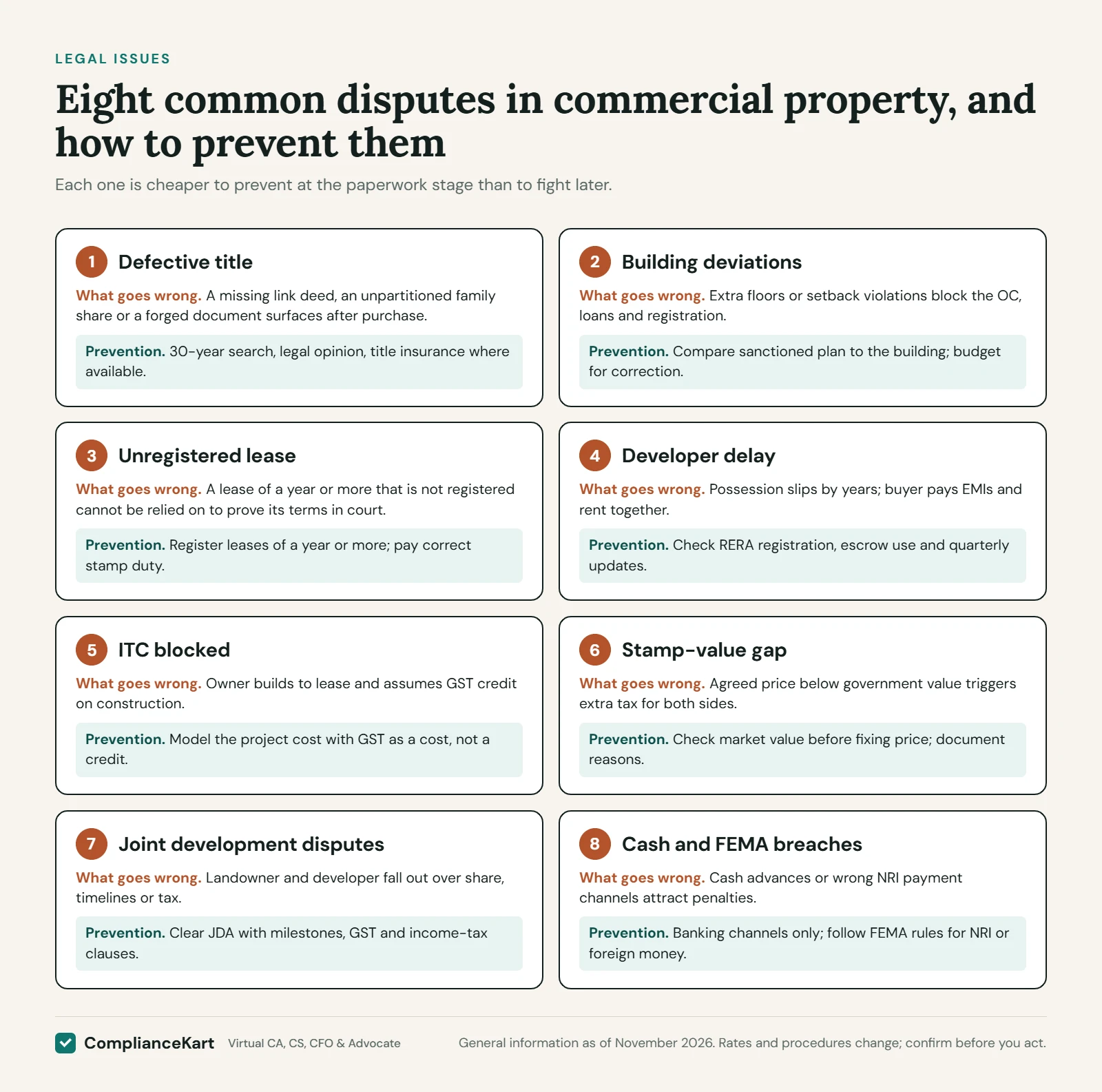
When disputes do arise, the forum depends on who you are and what went wrong:
- Buyer against developer: a complaint before TG-RERA for delay, defects or changes to the plan. Commercial allottees are protected by RERA. Consumer forums may not be available where the unit was bought for a commercial purpose, unless it was for self-employment.
- Title and possession disputes: civil suits for declaration, injunction or specific performance before the civil courts.
- Lease disputes: arbitration if the lease has an arbitration clause; otherwise civil suits for eviction or recovery. Rent control protections apply only within their statutory limits and rarely help high-value commercial tenancies.
- Developer insolvency: allottees are treated as financial creditors under the Insolvency and Bankruptcy Code.
- Tax disputes: GST and income-tax notices on property transactions, for example on reverse charge on rent or ITC claimed on construction, follow the appeal routes under each law. Our GST litigation and appeals page explains the GST route.
Commercial property in Hyderabad: the local picture
Most new office supply sits in the western corridor: HITEC City and Madhapur, Gachibowli, Nanakramguda and the Financial District, with newer land parcels around Kokapet and Neopolis. Each area brings its own checks:
- HMDA auction layouts around Kokapet and Neopolis come with auction conditions on use, payment schedules and construction timelines. Read the auction terms alongside the sale deed.
- Lake and nala protection: the city has taken action against structures in lake FTL and buffer zones. Verify FTL maps for any site near a water body, however old the building.
- Airport height limits apply to parts of the city near Begumpet and on the approach to Rajiv Gandhi International Airport.
- Tenants setting up offices also need their own registrations: shops and establishments registration, a GHMC trade licence and the right GST address. Our business licensing service covers these.
Common mistakes to avoid
- Paying a token advance before seeing the EC, the sanctioned plan and the OC.
- Relying on “super built-up area” without measuring carpet area.
- Signing a multi-year commercial commitment as a chain of unregistered 11-month agreements.
- Assuming GST on constructing a building to lease will be refunded as credit.
- Agreeing a price below the government market value without planning for the income-tax effect.
- Forgetting to deduct TDS on property purchase or rent, which leads to interest, disallowance and notices.
- Accepting a POA-based sale without checking that the POA is registered and specific.
Why work with ComplianceKart
A commercial property deal is rarely just a legal question or just a tax question. The title opinion affects the lender, the lease structure affects GST and TDS, and the ownership vehicle affects income tax and future exit. ComplianceKart is a boutique practice bringing CAs, CSs and advocates under one roof, so these pieces are reviewed together rather than in separate silos.
Think of it like a multi-speciality hospital: one patient file, with the right specialists looking at the same case and talking to each other, instead of you carrying reports from one clinic to another.
We can help with:
- Title and approvals review for commercial property before you buy or lease.
- Drafting and reviewing lease deeds, sale agreements and joint development agreements.
- GST structuring for rent, construction and sale, and replies to GST notices.
- TDS compliance on property purchase and rent under the Income-tax Act, 2025.
- Setting up a company or LLP to hold the property, and FEMA compliance for NRI or foreign investment.
WhatsApp us about your commercial property · Email team@compliancekart.com · Call 99595 36391
FAQs
Is GST payable when I buy a completed commercial building in Hyderabad?
No. Once the occupancy or completion certificate has been issued, the sale of the building is not a supply under GST. You pay stamp duty and registration charges instead. GST applies only where you buy before completion.
Does RERA apply to commercial projects in Telangana?
Yes. RERA covers commercial and residential projects alike. A promoter must register with TG-RERA where the land exceeds 500 sq m or there are more than eight units across all phases, and cannot advertise or sell before registration.
Can I claim GST input tax credit on constructing a building that I will rent out?
Generally no. Section 17(5)(d) of the CGST Act blocks credit on construction of immovable property on your own account. The Finance Act, 2025 amended it retrospectively from 1 July 2017 to override the Supreme Court’s Safari Retreats reading. Plan the project assuming the GST is a cost.
Do I have to pay GST on rent if my landlord is not registered?
If you are a GST-registered tenant (other than a composition taxpayer) renting commercial property from an unregistered landlord, you pay 18% GST under reverse charge. You can usually claim it back as input tax credit if the premises are used for taxable business supplies.
What TDS applies when buying commercial property?
The buyer deducts 1% from payments to a resident seller if the price or stamp duty value is ₹50 lakh or more, under section 393(1) of the Income-tax Act, 2025 (formerly section 194-IA). Higher withholding applies if the seller is a non-resident.
Is an 11-month agreement enough for an office lease?
It avoids compulsory registration, but it gives neither side security for a longer occupancy. For a multi-year commitment with fit-out investment, a registered lease deed with the correct stamp duty protects both landlord and tenant far better.
Related guides
- GST on real estate in Hyderabad
- RERA registration in Hyderabad
- NRI property: buying, renting, selling and repatriation
- FEMA compliance and NRI services
- Business licensing in Hyderabad
The takeaway
A commercial building is only as good as its papers. Check title and approvals first, structure ownership with tax and exit in mind, budget GST on construction as a cost, register long leases, and get TDS right on every payment. Doing this before money changes hands costs a fraction of fixing it afterwards.
This article is general information as of November 2026 and is not legal or tax advice for a specific transaction. Rates, thresholds and procedures change; confirm the current position before acting.
Need this done for your business?
Send us one message. A CA, CS or Advocate replies within a working day — no forms, no obligation.