NRI Taxation and Compliance (Part 10): What the Income-tax Act, 2025 Changes for NRIs
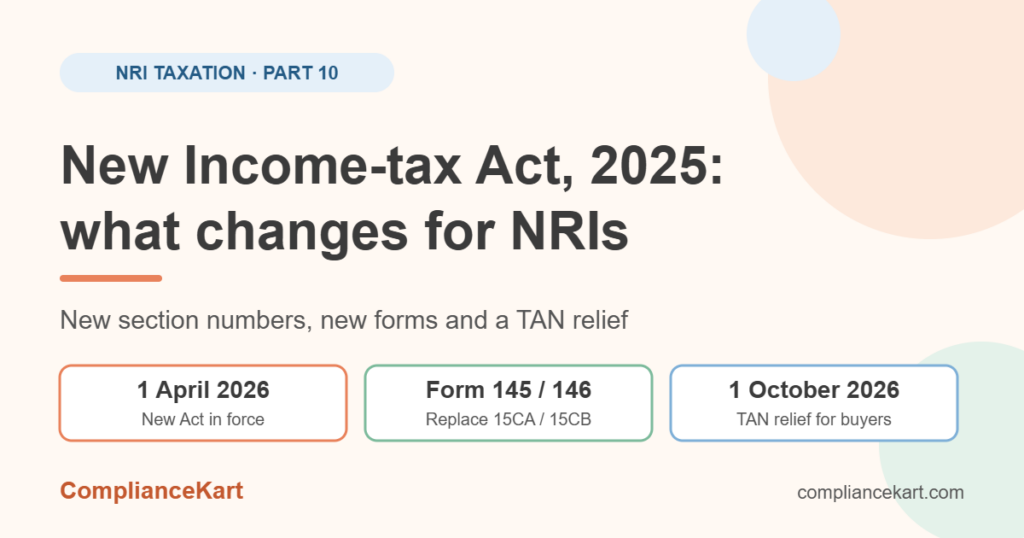
New section and form numbers for NRIs, Forms 145 and 146, treaty Form 41 and no TAN for resident individual buyers from 1 October 2026.
An NRI in Dubai agrees to sell a flat in Kondapur. The buyer, a salaried resident, searches online and finds advice to apply for a TAN, deduct under section 195 and ask for Form 15CB. Much of that advice describes the old law.
- Part 1: Residential status
- Part 2: Income taxation
- Part 3: Property
- Part 4: Banking and investments
- Part 5: Returning to India
- Part 6: Investing in Indian businesses
- Part 7: Gifts, inheritance and succession
- Part 8: TDS and remittance forms
- Part 9: Return filing, refunds and notices
- Part 10: Income-tax Act, 2025 changes (you are here)
- Part 11: Foreign assets scheme (FAST-DS)
- Part 12: Common mistakes by NRIs
Which law applies to your transaction?
| Situation | Law that applies |
|---|---|
| Income of FY 2025-26 (return for AY 2026-27) | Income-tax Act, 1961, even if the return is filed or revised after 1 April 2026 |
| Income from 1 April 2026 (Tax Year 2026-27) | Income-tax Act, 2025 |
| Amount paid or credited on or before 31 March 2026 | TDS under the 1961 Act |
| Remittance made on or after 1 April 2026 | Form 145 and, where needed, Form 146 |
| Proceedings already pending on 1 April 2026 | Continue under the 1961 Act |
“Tax Year” (the 12-month financial year) now replaces the terms “previous year” and “assessment year” for periods under the new Act.
Residential status: the tests continue
| Test | Position under the 2025 Act |
|---|---|
| Basic test (section 6) | 182 days in the tax year; or 60 days in the year plus 365 days in the preceding four years |
| Citizen leaving for employment abroad or as ship crew | Resident only if present for 182 days or more |
| Visiting citizen or person of Indian origin with Indian-source income above ₹15 lakh | 120 days replaces 60 days in the second test; below this level, the 182-day relaxation applies |
| Deemed residency, section 6(7) (earlier 6(1A)) | Indian citizen with income above ₹15 lakh who is not liable to tax elsewhere |
| Not ordinarily resident, section 6(13) (earlier 6(6)) | Criteria unchanged; earlier years count in the look-back |
The ₹15 lakh limit excludes income from foreign sources. Years beginning before 1 April 2026 are still decided under the 1961 Act. For worked examples, read Part 1: Residential status.
Section map for NRIs
| Subject | 1961 Act | 2025 Act |
|---|---|---|
| TDS on sums paid to non-residents | 195 | 393(2) |
| Reporting of remittances | 195(6) | 397(3)(d) |
| Lower or nil TDS certificate | 197 | 395(1) |
| Higher TDS where PAN is not given | 206AA | 397(2) |
| Information for treaty relief | 90(5), 90A(5) | 159(8) |
| Special provisions for NRIs | 115C to 115H | 212 to 217 |
| NRE account interest exemption | 10(4)(ii) | Schedule IV |
The special NRI regime continues, including concessional rates, the reinvestment exemption and the option to continue benefits after becoming resident. Elections and declarations validly made earlier are protected by the transition rules. Check the exact conditions before relying on them.
Form map: old number to new number
| Purpose | Old form | New form |
|---|---|---|
| Application for lower or nil TDS | 13 | 128 |
| Payer application to fix taxable portion | 15E | 129 |
| Remittance information | 15CA | 145 |
| Chartered Accountant certificate for remittance | 15CB | 146 |
| Self-declaration for treaty relief | 10F | 41 |
| Quarterly TDS statement, non-resident payments | 27Q | 144 |
| TDS certificate (non-salary) | 16A | 131 |
| Property TDS certificate | 16B | 132 |
| Annual tax statement | 26AS | 168 |
| Foreign tax credit statement | 67 | 44 |
Buying property from an NRI after 1 October 2026
| Point | Up to 30 September 2026 | From 1 October 2026 (resident individual or HUF buyer) |
|---|---|---|
| TAN | Required | Not required |
| Reporting | TDS payment under TAN and quarterly statement | Form 141, Schedule E, using PAN |
| TDS provision | Section 393(2) from 1 April 2026 | Section 393(2), Table Sl. No. 17 |
Companies, firms and LLPs buying from a non-resident are outside this relief and continue with TAN-based compliance. Schedule B of Form 141 is for resident sellers; using it for an NRI seller is an error. See NRI property sale in Hyderabad: TDS and repatriation.
Sending money abroad: Form 145 and Form 146
| Part of Form 145 | When it is used |
|---|---|
| Part A | Taxable remittances not exceeding ₹5 lakh in the tax year |
| Part B | Above ₹5 lakh, with an Assessing Officer certificate or order under section 395(1) or 395(2) |
| Part C | Above ₹5 lakh, with a Chartered Accountant certificate in Form 146 |
| Part D | Remittance not chargeable to tax |
- File Form 145 before the money leaves India.
- It cannot be edited. It can be withdrawn within 7 days of submission.
- Certain remittances are exempt, such as individual remittances not needing RBI approval and listed purpose codes. Check the list first.
- Failure to furnish it, or wrong information, can attract a penalty of up to ₹1 lakh under section 462.
Treaty relief: TRC plus Form 41
A non-resident claiming relief under a tax treaty needs a Tax Residency Certificate (TRC, issued by the country of residence) and Form 41, filed on the e-filing portal. Check that the TRC covers the relevant Indian tax year. Keep supporting records, because the department may call for them.
Common mistakes
| Mistake | Possible result | Fix |
|---|---|---|
| Quoting old sections or forms for 2026-27 | Rejected or defective compliance | Use the map above |
| Applying the new Act to FY 2025-26 return | Wrong computation | File AY 2026-27 under the 1961 Act |
| Buyer treats NRI seller like a resident | Short deduction, interest and penalty exposure | Confirm status; use section 393(2) |
| Sending money first, Form 145 later | Penalty and bank queries | File before remittance |
| Claiming treaty rate without TRC and Form 41 | Relief may be denied | Collect both early |
NRI owners with property in West Hyderabad
Flats around Kondapur, Gachibowli, Kokapet and the Financial District are often bought with bank loans and paid in instalments. Buyers should agree the TDS rate, the net payment to the seller and the bank disbursement plan before signing. Related reading: Part 8 (written around the earlier section 195 framework; read it with this update).
Why work with ComplianceKart
ComplianceKart is a boutique practice bringing CAs, CSs and advocates under one roof. Think of a multi-speciality hospital: the physician, surgeon and pharmacist read from one patient file, so you never carry reports between buildings. Section mapping, TDS, FEMA repatriation and the return are checked together.
Send a WhatsApp message. Please do not send PAN, Aadhaar or bank details in the first message.
Frequently Asked Questions
Has the NRI definition changed from April 2026?
The basic day-count tests continue under section 6 of the 2025 Act. Several sub-section numbers have changed.
Does a buyer still need a TAN to buy from an NRI?
A resident individual or HUF does not, from 1 October 2026. Companies, firms and LLPs still follow TAN-based compliance.
Are Forms 15CA and 15CB still used?
Not for remittances on or after 1 April 2026. Use Forms 145 and 146.
Is Form 146 needed for every remittance?
No. It is needed for Part C: taxable remittances above ₹5 lakh in the tax year where no Assessing Officer certificate is obtained.
Is my old lower deduction certificate valid?
A section 197 certificate remains valid if it covers Tax Year 2026-27 receipts.
Sources
- Income Tax Department: FAQs on transition to the Income-tax Act, 2025
- Income Tax Department: FAQs on tax deducted at source
- Income Tax Department: forms under the Income-tax Rules, 2026
- FAQs on Form 145
- FAQs on Form 41
- CBDT Notification No. 121/2026 dated 22 September 2026
- e-Filing portal: FAQs on Form 141
Law checked as on 25 November 2026. General information only, not advice on any specific case. Examples are illustrative. Please verify the latest notifications before acting.
Need this done for your business?
Send us one message. A CA, CS or Advocate replies within a working day — no forms, no obligation.