NRI Taxation and Compliance (Part 11): FAST-DS 2026 Foreign Assets Disclosure Scheme
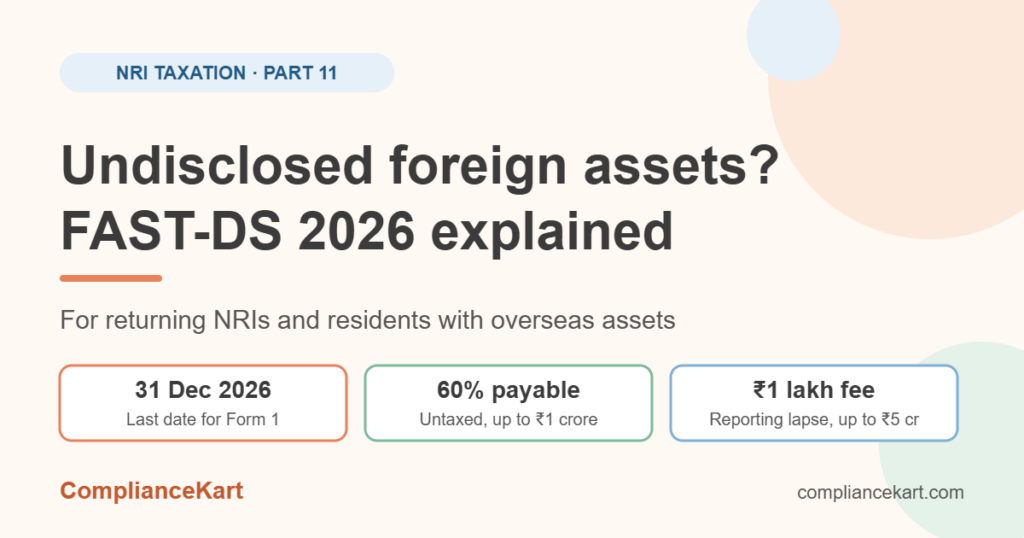
FAST-DS 2026 for returning NRIs and residents: who can declare, 60% or ₹1 lakh payable, valuation, timelines and the 31 December 2026 last date.
A software engineer moves back from the United States to Gachibowli. A brokerage account, a few vested company shares and an old bank account stayed overseas. None of them appeared in the foreign assets schedule (Schedule FA) of her Indian returns.
- Part 1: Residential status
- Part 2: Income taxation
- Part 3: Property
- Part 4: Banking and investments
- Part 5: Returning to India
- Part 6: Investing in Indian businesses
- Part 7: Gifts, inheritance and succession
- Part 8: TDS and remittance forms
- Part 9: Return filing, refunds and notices
- Part 10: Income-tax Act, 2025 changes
- Part 11: Foreign assets scheme (FAST-DS) (you are here)
- Part 12: Common mistakes by NRIs
Why this matters
Under the Black Money (Undisclosed Foreign Income and Assets) and Imposition of Tax Act, 2015, a resident who is ordinarily resident must report foreign assets and income in the return. Failure can attract a ₹10 lakh penalty under section 42 or 43, apart from tax, other penalty and prosecution provisions.
Who can declare
- A person resident in India for the relevant year.
- A person now non-resident or not ordinarily resident, who was resident in the year the foreign income arose or the asset was acquired.
- Cases where no return was filed, the asset or income was left out, or income escaped assessment.
Not covered: proceeds of crime where proceedings are initiated or pending under the Prevention of Money Laundering Act, 2002, and assessment years where Black Money Act assessment is already complete. Check section 140 of the Finance Act, 2026 for the full exclusions.
Two categories
| Point | Category 1: not taxed | Category 2: reporting lapse |
|---|---|---|
| What it covers | Undisclosed foreign asset, or foreign income not offered to tax | Asset bought from income earned while non-resident, or from income already taxed in India, but not reported |
| Value limit | Asset value plus income: up to ₹1 crore | Assets: up to ₹5 crore |
| Amount payable | 30% tax plus an equal additional amount (60%) | Flat fee of ₹1 lakh |
An asset bought partly from undisclosed income falls in Category 1. One Form 1 can cover both categories. An asset on which a section 42 or 43 penalty is already levied cannot be declared under Category 2.
Valuation: fixed as on 31 March 2026
| Asset | Broad method |
|---|---|
| Bank account | Total deposits from opening to 31 March 2026, excluding deposits funded by withdrawals from the same account |
| Quoted shares | Higher of cost and the average of the day’s lowest and highest price |
| Immovable property | Higher of cost and open market price, supported by a valuation report |
| Unquoted equity shares | Higher of cost and the prescribed book-value formula |
Values are reported in rupees using the prescribed exchange-rate method. For assets other than bank accounts, a later valuation difference of up to 20% does not by itself make the declaration invalid. This margin does not apply to bank accounts.
Process and timelines
| Example date | Event |
|---|---|
| December 2026 | Form 1 filed |
| By 31 January 2027 | Form 2 expected |
| If Form 2 is received in January 2027: by 31 March 2027 | Pay without interest |
| By 31 May 2027 | Last extended date, with simple interest of 1% for each month or part |
Worked examples
| Facts | Law applied | Answer |
|---|---|---|
| Foreign bank account valued at ₹60 lakh and untaxed foreign income of ₹20 lakh | Total ₹80 lakh is within ₹1 crore: Category 1 | ₹36 lakh on the account and ₹12 lakh on the income: ₹48 lakh |
| Shares worth ₹35 lakh bought from salary already taxed in India, missing from Schedule FA | Category 2, within ₹5 crore | Fee of ₹1 lakh |
| Assets worth ₹6.5 crore bought while non-resident, never reported | Above the Category 2 limit | Not eligible; review other correction and defence options |
| Only a foreign bank account and shares, total ₹15 lakh, bought from taxed money, all income taxed | Within the ₹20 lakh relief for non-immovable assets | Sections 42 and 43 penalty does not apply; report correctly going forward |
Returning NRIs and employees with overseas shares
- Build a year-wise residential status table first. See Part 1 and Part 5: Returning to India.
- Money saved abroad while non-resident is not taxed merely because you returned. Income and assets of your resident years need separate review.
- For employee shares (ESOPs, RSUs), trace the grant, vesting date, residential status and tax already paid. Do not assume the category.
- The scheme and your ordinary return are separate. A belated return for AY 2026-27 has its own last date of 31 December 2026.
Technology employees around Hitech City, Kondapur and the Financial District who have worked abroad should list every overseas account, holding and retirement plan before choosing a route.
Documents to collect now
- Passport entries and day count for each year
- Account statements from the date of opening
- Share grant, vesting, purchase and sale records
- Foreign tax returns and salary records
- Indian returns, with Schedule FA and foreign income schedules
- Valuation reports for property or unquoted shares
Common mistakes
| Mistake | Fix |
|---|---|
| Waiting for a notice before reviewing | Complete the asset list in early December |
| Treating every lapse as a ₹1 lakh case | Trace the source of each asset |
| Valuing a bank account at its closing balance | Apply the deposit-based rule |
| Ignoring joint accounts | Each holder checks and reports their share |
| Filing Form 1 and missing payment | Arrange funds before filing |
Why work with ComplianceKart
ComplianceKart is a boutique practice bringing CAs, CSs and advocates under one roof. Think of a multi-speciality hospital: the physician, surgeon and pharmacist read from one patient file, so you never carry reports between buildings. Residential status, source of funds, valuation and return disclosures are reviewed together.
Send a WhatsApp message. Please do not send PAN, Aadhaar or bank details in the first message.
Frequently Asked Questions
What is the last date for FAST-DS 2026?
Form 1 must be filed on or before 31 December 2026.
Can a person who is now an NRI declare?
Yes, if resident in India in the year the income arose or the asset was acquired, subject to other conditions.
Is the ₹1 lakh fee available for all foreign assets?
No. It applies to specified reporting lapses where the aggregate value is up to ₹5 crore.
Do small foreign assets need declaration?
Non-immovable assets up to ₹20 lakh in aggregate are outside section 42 and 43 penalty. Untaxed income needs separate review.
Does the scheme give full immunity from everything?
No. Immunity is under the Black Money Act and only for the income or asset validly declared and paid for.
Sources
- CBDT Notification No. 114/2026: FAST-DS Rules, 2026
- Income Tax Department: FAQs on FAST-DS
- Supplementary FAQs on FAST-DS
- Black Money Act: section 42
- Black Money Act: section 49
- FAQs on transition to the Income-tax Act, 2025
Law checked as on 25 November 2026. General information only, not advice on any specific case. Examples are illustrative. Please verify the latest notifications before acting.
Need this done for your business?
Send us one message. A CA, CS or Advocate replies within a working day — no forms, no obligation.