GST Refund for Excess or Wrong Payment: Cash Ledger, Section 77 & Pre-Deposit (57th Council Update)
GST refund for excess payment, cash ledger balance, wrong-head tax (Section 77) and appeal pre-deposit with interest. Includes 57th GST Council recommendations.
A Gachibowli startup deposits ₹3 lakh in the cash ledger ahead of a quarter-end, then finds a larger credit balance than it expected and no liability to set the cash against. Another business charged CGST and SGST on a sale that turns out to be inter-State. A third customer cancels a large order after paying an advance, and the invoice is never raised. These are not export or inverted-duty problems. They are payment-error refunds, and they follow different rules.
Where did the money go?
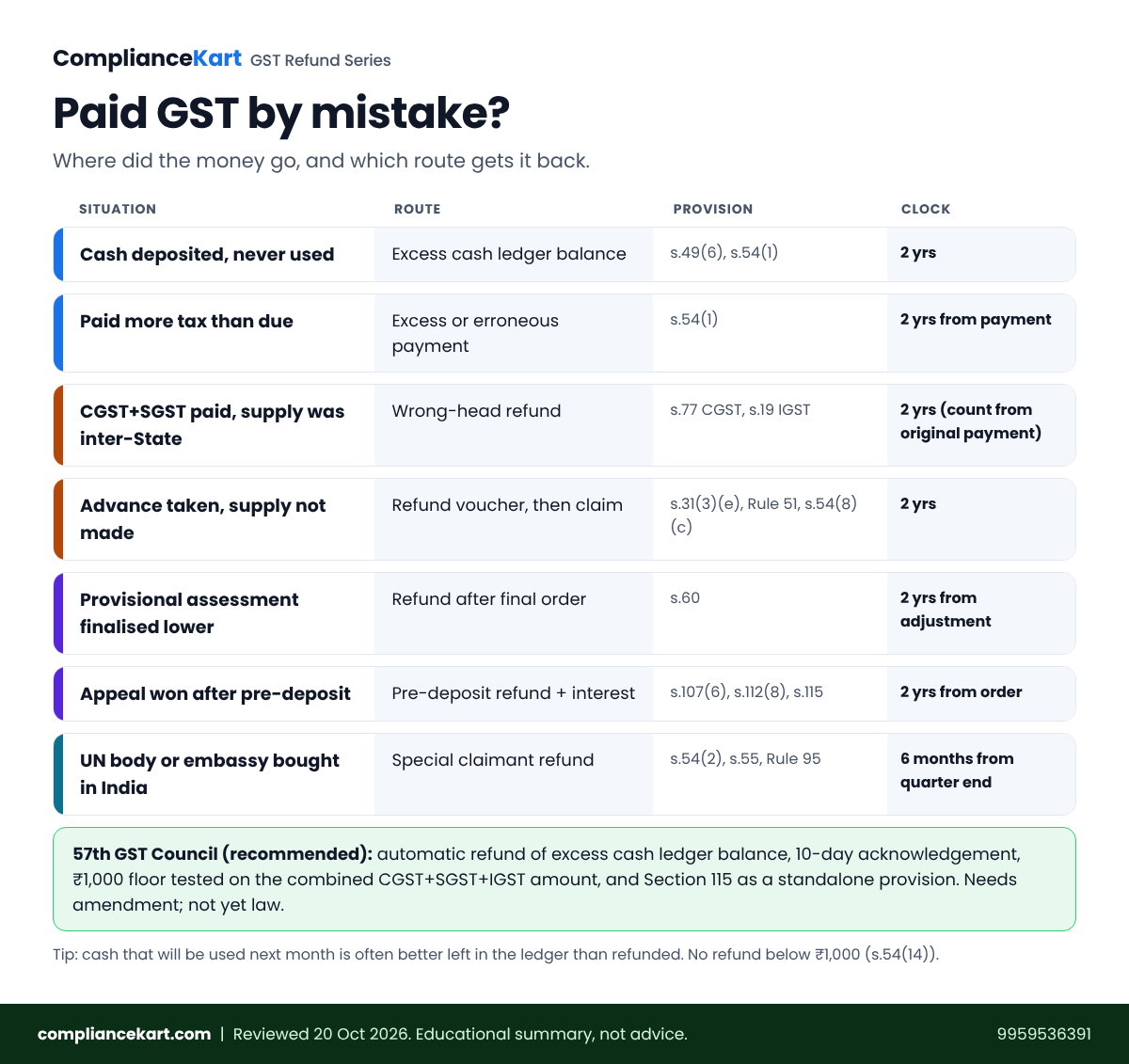
| Situation | Route | Key provisions | Evidence that matters |
|---|---|---|---|
| Cash deposited but never used | Excess balance in electronic cash ledger | s.49(6); s.54(1) | Cash ledger statement; proof it is not needed for dues; returns filed |
| Paid more tax than the liability | Excess or erroneous payment | s.54(1); Expl. (2)(h) | Working showing the correct liability; GSTR-3B; challan |
| CGST+SGST paid, supply later held inter-State (or the reverse) | Wrong-head refund | s.77 CGST; s.19 IGST | Documents showing the character of the supply; proof of payment of the correct tax |
| Advance received, supply not made | Refund voucher route | s.31(3)(e); Rule 51; s.54(8)(c) | Advance receipt and refund voucher; proof the advance was refunded |
| Tax paid provisionally, later finalised at a lower amount | Refund after provisional assessment | s.60; Expl. (2)(f) | Final assessment order; adjustment |
| Appeal won after pre-deposit | Refund of pre-deposit with interest | s.107(6); s.112(8); s.115 | Appellate order; payment challan |
Excess cash ledger balance
Section 49(6) lets a registered person claim any balance in the electronic cash ledger, after meeting liabilities, as a refund under Section 54. The Act’s own text contemplates this being claimed through the return filed under Section 39 verify, but the portal has in practice used RFD-01. Before you claim, ask whether the balance will be needed next month. Cash that will be used within a period is better left in the ledger than refunded, because a refund claim invites scrutiny. No refund is paid below ₹1,000 under Section 54(14).
Wrong head, wrong tax, cancelled advances
CGST+SGST paid instead of IGST (or the reverse)
Section 77 allows a refund of the tax paid under the wrong head, and provides that interest is not payable on the correct IGST later paid. The ledger sequence matters: the correct head must be paid, and the refund then claimed of the wrongly paid tax. Because the date from which the two years run is not free of doubt, count conservatively from the original payment verify.
Advance received but supply not made
Where an advance is received and the supply is not made, a refund voucher under Section 31(3)(e) and Rule 51 is issued to the customer. The tax you paid on that advance is then claimed under Section 54(8)(c). Skipping the voucher is the most common reason such claims fail.
Unjust enrichment
Refunds of tax the applicant has passed on to a customer go to the Consumer Welfare Fund under Section 57, unless the case falls in the exceptions in Section 54(8). Cases covered by Section 54(8) include unutilised-ITC refunds for zero-rated supplies and inverted duty, tax on supplies not provided, refunds under Section 77, and tax or interest the applicant did not pass on. Claims over ₹2 lakh need a certificate from a Chartered Accountant or Cost Accountant (Rule 89(2)); below that, a declaration is enough verify.
Pre-deposit refunds
To appeal, a taxpayer pays the admitted amount plus a percentage of the disputed tax: 10% before the first appellate authority (Section 107(6)) and 20% before the Appellate Tribunal (Section 112(8)), each with statutory caps. If the appeal succeeds, the pre-deposit is refundable. Section 115 provides interest on it, at the rate notified verify, from the date of payment to the date of refund. A refund application must be filed, again within two years from the date the order is communicated (Expl. (2)(d)). Our guide on first appeal vs GSTAT appeal and the note on GSTAT filing deadlines explain the stages.
Provisional assessment and special claimants
Provisional assessment (Section 60). Where tax was paid on a provisional basis and the final assessment results in a lower liability, the excess is refundable. The two-year period runs from the date of adjustment of tax after the final assessment (Explanation (2)(f)).
Special claimants (Sections 54(2) and 55). United Nations bodies, notified multilateral financial institutions, consulates and embassies can claim tax on inward supplies within six months from the end of the quarter of receipt, on the prescribed form. Casual and non-resident taxable persons cannot recover the advance deposited under Section 27(2) until all returns for the registration period are filed (Section 54(13)).
What the 57th GST Council recommended for these refunds
- Excess cash ledger balance: Phase 1 of automation to sanction the full refund without officer intervention.
- Acknowledgement or deficiency memo within 10 days instead of 15, with deemed acknowledgement if neither is issued.
- Section 54(14): the ₹1,000 threshold to apply to the combined CGST, SGST/UTGST and IGST amount.
- Section 115: to become a standalone provision on the interest for refund of pre-deposit, with a clarifying circular.
If these are legislated, small cash-ledger refunds will get faster, and the ₹1,000 floor will be tested on the total, not each head. Until the amendment and rules arrive, file under the existing process and keep a note of the claim date, so interest under Section 56 can be computed if processing runs beyond 60 days. Our note on the 57th Council refund recommendations records what has been notified.
Five mistakes that cost startups money
- Refunding cash that will be needed next month. Weigh refund against set-off.
- Paying the correct head before the wrong one is reversed. Document the sequence in a note on file.
- No refund voucher on cancelled orders. The customer’s advance and your tax claim both need it.
- Missing the two-year clock. Diarise the relevant date for each claim on the day the error is found.
- Treating an ITC balance as cash. Only Section 54(3) credit is refundable (Part 2 and Part 3).
Hyderabad context
Startups in Kondapur, Hitech City, Gachibowli and Kothaguda often make these errors in their first year of GST filing: wrong-head payments on inter-State SaaS or hardware sales, and cash deposits made to be on the safe side at quarter-end. Embassy or UN-body supplies in Hyderabad are infrequent but sit in a separate procedure.
Why work with ComplianceKart
A refund of a mistaken payment is often a small amount with a documentation burden out of proportion to it. ComplianceKart is a boutique practice with CAs, CSs and advocates under one roof, like a multi-speciality hospital where the doctor who reads the scan and the one who treats you sit in the same building. We reconstruct the error from your ledgers and returns, decide whether a refund or an adjustment is the better course, and take rejections forward in appeal. We make no promise on the outcome or its timing.
Frequently asked questions
Can I get a refund of the balance in my electronic cash ledger?
Yes, under Section 49(6) read with Section 54(1), subject to the ₹1,000 minimum in Section 54(14). The 57th GST Council has recommended automatic sanction of the full excess cash ledger balance as Phase 1 of automation, which still needs amendment.
I paid CGST and SGST but the supply was inter-State. How do I get the money back?
Pay the correct IGST and claim a refund of the wrongly paid CGST and SGST under Section 77 of the CGST Act and Section 19 of the IGST Act. Interest is not payable on the IGST so paid, as Section 77 provides.
What happens to an advance if the order is cancelled?
Issue a refund voucher to the customer under Section 31(3)(e) and Rule 51, return the advance, and claim the tax paid on that advance under Section 54(8)(c) within two years.
Is interest payable on refund of the appeal pre-deposit?
Yes. Section 115 provides interest on the refund of pre-deposit from the date of payment to the date of refund. The 57th GST Council has recommended making Section 115 a standalone provision with a clarifying circular; check the notified rate before computing.
Is a CA certificate needed for these refunds?
For claims above ₹2 lakh where unjust enrichment is in question, Rule 89(2) requires a certificate from a Chartered Accountant or Cost Accountant; below that, a declaration is enough. Claims within the exceptions in Section 54(8) are treated differently.
What is the time limit for these refunds?
Two years from the relevant date in Explanation (2) to Section 54. For tax paid in error it is the date of payment; for appellate orders, the date of communication; for provisional assessments, the date of adjustment.
Paid GST by mistake?
Tell us what was paid, under which head and when. We will check the route, the time limit and the evidence needed.
WhatsApp usEmailCall 9959536391GST registration & filingContinue the series
Disclaimer. This article is for general information on Indian GST law as at 20 October 2026 and is not advice on any specific case. Refund eligibility depends on facts, period and documents. Items marked verify should be checked against the current official text before reliance. Contact: team@compliancekart.com · 9959536391 · compliancekart.com.
Need this done for your business?
Send us one message. A CA, CS or Advocate replies within a working day — no forms, no obligation.