Subsidiary of a Foreign Company in Hyderabad: From Parent Board Resolution to FC-GPR
How a foreign company sets up a wholly owned subsidiary in Hyderabad: FDI route, directors, SPICe+, FC-GPR, FLA and transfer pricing.
A Singapore software firm has won its first Indian enterprise client and wants a delivery team in Gachibowli within a quarter. Its board asks three things: can we own 100%, which entity do we pick, and what reporting begins the day money lands?
Which entity should a foreign company use in Hyderabad?
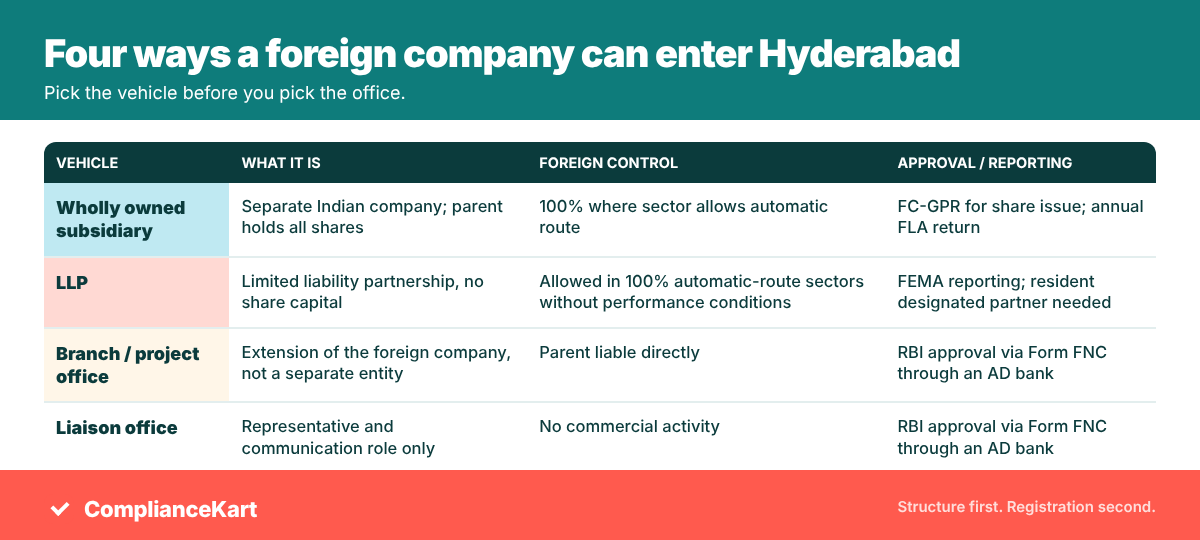
A wholly owned subsidiary (WOS) is a separate Indian company in which the foreign parent holds all the shares (a company is a subsidiary where another company controls its board or holds more than half its voting power, section 2(87), Companies Act, 2013). It gives limited liability, clean contracts and an Indian tax identity. A branch, project or liaison office needs prior RBI approval through an authorised dealer bank on Form FNC, and the parent remains directly liable for a branch or project office.
Is 100% foreign ownership allowed? Check the FDI route first
Foreign direct investment (FDI) enters India under the automatic route in most sectors, with no prior government approval, or the government route in sectors with caps or conditions. A WOS is only possible without approval where the sector allows 100% FDI under the automatic route. Check three things before signing anything:
- Sector list: check your activity against the current FDI policy (software and IT services are generally open; some sectors are capped or prohibited).
- Land-border countries: Press Note 3 (2020) requires government approval where the investor, or its beneficial owner, is from a country sharing a land border with India.
- Conditions: some sectors carry minimum capitalisation, local-sourcing or licensing conditions.
Requirements for a subsidiary of a foreign company in Hyderabad
- Two shareholders and two directors. A WOS is usually the parent plus a nominee who holds one share on the parent’s behalf.
- One resident director. At least one director must stay in India for 182 days or more in the financial year (section 149(3)). Foreign nationals may be the other directors.
- Registered office in Telangana, with proof of ownership or lease, owner’s no-objection letter and a utility bill. Hitech City, Gachibowli, Madhapur and the Financial District are common choices, and virtual or co-working addresses need ownership and lease documents like any other.
- Authenticated parent documents: certificate of incorporation, charter documents, board resolution authorising the investment and signatories, and ownership details of ultimate beneficial owners. These typically need notarisation plus apostille or consular attestation, depending on the parent’s country.
- DSC and DIN for each director, and demat of subscriber shares for companies incorporated from 1 July 2025.
Step-by-step: incorporating the Indian subsidiary
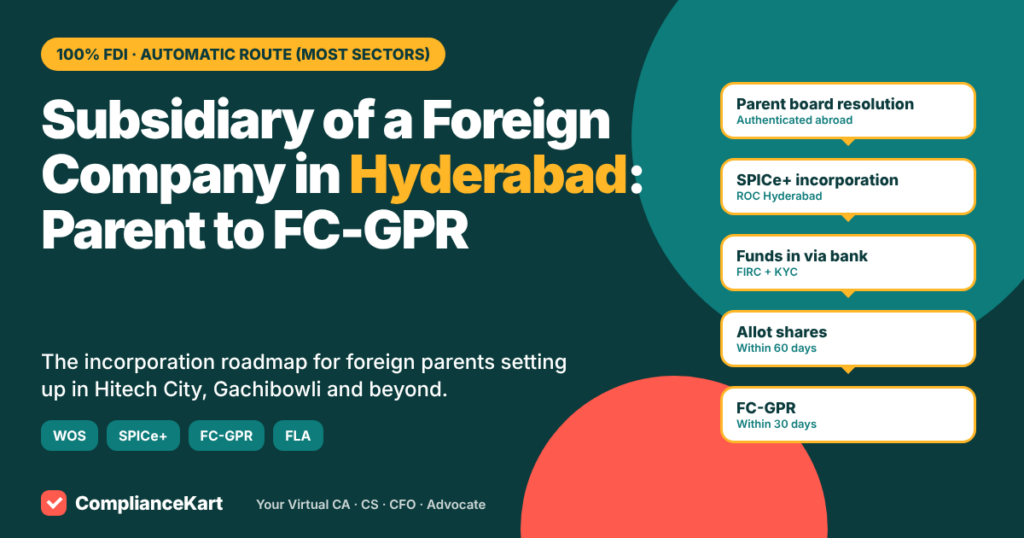
- Parent board resolution approving the subsidiary, the nominee and the authorised signatory.
- Authenticate documents abroad and obtain DSC and DIN for directors.
- Name approval and SPICe+ filing with e-MoA and e-AoA, with PAN, TAN and other registrations through AGILE-PRO.
- Registrar review: the ROC for Telangana may raise queries, and the filing allows a limited number of resubmissions, each within 15 days.
- Corporate bank account. Banks usually run enhanced KYC on the foreign parent and its ultimate beneficial owners, and this often takes longer than incorporation itself.
- Remit capital through banking channels; the bank issues the Foreign Inward Remittance Certificate (FIRC).
- Allot shares within 60 days of receiving the money, or the funds must be refunded.
- File FC-GPR on the RBI’s FIRMS portal within 30 days of allotment (not from the date of receipt).
Plan for incorporation in about 2 to 3 weeks and a working bank account plus completed FC-GPR in roughly 6 to 10 weeks in total, depending on the parent’s KYC.
Funding the subsidiary: pricing and FEMA rules
Shares subscribed to the Memorandum on incorporation by a non-resident are issued at face value. Later issues must follow the RBI’s pricing guidelines, which require the price to be no lower than a fair value determined by a valuer, so budget for a valuation certificate before any follow-on allotment. Intra-group loans have separate External Commercial Borrowing (ECB) rules, so do not fund the subsidiary through informal advances.
Post-incorporation compliance for a foreign-owned subsidiary
| When | Compliance |
|---|---|
| Within 30 days of incorporation | INC-22 (registered-office verification), first auditor appointment, first board meeting |
| Within 30 days of allotment | Form FC-GPR on FIRMS |
| Within 180 days | INC-20A (declaration of commencement of business) |
| Every year | Annual Foreign Liabilities and Assets (FLA) return to the RBI (due by 15 July each year), AOC-4, MGT-7, DIR-3 KYC, income tax return |
| From the first related-party transaction | Transfer pricing documentation and an accountant’s report (Form 3CEB) for international transactions |
Transfer pricing needs particular attention: payments to the parent for services, royalties or cost-sharing must be at arm’s length from year one. For more on avoidable defaults see our guide to common private limited company non-compliances and our FEMA explainer on the Export Declaration Form for export-focused subsidiaries.
Planning an Indian subsidiary?
Tell us the parent’s country, sector and expected capital. A CA, CS or advocate replies within a working day.
Ask on WhatsAppCall 9959536391Email usWhy set up in Hyderabad: Hitech City, Financial District and Kokapet
Foreign parents usually choose Hyderabad for technology talent and established business districts. Teams often settle in Hitech City, Gachibowli, Kondapur, Madhapur, Nanakramguda and the Financial District, with newer campuses around Kokapet and Neopolis. These are contextual locations, not market statistics. Whichever you choose, the registered office must be a genuine address in Telangana with valid documents, and local registrations such as GST and Shop and Establishment follow the premises. Our private limited company incorporation service covers the base entity. For overseas Indians planning their own company, see NRI company registration in Hyderabad.
Common mistakes foreign parents make
- Assuming the automatic route applies without checking the sector and Press Note 3.
- Appointing no genuinely resident director.
- Remitting money before the bank and FEMA paperwork is ready, then missing the 60-day allotment window.
- Counting the FC-GPR 30 days from receipt of funds instead of allotment.
- Skipping a valuation before a follow-on share issue.
- Paying the parent management fees without a transfer-pricing file.
Why work with ComplianceKart
ComplianceKart is a boutique practice bringing CAs, CSs and advocates under one roof. Like a multi-speciality hospital, one coordinated team looks at the same file: the CS runs ROC filings and board papers, the CA handles FDI reporting, FLA and transfer pricing, and the advocate reviews the shareholder, services and intercompany agreements. We work online with parents in other time zones and give one checklist for the whole journey, but we do not guarantee approvals, bank decisions or regulator outcomes.
Foreign subsidiary in Hyderabad: frequently asked questions
Can a foreign company own 100% of an Indian subsidiary?
Yes, in sectors where 100% FDI is permitted under the automatic route. In sectors with caps, conditions or prohibitions, the permitted level or the approval route depends on the FDI policy, and Press Note 3 adds an approval requirement for certain land-border countries.
How many directors does a wholly owned subsidiary need?
At least two for a private company, with at least one director who is resident in India (182 days or more in the financial year). The other directors can be foreign nationals.
What is Form FC-GPR and when is it due?
It reports the issue of shares to a non-resident investor on the RBI’s FIRMS portal, within 30 days of allotment.
How long does it take to set up a subsidiary in Hyderabad?
Incorporation alone often takes about two to three weeks once documents are authenticated, and a working bank account with the first FC-GPR can take about six to ten weeks overall.
Branch office or wholly owned subsidiary: which is better?
A subsidiary is a separate entity with limited liability and no RBI Form FNC approval. A branch needs prior RBI approval and keeps the parent directly liable, so it suits only specific activities.
Bottom line
Choose the vehicle, verify the FDI route, authenticate documents and calendar FC-GPR, FLA and transfer-pricing deadlines before the first rupee moves. This article is general information and not advice on your facts.
Sources: Ministry of Corporate Affairs · Reserve Bank of India (FEMA, FIRMS) · DPIIT, FDI policy and Press Note 3 (2020) · ComplianceKart Knowledge Updates
Need this done for your business?
Send us one message. A CA, CS or Advocate replies within a working day — no forms, no obligation.