POSH Act in Hyderabad: Who Needs an Internal Committee and What Happens If You Skip It
Does your Hyderabad business need an Internal Committee under the POSH Act? Who must form one, timelines, annual reports and penalties, explained.
Illustration: a Hyderabad software startup grows from six people to twelve in a year. Nobody has complained about anything, so nobody has thought about a POSH committee. Then a client’s vendor-onboarding checklist asks one question: “Please share your Internal Committee constitution order.” The startup has none.
The short answer: under the Sexual Harassment of Women at Workplace (Prevention, Prohibition and Redressal) Act, 2013 (the POSH Act), an employer must constitute an Internal Committee (IC) by written order at each office or branch. Establishments with fewer than ten workers fall under the district-level Local Committee instead. Failing to constitute an IC can attract a fine of up to ₹50,000 under Section 26, and repeat default carries heavier consequences. This guide explains who needs a committee, how to form it, the timelines, the reports and the penalties.
Why should you comply?
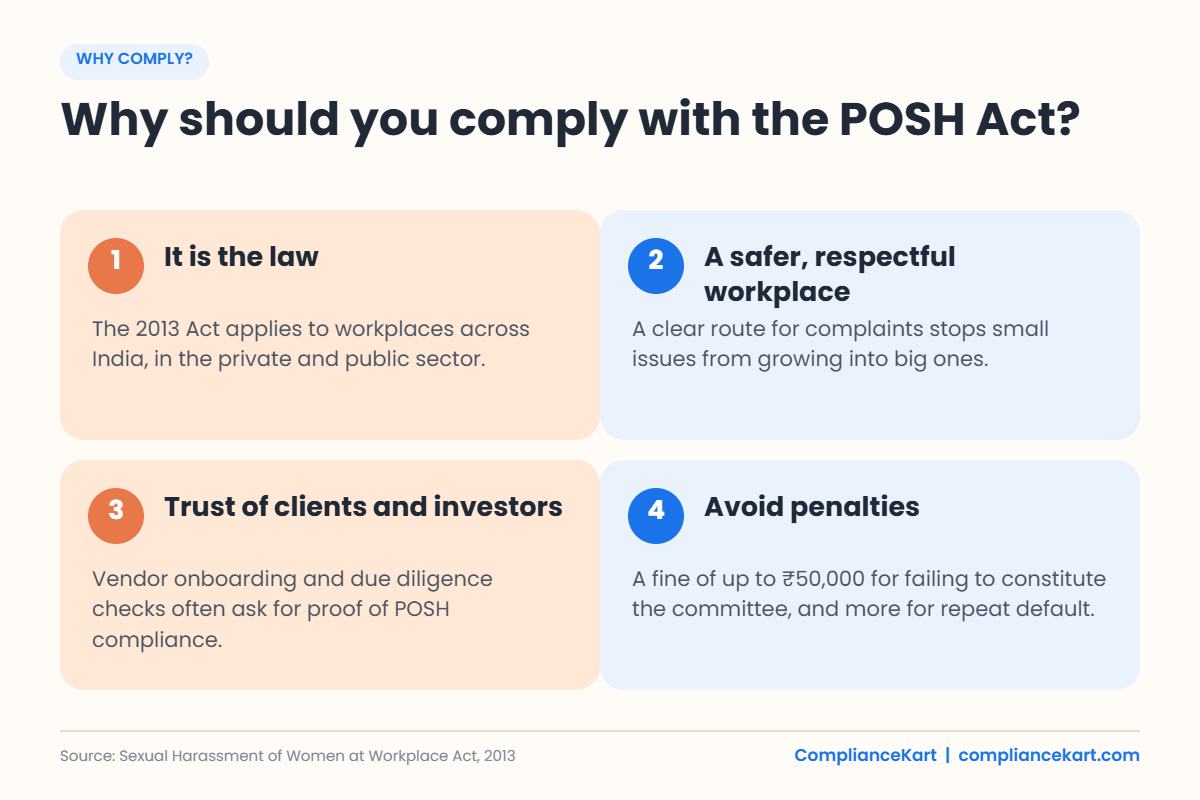
Because it is the law, and because it protects both your people and your business. The Act gives every woman at work a clear, confidential route to complain, and gives the employer a clear process to follow. It came into force on 9 December 2013 and gave statutory form to the guidelines in Vishaka v. State of Rajasthan (1997). Clients, investors and enterprise customers often ask for proof of compliance, and the penalties for default are real (see below).
What counts as sexual harassment?
Section 2(n) defines sexual harassment as unwelcome acts or behaviour, direct or implied, such as physical contact and advances, a demand or request for sexual favours, sexually coloured remarks, showing pornography, or any other unwelcome physical, verbal or non-verbal conduct of a sexual nature. The workplace is not limited to your office: it extends to places visited during the course of employment and transport provided by the employer (Section 2(o)).
Who should comply?
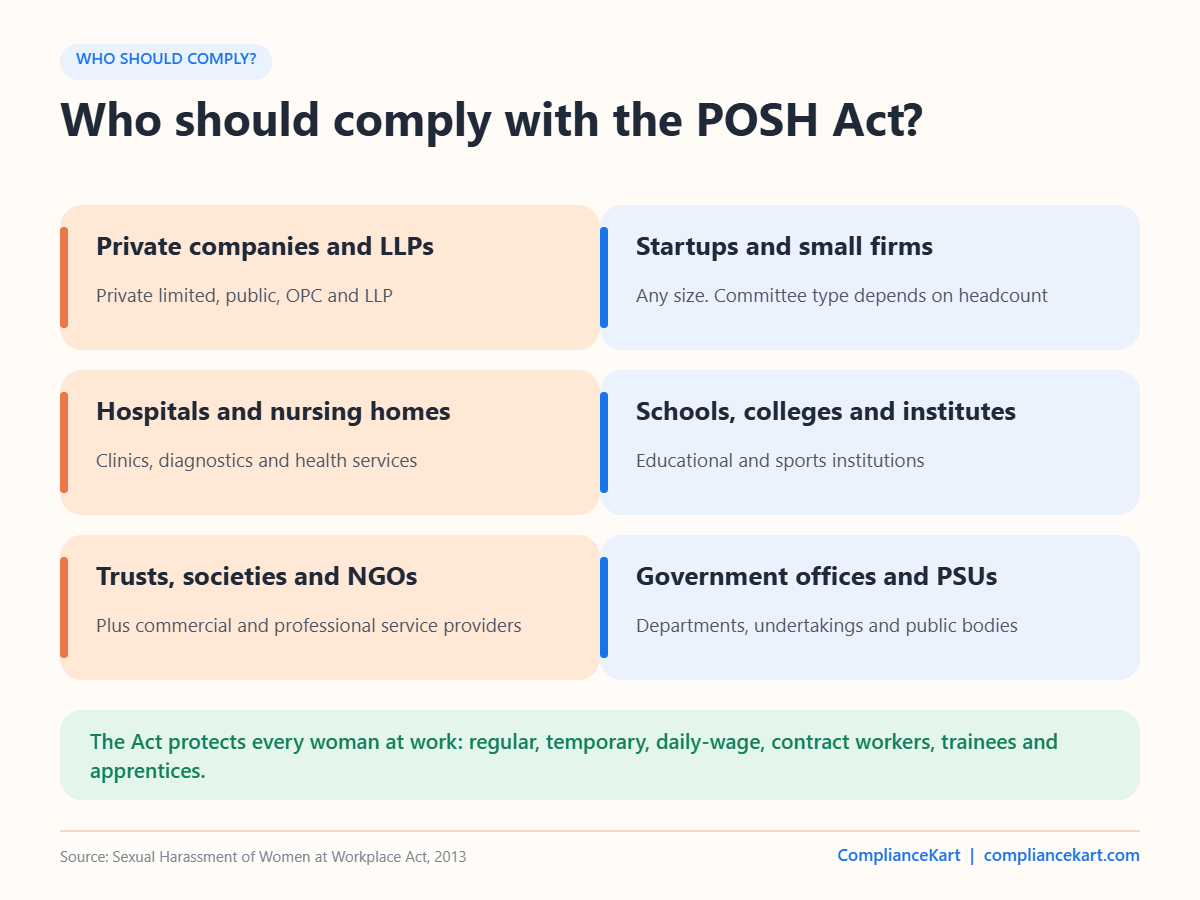
Almost every kind of workplace. Section 2(o) covers government departments and public undertakings; hospitals, nursing homes, and educational and sports institutions; and any private organisation, venture, enterprise, society, trust, NGO or service provider carrying on commercial, professional, vocational, educational, industrial, health or financial activities. It also covers a dwelling place or house where a domestic worker is employed. So if you run a company, LLP, firm, clinic, school or trust in Hyderabad, the Act applies to you; what changes with size is the type of committee.
Eligibility: does your business need an Internal Committee?
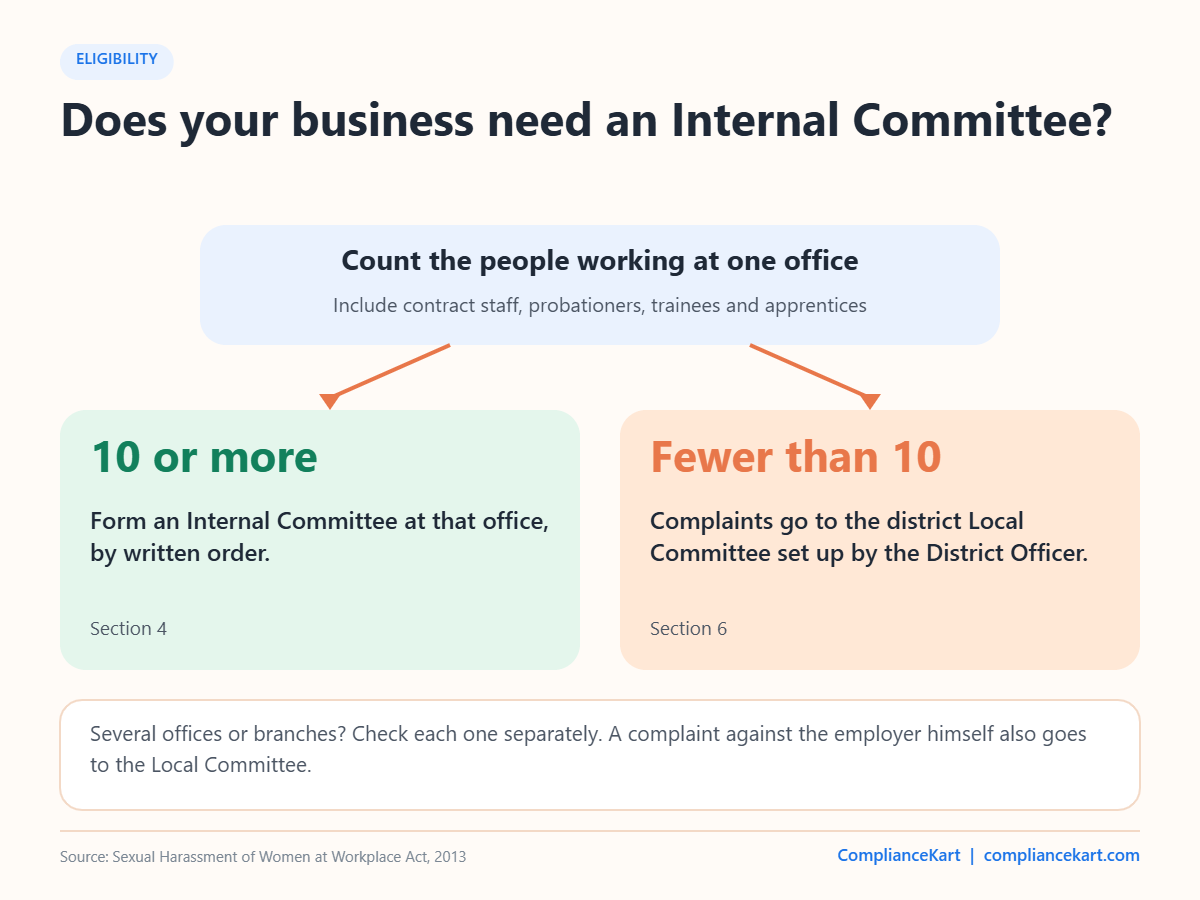
- Every employer, at every office or branch. Section 4(1) requires a written order constituting the IC. Where offices are at different places, an IC is needed at each administrative unit or office.
- Fewer than ten workers: Section 6 provides for a Local Committee, constituted by the District Officer, to receive complaints from such establishments. It also receives complaints made against the employer himself.
In practice, ten workers is the working threshold for having your own IC. Count everyone who works for you, including contract staff, probationers, trainees and apprentices, and check the count office by office.
How the Internal Committee is formed
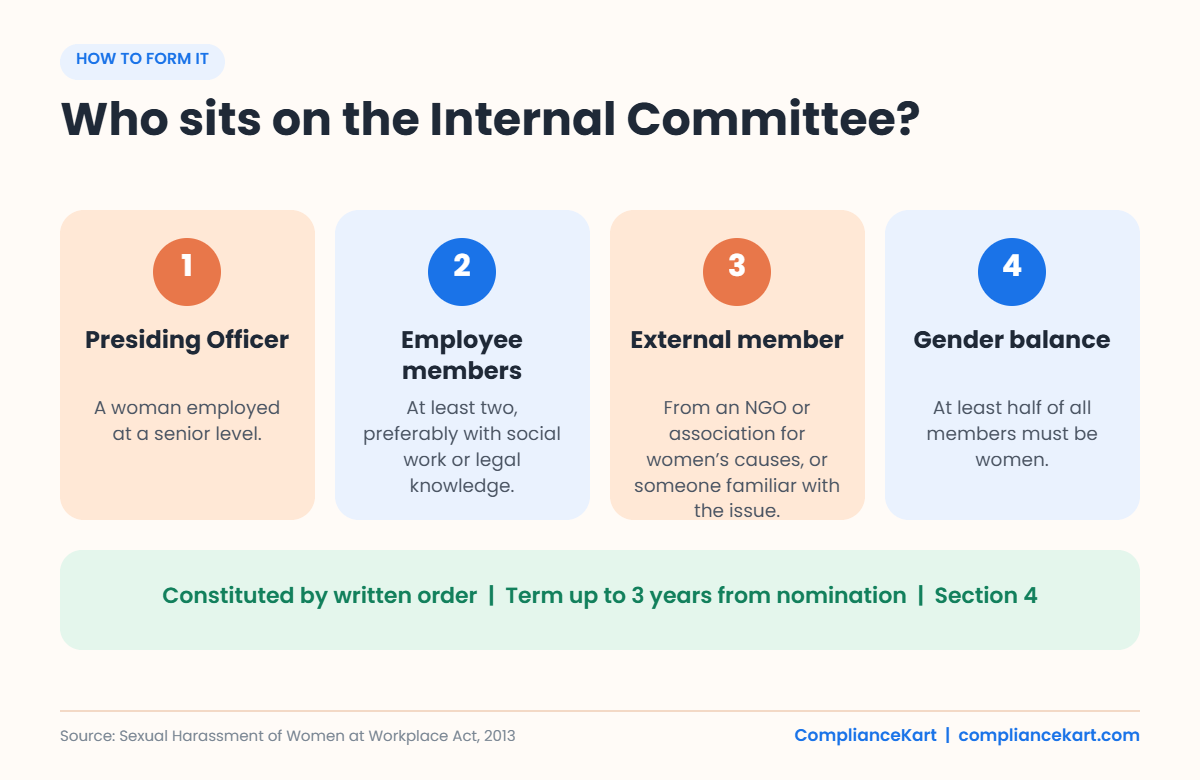
| Member | Requirement (Section 4) |
|---|---|
| Presiding Officer | A woman employed at a senior level |
| Employee members | Not less than two, preferably committed to the cause of women or with social work or legal knowledge |
| External member | One member from an NGO or association committed to women’s causes, or a person familiar with sexual harassment issues |
| Women members | At least half of the total members must be women |
| Tenure | Not exceeding three years from nomination, as specified by the employer |
A small team often struggles to find a senior woman employee. If your team is genuinely unable to staff the committee as the Act requires, take advice before nominating someone to “fill the seat”; a defectively constituted IC can weaken the inquiry it conducts.
When to comply?
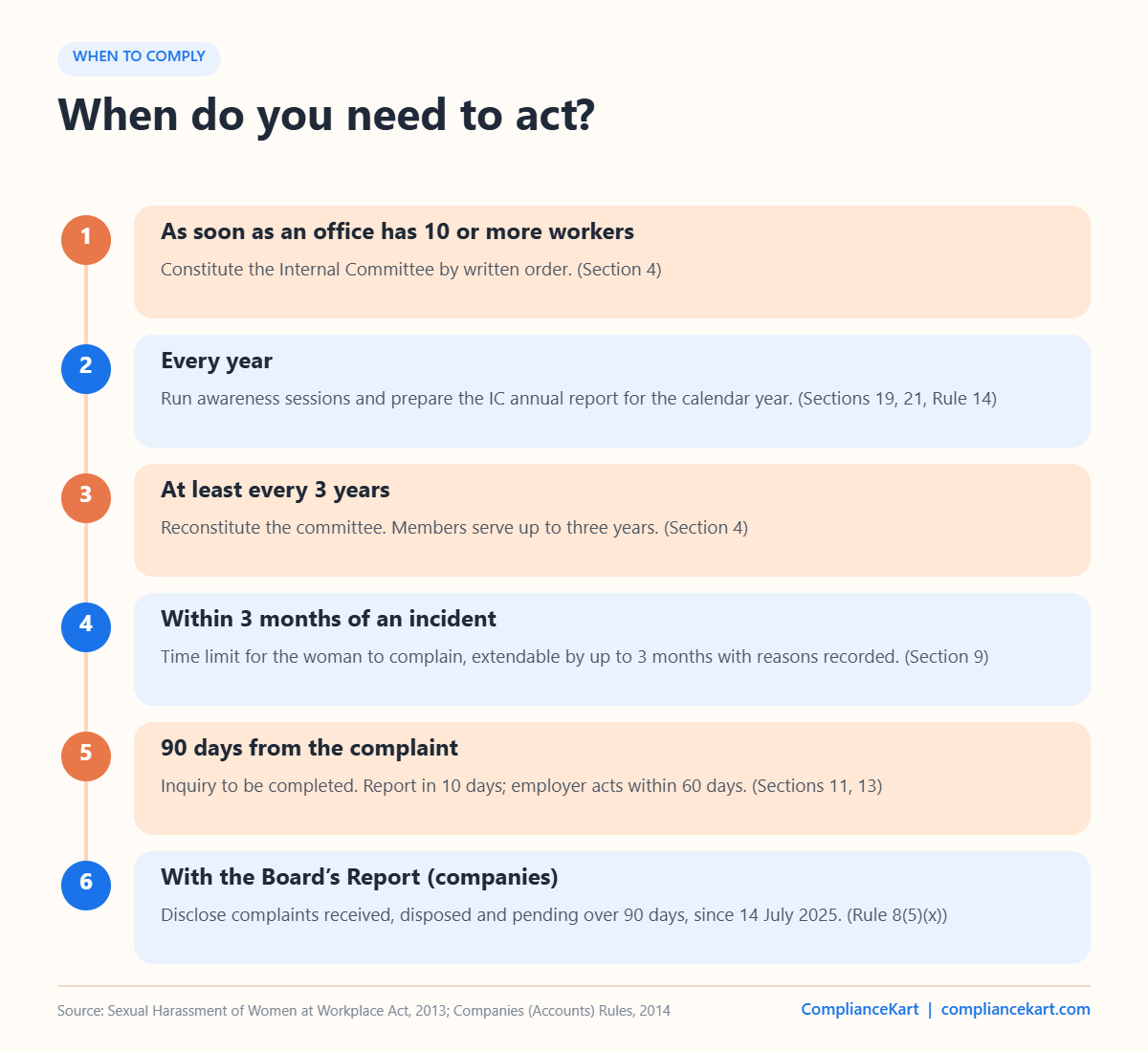
Timelines once a complaint is made
| Stage | Timeline | Provision |
|---|---|---|
| Written complaint by the aggrieved woman | Within 3 months of the incident or the last incident in a series; extendable by up to 3 months for reasons recorded in writing | Section 9(1) |
| Conciliation (only if she requests it, before inquiry) | No monetary settlement can be the basis of conciliation | Section 10 |
| Inquiry | To be completed within 90 days | Section 11(4) |
| Inquiry report to employer | Within 10 days of completing the inquiry | Section 13(1) |
| Employer acts on the recommendation | Within 60 days of receiving it | Section 13(4) |
| Appeal against the recommendation | Within 90 days | Section 18 |
Identities of the parties and witnesses, and the contents of the complaint and inquiry, are confidential under Section 16. Share them on a strict need-to-know basis.
What an employer must do every year
Section 19 lists the employer’s duties. For most businesses it translates into this checklist:
- Provide a safe working environment.
- Display the penal consequences of sexual harassment and the order constituting the IC at a conspicuous place.
- Hold workshops and awareness programmes at regular intervals, and orientation for IC members.
- Give the committee the facilities, information and attendance of respondents and witnesses it needs.
- Assist a woman who chooses to file a criminal complaint, and treat sexual harassment as misconduct under your service rules.
Annual reporting: two different reports
1. The IC’s annual report (Section 21, Rule 14). The IC prepares a report for each calendar year and submits it to the employer and the District Officer. It covers complaints received, complaints disposed of, cases pending for more than 90 days, workshops or awareness programmes held, and the action taken. Some District Officers prescribe their own format and date, so check what applies to your district.
2. The Board’s Report (companies only). Rule 8(5)(x) of the Companies (Accounts) Rules, 2014 first required a statement that the company has complied with the IC provisions. Since 14 July 2025, the Companies (Accounts) Second Amendment Rules, 2025 (G.S.R. 357(E), dated 30 May 2025) also require the Board’s Report to state the number of complaints received, disposed of, and pending for more than ninety days. Section 22 of the POSH Act separately requires employers to report case numbers in their annual report, or to the District Officer where no such report is prepared. See our compliance calendar for startups to place this in your yearly cycle.
What if you do not comply?
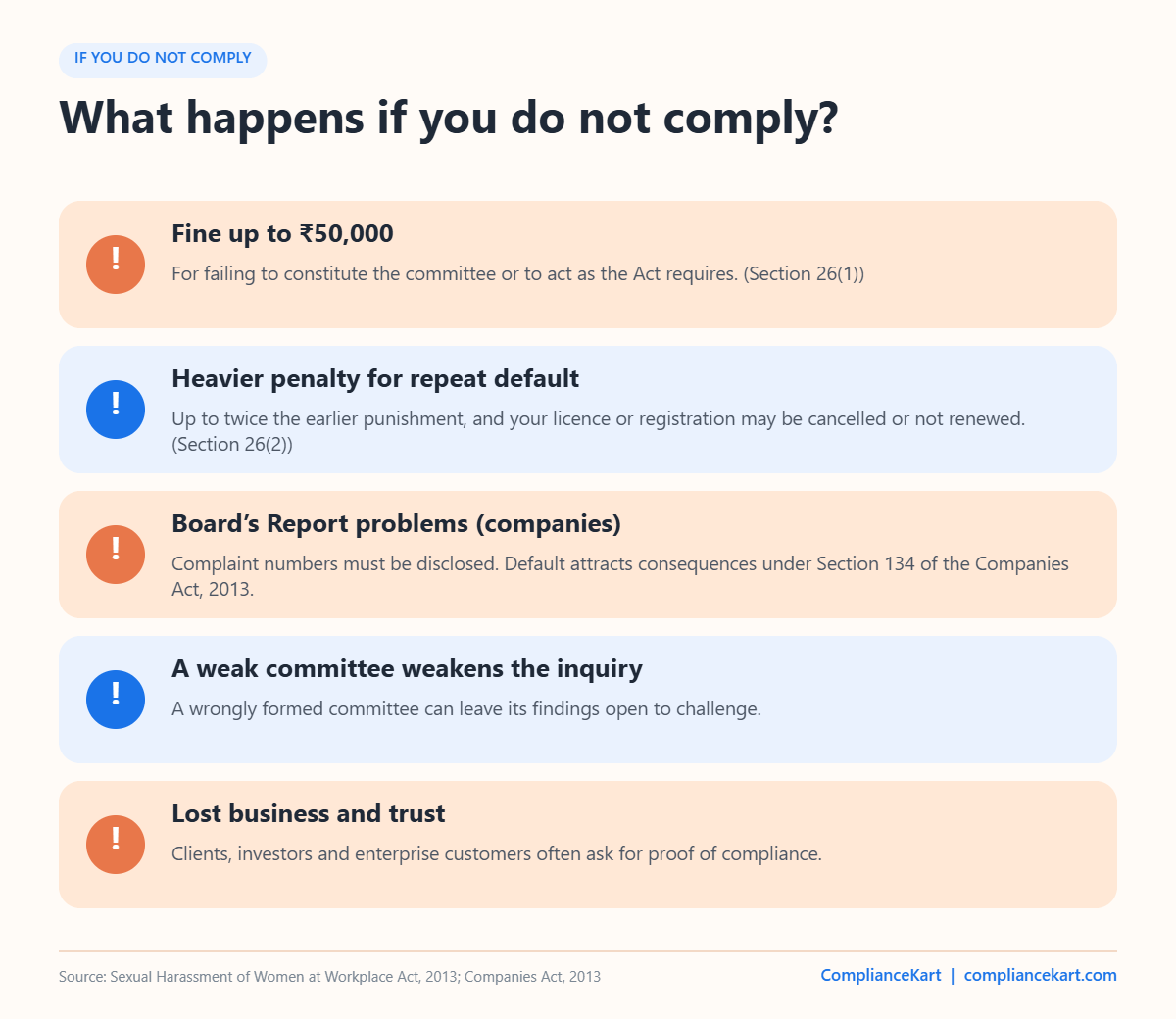
- Section 26(1): failure to constitute an IC, or to act on the committee’s recommendations or reporting duties, can attract a fine that may extend to ₹50,000.
- Section 26(2): for repeat default, up to twice the earlier punishment, and cancellation, withdrawal or non-renewal of a licence or registration needed for the business.
- Board’s Report defaults: non-compliance with the Board’s Report requirements attracts consequences under Section 134 of the Companies Act, 2013.
The practical cost is often larger than the fine: a defective committee can invalidate an inquiry, and clients and investors increasingly ask for proof of POSH compliance during due diligence.
The Supreme Court is pressing for enforcement
In Aureliano Fernandes v. State of Goa (Civil Appeal No. 2482 of 2014, judgment dated 12 May 2023), the Supreme Court noted serious lapses in implementation and gave directions to ensure ICs and Local Committees exist. On 3 December 2024, in the same proceedings together with Initiatives for Inclusion Foundation v. Union of India (W.P.(C) No. 1224 of 2017), the Court directed States and Union Territories to appoint District Officers, constitute Local Committees, designate nodal officers and activate SHe-Box, the online complaint portal, where available. The Court has continued to monitor compliance. For a private employer, the message is simple: expect District Officers to check whether ICs actually exist.
Common mistakes we see
- Having a POSH policy but no signed constitution order for the IC.
- Appointing no external member, or letting the committee’s three-year tenure lapse unnoticed.
- One IC for several offices or branches.
- No annual awareness session, so there is nothing to show in the annual report.
- Treating “zero complaints” as “nothing to file”. A nil report is still reported.
- Discussing a complaint outside the committee, which breaches confidentiality.
POSH compliance for Hyderabad businesses
Hitech City, Gachibowli, Kondapur and the Financial District are full of startups, IT services firms and GCCs that cross the ten-person mark quickly, often with staff split between an office, a co-working space and remote work. If you also run an office elsewhere in Hyderabad or Telangana, each branch needs to be covered. Companies in this belt that raise funding or sign enterprise client contracts should expect POSH questions in due diligence and vendor onboarding. For related employer obligations, see our guide on PF, ESI and labour law limits for employers.
Why work with ComplianceKart
ComplianceKart is a boutique practice bringing CAs, CSs and advocates under one roof. POSH compliance cuts across all three: the Board’s Report disclosure is a company-law matter, the committee, policy and inquiry procedure are legal matters, and the annual reporting sits with your compliance calendar. Like a multi-speciality hospital, where the specialists consult each other instead of sending you from one clinic to the next, the same team looks at the whole picture. We can help you with the IC constitution order, a POSH policy, the annual report and the Board’s Report disclosure. We do not guarantee outcomes in any complaint or proceeding.
Message us on WhatsApp | team@compliancekart.com | 9959536391
Frequently asked questions
Does the POSH Act apply to a business with fewer than ten employees?
Yes. The Act applies to all workplaces. The difference is the forum: for establishments with fewer than ten workers, complaints go to the Local Committee constituted by the District Officer under Section 6.
Is an external member compulsory on the Internal Committee?
Yes. Section 4 requires one member from an NGO or association committed to women’s causes, or a person familiar with sexual harassment issues.
What is the time limit to file a complaint?
Three months from the incident, or the last incident in a series. The committee may extend this by up to three months for reasons recorded in writing (Section 9(1)).
Can a man file a complaint under the POSH Act?
The Act protects women, so a complaint by a man is not covered by it. Employers often add a gender-neutral conduct policy so that other complaints have a defined process.
Are the IC annual report and the Board’s Report the same thing?
No. The IC’s report under Section 21 goes to the employer and the District Officer. The Board’s Report disclosure applies to companies under the Companies (Accounts) Rules, 2014.
This article is for general information and is not legal advice. Laws, notifications and court directions change; confirm the current position for your facts before acting.
Sources
- Sexual Harassment of Women at Workplace (Prevention, Prohibition and Redressal) Act, 2013 (India Code)
- Sexual Harassment of Women at Workplace (Prevention, Prohibition and Redressal) Rules, 2013, Rule 14 (annual report)
- MCA Notification G.S.R. 357(E) dated 30 May 2025: Companies (Accounts) Second Amendment Rules, 2025
- Aureliano Fernandes v. State of Goa, Civil Appeal No. 2482 of 2014 (12 May 2023), report
- Supreme Court order dated 3 December 2024, report
Need this done for your business?
Send us one message. A CA, CS or Advocate replies within a working day — no forms, no obligation.