GST Refund on Exports: LUT vs IGST Payment — What IT, SaaS & Pharma Exporters Must Know
GST refund on exports explained: LUT vs IGST payment, Rule 89(4) formula, documents, FEMA link and 57th GST Council changes. For IT, SaaS and pharma exporters.
A SaaS company in Hitech City invoices a US client ₹60 lakh a quarter. Its own costs (office rent, cloud hosting, consultants) carry 18% GST, so credit builds up every month, and there is hardly any domestic output tax to set it against. The finance head asks the question every exporter eventually asks: should we export under a Letter of Undertaking and claim the credit back, or pay IGST and claim that back?
What counts as an export
Goods: taking goods out of India to a place outside India (Section 2(5), IGST Act). Services: all five conditions of Section 2(6), IGST Act must be met: the supplier is in India; the recipient is outside India; the place of supply is outside India; payment is received in convertible foreign exchange (or in Indian rupees where the RBI permits); and the supplier and recipient are not merely establishments of a distinct person. Intermediary services are generally treated as supplied at the supplier’s location and are the most common reason a claimed “export” fails. Our guide on export of services, LUT and FEMA covers that test in detail.
LUT or pay IGST: the real trade-off
| Parameter | Route A: export under LUT | Route B: pay IGST and claim refund |
|---|---|---|
| Cash outflow | No IGST paid on the export invoice | IGST paid upfront, recovered on refund |
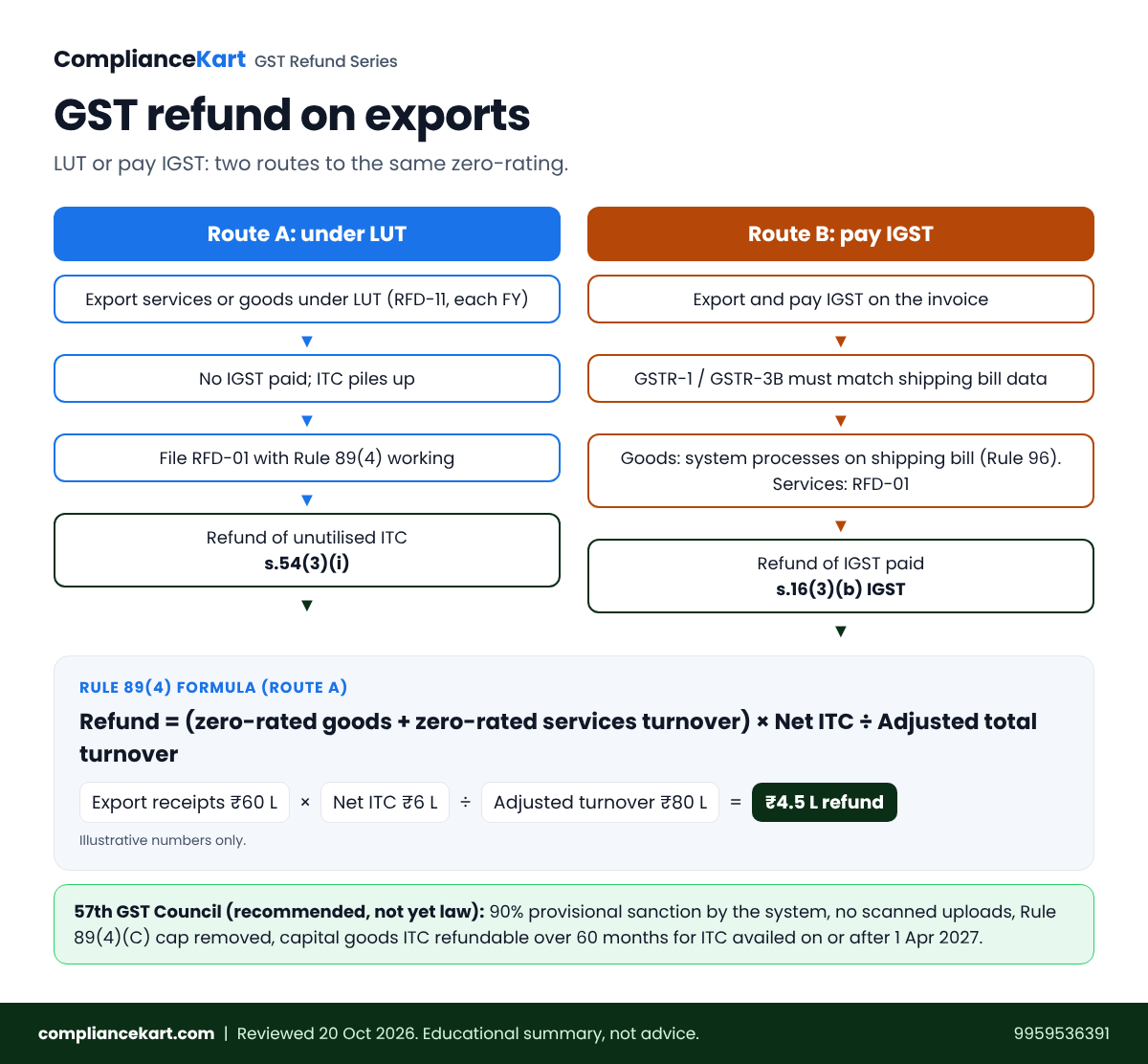
| What is refunded | Unutilised ITC (s.54(3)(i)) by RFD-01, using the Rule 89(4) formula | The IGST paid. For goods, processing runs off shipping-bill data under Rule 96 verify |
| Paperwork | LUT (FORM GST RFD-11) filed for each financial year; lapses on 31 March if not renewed | No LUT; correct GSTR-1 and GSTR-3B, shipping bill and EGM matching are critical |
| Risk | Refund limited by the formula; heavy statement-based scrutiny | Refund can be withheld for return mismatches; Rule 96(10) restrictions (omitted from 8 Oct 2024) still litigated for pending cases |
| Who it suits | IT, SaaS, consulting, GCCs; manufacturers with large ITC | Exporters with thin working-capital pressure and clean return data |
Rule 96(10) restricted IGST refunds for exporters who had availed certain concessional or exemption notifications. It was omitted by Notification No. 20/2024-Central Tax (8 October 2024). The Gujarat High Court has held the omission to be prospective but that pending proceedings are protected, so exporters whose claims were rejected earlier on this ground should examine their remedies verify.
How the refund is computed (LUT route)
Rule 89(4) of the CGST Rules applies this formula:
Refund = (Turnover of zero-rated supply of goods + Turnover of zero-rated supply of services) × Net ITC ÷ Adjusted Total Turnover
“Net ITC” is the ITC availed on inputs and input services in the relevant period (excluding credit separately claimed under sub-rules (4A) or (4B)). For services, the turnover is measured on foreign-exchange receipts in the period, adjusted for advances; for goods, the value is the lower of the invoice value and FOB value, subject to the limit on like goods supplied domestically verify.
| Illustration (assumed numbers) | ₹ lakh |
|---|---|
| Export of services (receipts in the quarter) | 60 |
| Domestic taxable supplies | 20 |
| Adjusted total turnover (60 + 20) | 80 |
| Net ITC (inputs + input services) | 6 |
| Refund = 60 × 6 ÷ 80 | 4.5 |
The illustration is only a worked example of the formula. Actual claims depend on period-specific values, limits on the ITC ledger balance and statements filed.
What the 57th GST Council recommended for exporters
- 90% provisional sanction by the system for zero-rated claims on risk evaluation; Phase 2 moves to automated full sanction after adjusting pending dues.
- No scanned document uploads with a system-readable RFD-01 for zero-rated claims.
- Rule 89(4)(C) cap (1.5 times like-goods value on goods turnover) proposed to be removed.
- Capital goods ITC to become refundable for zero-rated supplies, spread over 60 months, for ITC availed on or after 1 April 2027.
- Acknowledgement or deficiency memo in 10 days instead of 15, with deemed acknowledgement.
For exporters, the practical lesson is to keep ITC records by date of availment and by category (inputs, input services, capital goods). If the recommendations are legislated, eligibility for capital-goods credit will turn on the availment date. The Finance Act, 2026 also removes the ₹1,000 floor for IGST refunds on exports of goods from a date to be notified verify, and CBIC Instruction 06/2025-GST already permits risk-based provisional sanction of 90% for low-risk claims. Taxpayers notified as high-risk, and claims with pending show cause notices or appeals, are excluded from that facility verify. For a running account of changes, see our note on the 57th Council refund recommendations.
Documents and the FEMA link
- Export evidence. Goods: shipping bills and export general manifest data. Services: invoices and, for refund claims, the proof of foreign-exchange receipt (FIRC or e-BRC) under Rule 89(2).
- Return consistency. The supplies must appear in GSTR-1 and be reflected in GSTR-3B. The refund statements must tie to them.
- ITC support. Credit claimed should be supported by GSTR-2B and valid tax documents.
- Unjust-enrichment position. Zero-rated and inverted-duty refunds are among the cases where the refund goes to the applicant under Section 54(8); a declaration or certificate may still be needed for other claims.
- FEMA realisation. If export proceeds are not realised within the period allowed under FEMA, Rule 96B provides for recovery of the refund with interest verify. Keep banking-channel receipts and e-BRC records ready.
Why export refunds get stuck
| Reason | What to do |
|---|---|
| Service wrongly treated as export (for example intermediary services) | Test each of the five Section 2(6) conditions before the first invoice, and keep the contract and place-of-supply analysis on file |
| GSTR-1 and GSTR-3B do not match the refund statement | Reconcile before filing RFD-01, and correct returns first |
| LUT expired on 31 March | Diarise a renewal for 1 April each year |
| Credit includes ineligible items or is not in GSTR-2B | Run an ITC eligibility review before preparing Net ITC |
| Export duty paid or drawback of central tax availed on the goods | Section 54(3) bars the ITC refund in those cases; consider whether claims should be limited |
| Delay beyond the relevant date | Count two years from the Explanation (2) date, not from the invoice or the filing |
Hyderabad context
Service exporters in Hitech City, Kondapur, Gachibowli, Madhapur and the Financial District, as well as GCC set-ups, typically hold a regular LUT and file quarterly RFD-01 claims. Pharma exporters around Genome Valley, Jeedimetla and Patancheru combine export refunds with an inverted-duty position on domestic sales, which we cover in Part 3. The jurisdictional officer is decided by your registration.
Why work with ComplianceKart
An export refund looks like a GST form but is also an FEMA realisation file, an accounting reconciliation and, if rejected, a litigation brief. ComplianceKart is a boutique practice bringing CAs, CSs and advocates under one roof, in the way a multi-speciality hospital brings physicians, surgeons and diagnostics into one coordinated plan. We prepare the claim, test it against the order you may later receive, and appear in appeals where needed. We do not guarantee refunds or timelines; the department decides each claim on its facts.
Frequently asked questions
Is GST refund on exports automatic?
No. Exports under LUT require an RFD-01 application for unutilised ITC. For exports of goods with payment of IGST, processing is based on shipping bill and return data, but the returns must match. The 57th GST Council has recommended more system-based sanction, which is not yet in force.
LUT or IGST payment: which is better for IT and SaaS exporters?
Service exporters mostly export under LUT, because it avoids upfront IGST and the refund is of ITC. IGST payment can suit exporters who prefer a refund of tax paid, but it needs working capital and clean return matching.
What is the time limit for a GST refund on exports?
Two years from the relevant date. For goods, it is the date the ship or aircraft leaves India or the goods cross the land frontier. For services, it is generally the date of foreign-currency receipt or invoice, as Explanation (2)(c) to Section 54 provides.
Can pharma exporters claim both export refund and inverted-duty refund?
Both can arise, but they cover different supplies and the Rule 89(4) and Rule 89(5) formulas must not double-count the same ITC. The 57th Council has recommended widening inverted-duty refunds to input services and capital goods, but that needs amendments.
Will the 57th GST Council changes apply to my pending export refund claim?
Not automatically. The recommendations need amendments, rules or notifications. Until they are notified, current provisions apply. File on the existing process and keep records by ITC availment date.
What if export proceeds are not realised in time?
Rule 96B provides for recovery of the refund and interest where the proceeds are not realised within the FEMA period. Keep the FIRC or e-BRC and bank advice on file.
Planning your next export refund claim?
Share your export turnover, LUT status and the ITC balance. We will check the route, the working and the evidence before you file.
WhatsApp usEmailCall 9959536391GST registration & filingContinue the series
Disclaimer. This article is for general information on Indian GST law as at 20 October 2026 and is not advice on any specific case. Refund eligibility depends on facts, period and documents. Items marked verify should be checked against the current official text before reliance. Contact: team@compliancekart.com · 9959536391 · compliancekart.com.
Need this done for your business?
Send us one message. A CA, CS or Advocate replies within a working day — no forms, no obligation.