NRI Taxation in India: A Practical Guide for Tax Year 2026-27
NRI taxation in India explained: residency tests, TDS on property sale, DTAA, NRE/NRO rules, ITR filing and repatriation, with Hyderabad examples.
A software engineer in Dublin sells her flat in Kondapur and the buyer deducts ₹17 lakh as tax from the sale price. Her actual tax is barely half of that. Or a Seattle-based founder spends four months in Hitech City setting up a company and discovers that, with Indian income above ₹15 lakh and long earlier stays, the 120-day rule has quietly made him a tax resident. Both situations are common, and both are avoidable.
Which law applies to NRI taxation in India now?
The Income-tax Act, 2025 replaced the Income-tax Act, 1961 from 1 April 2026. Income for the 12 months from 1 April 2026 is now measured in a “tax year” (tax year 2026-27), not a “previous year” and “assessment year”. Income earned up to 31 March 2026 (financial year 2025-26) is still assessed under the 1961 Act. If you have not yet filed that return, the belated-return window is generally open until 31 December 2026 (check the notified date).
Many provisions were renumbered. Residence stays in section 6, treaty relief sits in section 159, TDS on payments to non-residents sits in section 393(2) (earlier section 195), and lower deduction certificates sit in section 395 (earlier section 197).
Who is an NRI for income tax? The three day-count tests
The Act does not use the word “NRI”. It asks whether you are a resident in a tax year. You are resident if you meet either test in section 6(2):
- Stay test: 182 days or more in India during the tax year.
- Look-back test: 60 days or more in the tax year and 365 days or more in the four preceding years.
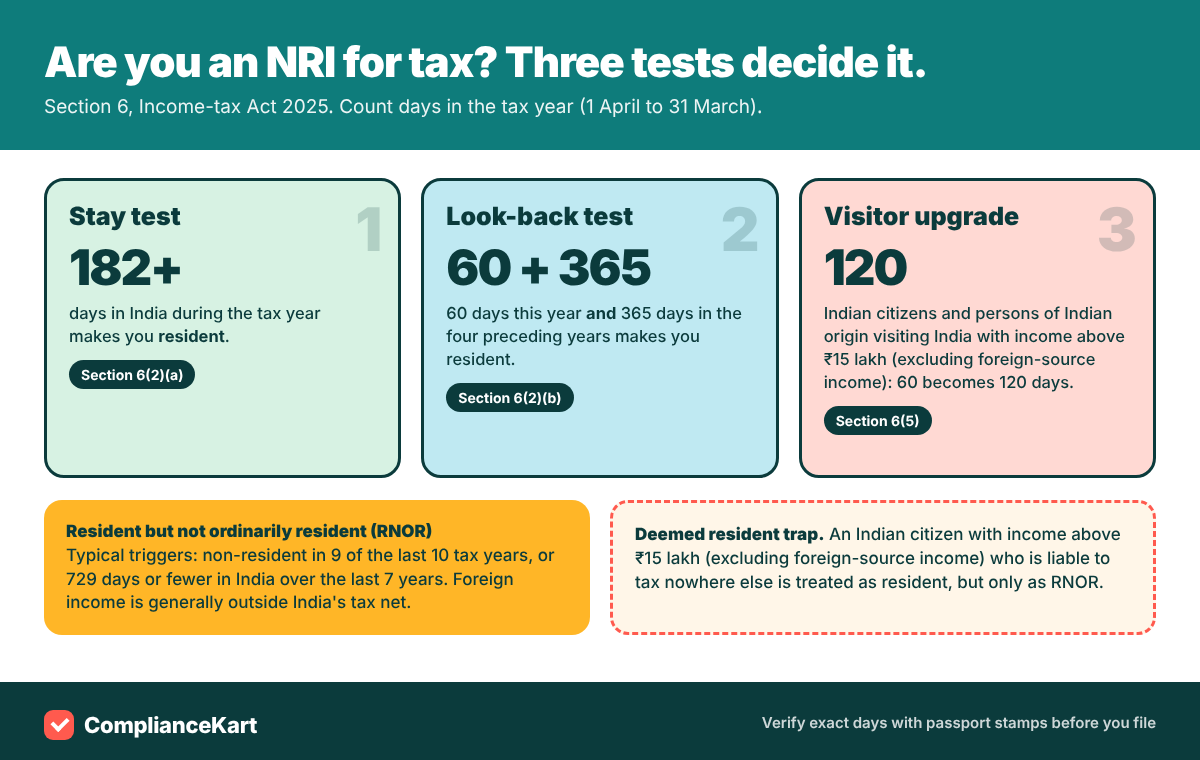
Two refinements matter for Indians abroad. First, if you are an Indian citizen or person of Indian origin visiting India and your Indian income (excluding foreign-source income) exceeds ₹15 lakh, the 60-day limb becomes 120 days. Second, an Indian citizen with income above ₹15 lakh who is liable to tax in no other country is treated as resident, but only as resident but not ordinarily resident (RNOR).
RNOR status also applies when you were non-resident in nine of the preceding ten tax years, or spent 729 days or fewer in India in the preceding seven. An RNOR is generally taxed on Indian income and on foreign business income controlled from India, not on other global income. That makes the first two years after returning home a planning window.
What income do NRIs pay tax on in India?
| Income | Taxable in India? | Practical point |
|---|---|---|
| Salary for services rendered in India | Yes | Taxable even if paid abroad. |
| Foreign salary for work done abroad | No (for a non-resident) | Becomes taxable if you turn resident, with RNOR relief on foreign income. |
| Rent from Indian property | Yes | Tenant must deduct TDS at the non-resident rate and credit rent to your NRO account. |
| NRO interest | Yes | Bank deducts TDS. A treaty may lower the rate. |
| NRE and FCNR(B) interest | Generally exempt while you stay a non-resident | Exemption can be lost on becoming resident. Check the 2025 Act position for your case. |
| Dividends from Indian companies | Yes | TDS is typically 20% plus surcharge and cess, subject to treaty relief. |
| Capital gains on Indian property, shares or funds | Yes | Rate depends on asset type and holding period. |
NRI property sale in India: capital gains and TDS
Land or a building held for more than 24 months produces a long-term capital gain taxed at 12.5% without indexation, plus surcharge and 4% cess. The option to pay 20% with indexation on property bought before 23 July 2024 is available only to resident individuals and HUFs, so an NRI does not get it. A gain on property held 24 months or less is short-term and taxed at the applicable rate.
The bigger shock is TDS. When the seller is a non-resident, the buyer deducts tax on the entire sale consideration, not on the gain. For long-term assets that is 12.5% plus surcharge and cess. For a sale above ₹1 crore the effective rate runs to about 14.95%.

In this illustration, the gap of roughly ₹9.36 lakh stays with the department until you file and claim a refund. The fix is a lower or nil deduction certificate from the Assessing Officer under section 395, applied for online before the sale is registered. Allow weeks for processing, and give the certificate to the buyer before payment.
You can also reduce the gain itself. Reinvestment exemptions (earlier sections 54, 54F and 54EC) are open to NRIs, but each has conditions on the new asset, timelines and caps. Check the matching provision in the 2025 Act before you commit funds.
NRE, NRO and FCNR accounts: where you park money matters
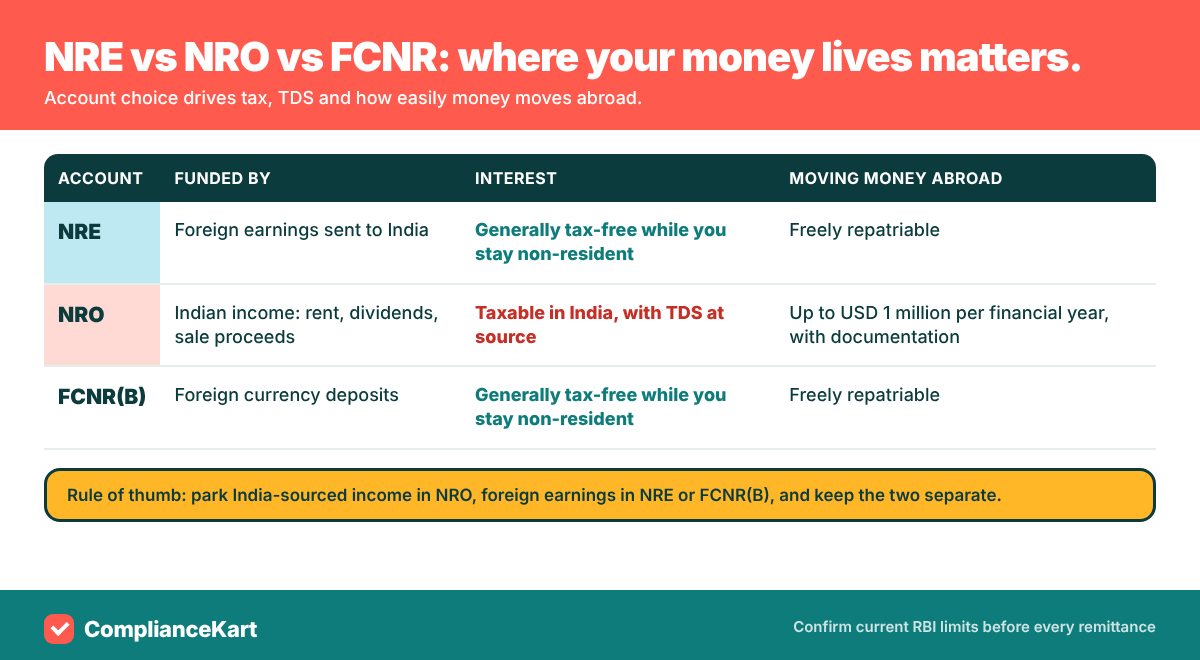
Keep India-sourced income such as rent and sale proceeds in an NRO account. Keep money earned abroad in NRE or FCNR(B). Mixing them muddles repatriation rights and invites questions from banks and the tax department.
DTAA relief for NRIs: avoid being taxed twice
India has tax treaties (Double Taxation Avoidance Agreements, or DTAAs) with many countries. Under section 159, treaty provisions apply where they are more beneficial than the Act. To claim relief you need a Tax Residency Certificate (TRC) from your country of residence. Payers also commonly ask for Form 10F and a no-permanent-establishment declaration. Without these, the bank or buyer applies the higher domestic rate and you chase a refund later.
If you pay tax in India and also in your country of residence, claim a foreign tax credit there. The rules differ by country, so read the treaty article and your home country’s credit rules together.
Filing an NRI income tax return in India
You must file if your Indian taxable income exceeds the basic exemption limit, if you want a refund of excess TDS, or if you have a capital gain to report or carry forward. NRIs generally file ITR-2, or ITR-3 if there is business or professional income, because ITR-1 and ITR-4 are meant for ordinarily resident individuals. For tax year 2026-27 the usual due date for non-audit cases is expected to be 31 July 2027 (check the notified date).
There is also an optional special regime for NRIs with investment income from specified foreign exchange assets, such as shares of Indian companies and certain deposits and securities. That income is taxed at a flat rate, and a return is not needed if that is your only Indian income and TDS has been deducted. The trade-off is that you give up deductions and indexation, so compare before opting in.
E-verification is the usual snag from abroad. Aadhaar OTP works only if your Aadhaar is linked to an active mobile number, so many NRIs verify through a pre-validated Indian bank account instead.
Repatriation rules: moving money out of India
- NRE and FCNR(B) balances can be freely repatriated.
- NRO balances and property sale proceeds can generally be remitted abroad up to USD 1 million per financial year, subject to FEMA conditions and documents (check the current RBI position before each remittance).
- Tax paperwork: remittances that are taxable in India need a payer declaration and, above ₹5 lakh in a year, a Chartered Accountant’s certificate. These are filed as Form 145 and Form 146 (earlier Forms 15CA and 15CB).
- Property rules: NRIs can buy residential and commercial property without RBI approval. Agricultural land, plantation property and farmhouses need special permission.
Hyderabad NRI tax issues: Kokapet, Gachibowli, Kondapur and beyond
Hyderabad NRI families often hold flats, villas and plots in Kokapet, Narsingi, Neopolis, Gachibowli, Kondapur and Kukatpally, and children or parents back home manage them. That brings predictable tax work: rent collected in Miyapur or Hitech City must be credited to an NRO account with TDS; a sale near the Financial District needs a lower deduction certificate before registration; and a family flat inherited from a parent needs a clean cost-of-acquisition trail. If you are an NRI founder planning an Indian company, read NRI company registration in Hyderabad and our private limited company incorporation service. Remittance and export declarations are covered in our FEMA export declaration explainer.
Seven common NRI tax mistakes
- Counting days from the calendar year instead of the Indian tax year (1 April to 31 March).
- Ignoring the 120-day rule when income exceeds ₹15 lakh.
- Letting the buyer deduct TDS on the full price without applying for a lower deduction certificate.
- Not collecting a TRC and Form 10F, so treaty relief is lost at source.
- Depositing rent or sale proceeds in an NRE account.
- Skipping the return because TDS was deducted, then losing a refund or the right to carry forward losses.
- Staying on a resident savings account after moving abroad. Convert to NRO or NRE within the period FEMA allows.
Why work with ComplianceKart
ComplianceKart is a boutique practice bringing CAs, CSs and advocates under one roof. Think of a multi-speciality hospital: a single file reaches the cardiologist, the radiologist and the surgeon without you booking three clinics. An NRI sale of property works the same way. The TDS certificate, the capital gains computation, the FEMA remittance and any legal paperwork move together instead of being chased across separate advisers. We work online with NRIs across time zones and cannot guarantee refunds, approvals or tax outcomes, only careful, documented work.
Talk to us about your NRI tax position
Share your country of residence, days spent in India, and what you plan to do (sell property, file a return, remit funds). A CA, CS or advocate replies within a working day.
Ask on WhatsAppCall 9959536391Email team@compliancekart.comNRI taxation in India: frequently asked questions
How many days can an NRI stay in India without becoming a tax resident?
Stay 181 days or fewer in the tax year, and also stay below the look-back limit. Visits of 60 days or more in a year combined with 365 days or more over the previous four years make you resident, and the 60-day figure becomes 120 days for Indian citizens and persons of Indian origin with Indian income above ₹15 lakh.
Is NRI income earned abroad taxable in India?
Not while you are a non-resident, unless it is received in India or arises from a business controlled from India. Once you become resident, global income is taxable, with RNOR status giving partial relief while it lasts.
What TDS applies when an NRI sells property in India?
The buyer deducts tax on the full sale value at the long-term capital gains rate of 12.5% plus surcharge and cess, or at the higher short-term rate if the property was held for 24 months or less. A lower deduction certificate under section 395 can reduce this.
Do NRIs need to file an income tax return in India?
Yes, if taxable Indian income crosses the exemption limit, if you want a refund of excess TDS, or if you have a capital gain to report. A return may be unnecessary if your only income is eligible investment income taxed under the special regime and TDS has been deducted.
How much can an NRI send abroad from India?
NRE and FCNR(B) funds are freely repatriable. NRO balances and sale proceeds can generally be remitted up to USD 1 million per financial year with documents. Check the current RBI conditions before each transfer.
Bottom line
NRI taxation in India rewards early planning. Count your days before booking flights, collect treaty documents before income is paid, apply for the lower deduction certificate before a sale, and match every remittance to its paperwork. This article is general information and not a substitute for advice on your facts.
Official sources: Section 6, Income-tax Act 2025 · Section 159 · Section 213 · Section 395 · Reserve Bank of India (FEMA) · Knowledge Updates
Need this done for your business?
Send us one message. A CA, CS or Advocate replies within a working day — no forms, no obligation.