Exporting Services from Hyderabad? GST, LUT, FEMA & the Tax Rules Freelancers and IT Firms Miss
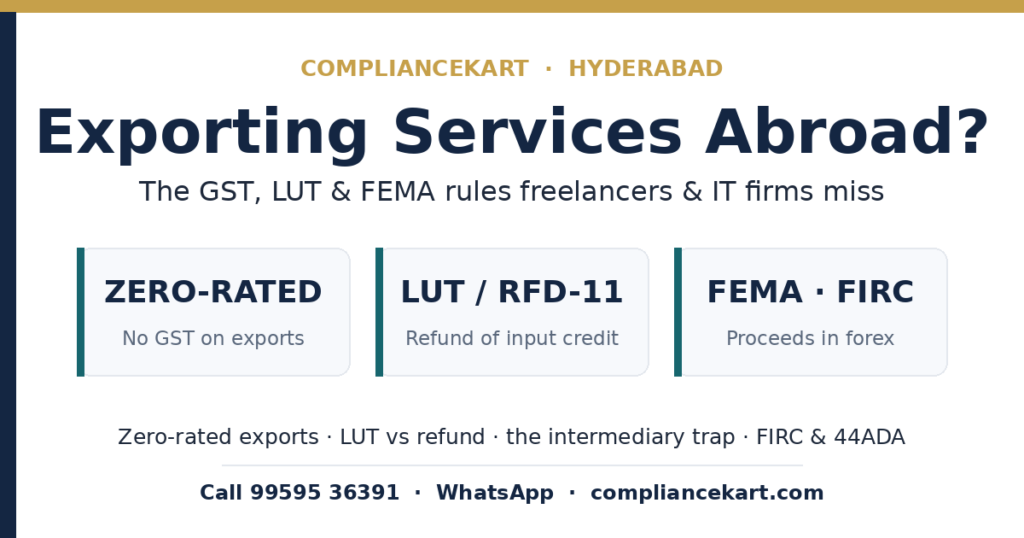
Export Of Services in Hyderabad: this ComplianceKart guide explains export of services for startups and businesses – the key requirements, the process, and the practical points founders in Hyderabad most often get wrong.
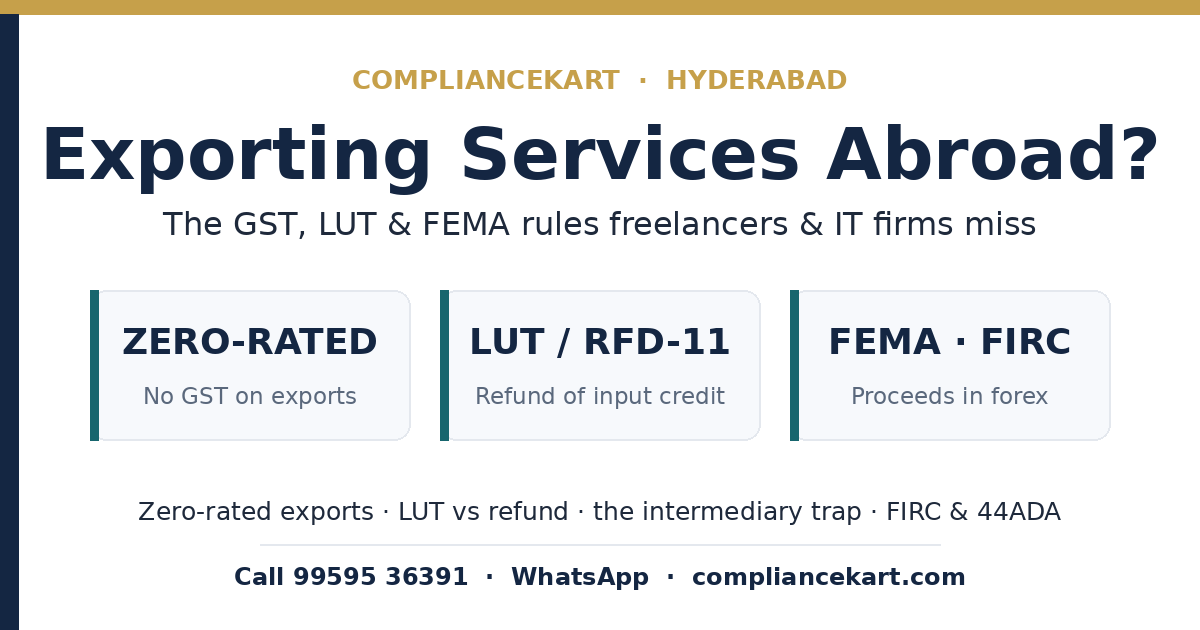
Hyderabad runs on foreign revenue. From independent developers and designers billing US and EU clients out of HITEC City, Madhapur and Kondapur, to boutique IT and consulting firms in Gachibowli and the Financial District serving overseas customers, a large share of the city’s professional income is earned abroad.
Yet the tax and regulatory treatment of that income — the export of services under GST, LUT and FEMA — is where we see the most avoidable mistakes. Get it right and your export of services income is effectively free of GST; get it wrong and you face demands, blocked refunds and FEMA questions. Here is what freelancers and IT firms in Hyderabad need to know. (Rules change; confirm the current position on the official GST portal before acting.)
Key takeaway: Export of services is zero-rated, not exempt — you charge no GST and still reclaim input credit. But the benefit depends on meeting every condition of the export definition, filing an LUT, and documenting your foreign-exchange realisation.
The big prize: export of services is “zero-rated”
Under the IGST Act, export of services is a zero-rated supply (Section 16). “Zero-rated” is better than “exempt”: you do not charge GST to your foreign client, and you can still recover the input tax credit on your expenses. That is the whole point — your export income should not carry a GST cost. But the benefit is conditional on your supply actually qualifying as an export.
What legally counts as export of services
Under Section 2(6) of the IGST Act, a supply qualifies as export of services only if all of these are met:
- The supplier is located in India (you, in Hyderabad);
- The recipient is located outside India;
- The place of supply is outside India;
- Payment is received in convertible foreign exchange (or in Indian rupees where permitted by the RBI); and
- The supplier and recipient are not merely establishments of the same person.
Miss any one of these and the supply may not be an export — which changes the tax outcome entirely. The place-of-supply condition, in particular, is where the traps hide.
The intermediary trap that catches Hyderabad service providers
Here is a frequent, expensive misunderstanding. If your service is treated as an “intermediary” service (broadly, arranging or facilitating a supply between two other persons, rather than providing the main service on your own account), the place of supply is the location of the supplier — i.e., India — under Section 13(8)(b) of the IGST Act. That means it may not qualify as an export of services, and GST could apply. Many Hyderabad founders who think they are “exporting” are actually characterised as intermediaries by the department. Whether you are an intermediary is a fact-specific, litigated question — get the characterisation reviewed before you assume zero-rating.
Two ways to export services under GST: LUT vs refund
Section 16(3) gives you two routes to enjoy zero-rating on your export of services:
| Route | How it works | Best for |
|---|---|---|
| LUT (without paying IGST) | File a Letter of Undertaking (Form GST RFD-11), export without charging IGST, and claim a refund of unutilised input tax credit. | Most freelancers & IT firms — no working capital blocked. |
| Pay IGST, then refund | Pay IGST on the invoice and claim a refund of the IGST paid. | Simpler in some cases, but parks your cash with the department until refund. |
For most service exporters the LUT route is cleaner. Remember to renew the LUT each financial year — an expired LUT is a common slip that forces you onto the pay-and-refund route mid-year.
Do you even need GST registration?
This is nuanced. A person supplying services (including inter-state and export) is generally not required to register until turnover crosses the ₹20 lakh threshold (₹10 lakh in special-category states) — an exemption from compulsory registration applies to inter-state suppliers of services up to that limit. However, to file an LUT and claim refunds, you need to be registered. So a small freelancer below the threshold with no input credit to recover may not need to register; a growing firm that wants to reclaim credit generally should. This is exactly the kind of call worth getting assessed rather than assuming.
Billing foreign clients from Hyderabad and unsure of your export of services position? Get it reviewed by a CA in Hyderabad — call 99595 36391 or WhatsApp ComplianceKart.
FEMA: getting paid, and proving it
Export of services is not only a GST matter — it is a foreign-exchange matter under FEMA. Key points:
- Proceeds must be received in convertible foreign exchange (or INR where RBI permits), through banking channels.
- Your bank issues a FIRC / e-BRC (Foreign Inward Remittance Certificate / Bank Realisation Certificate) — vital evidence that you actually realised the export proceeds, and often required to support your GST refund.
- Export proceeds are expected to be realised within the timeline prescribed by the RBI (historically nine months from the date of supply, subject to change and extensions). Track realisation; unrealised proceeds create FEMA exposure.
Platforms like Upwork, PayPal, Stripe or wire transfers each have their own documentation trail — make sure yours produces the foreign-exchange evidence you will need.
Don’t forget income tax
Zero-rating is a GST concept — your export of services income is still taxable under the Income-tax Act. For a resident, global income (including foreign receipts) is taxable in India, with credit for foreign tax under the applicable DTAA where relevant. Independent professionals may be able to use presumptive taxation under Section 44ADA (subject to the eligibility and turnover limits in force), which can simplify things considerably. The GST and income-tax positions are separate — plan both.
Why Hyderabad’s service exporters use a CA firm for this
The export-of-services regime sits at the intersection of GST, FEMA and income tax — three laws, one transaction. The difference between a clean, refund-generating export structure and a demand notice often comes down to characterisation (are you really an export, or an intermediary?), LUT discipline, and foreign-exchange documentation. Whether you are a solo developer in Kokapet, a design studio in Madhapur, or a services firm in Gachibowli or Nanakramguda, a CA firm near you that understands cross-border services can set the structure up correctly from your first foreign invoice.
Frequently Asked Questions
Do I have to charge GST to my foreign clients?
No, provided your supply qualifies as export of services under Section 2(6) of the IGST Act. Export of services is zero-rated, so you do not charge GST and can still claim input tax credit — but all the export conditions, including place of supply and receipt in convertible foreign exchange, must be met.
What is an LUT and do I need one?
A Letter of Undertaking (Form GST RFD-11) lets a registered exporter supply services without paying IGST and claim a refund of unutilised input tax credit. It must be filed each financial year. If you export under the without-payment route, you need a valid LUT.
I’m a freelancer earning from abroad — do I need GST registration?
Not always. Suppliers of services, including exporters, are generally exempt from compulsory registration until turnover crosses ₹20 lakh (₹10 lakh in special-category states). But to file an LUT and claim refunds you must be registered. The right answer depends on your turnover and whether you want to recover input credit.
Why might my export not qualify as an export under GST?
Common reasons include being characterised as an “intermediary” (place of supply becomes India under Section 13(8)(b)), not receiving payment in convertible foreign exchange, or the recipient being an establishment of the same person. Any of these can take you outside the export definition.
What documents prove I received foreign payment?
Your bank’s FIRC or e-BRC (Foreign Inward Remittance / Bank Realisation Certificate) evidences realisation of export proceeds in foreign exchange, and is typically required to support GST refunds and to satisfy FEMA. Keep these for every remittance.
Export the right way — with a Hyderabad CA who handles GST & FEMA
ComplianceKart sets up and runs the complete export-of-services structure for freelancers and IT firms across Hyderabad — GST registration and LUT, refund claims, FEMA and FIRC documentation, and income-tax planning — for clients in HITEC City, Gachibowli, Kondapur and Kokapet. Call 99595 36391, WhatsApp us, or contact us — your Virtual CA · CS · Advocate.
Need expert help with Export Of Services in Hyderabad?
ComplianceKart’s chartered accountants advise startups and businesses across Hyderabad on export of services and the related compliance that goes with it. For clear, defensible guidance on export of services – and support if any notice or litigation follows – talk to the ComplianceKart team today.
Related reading
Need this done for your business?
Send us one message. A CA, CS or Advocate replies within a working day — no forms, no obligation.