Legal Checklist to Raise Funding for Your Startup: Term Sheet, Due Diligence and Allotment
A founder-friendly legal checklist before raising funding: clean cap table, term sheet, data room, valuation, share allotment and post-closing filings.
A founder in Financial District has a promising term sheet but the investor’s lawyer lists twenty documents to be produced in a week. Founders who prepare early avoid delays and keep leverage. This is a practical legal checklist.
Short answer: before raising funding, make sure your company’s records are clean, your cap table matches the ROC records, IP is owned by the company, key contracts are signed, and your tax compliances are current. After closing, shares must be allotted and filings made on time, and foreign investment adds specific FEMA reporting.
Step-by-step legal roadmap
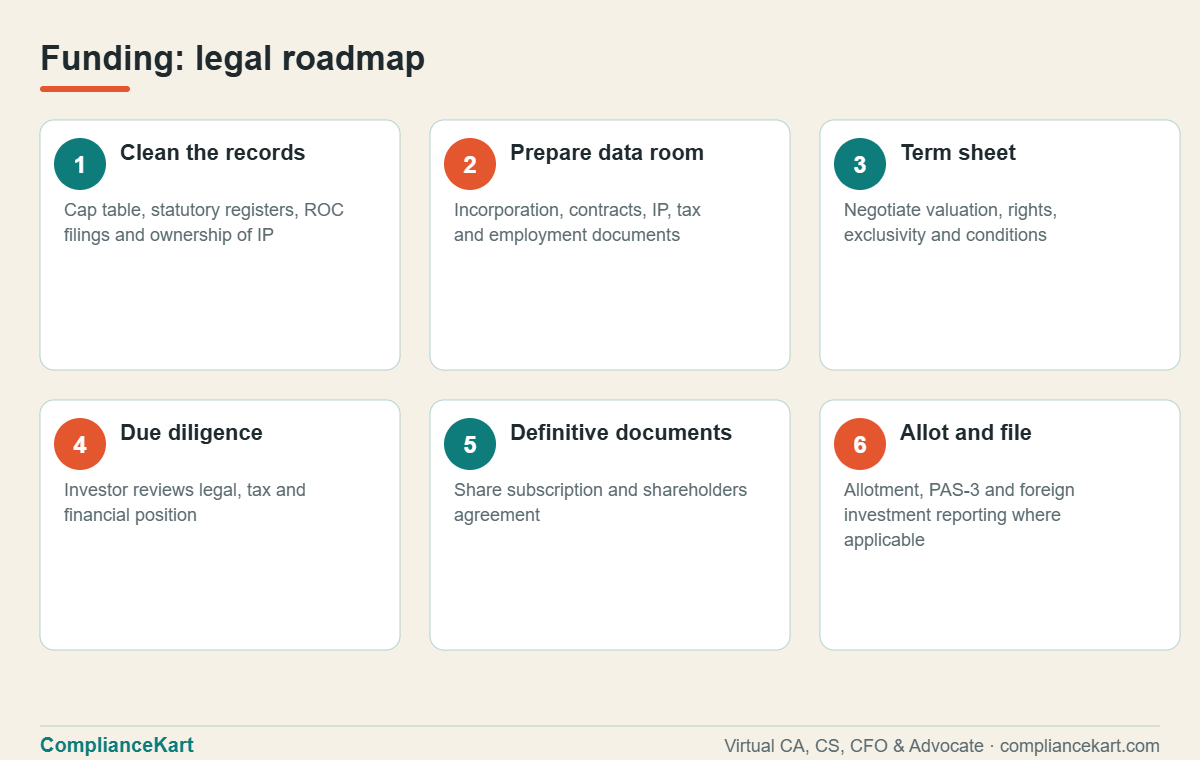
1. Clean cap table and statutory records
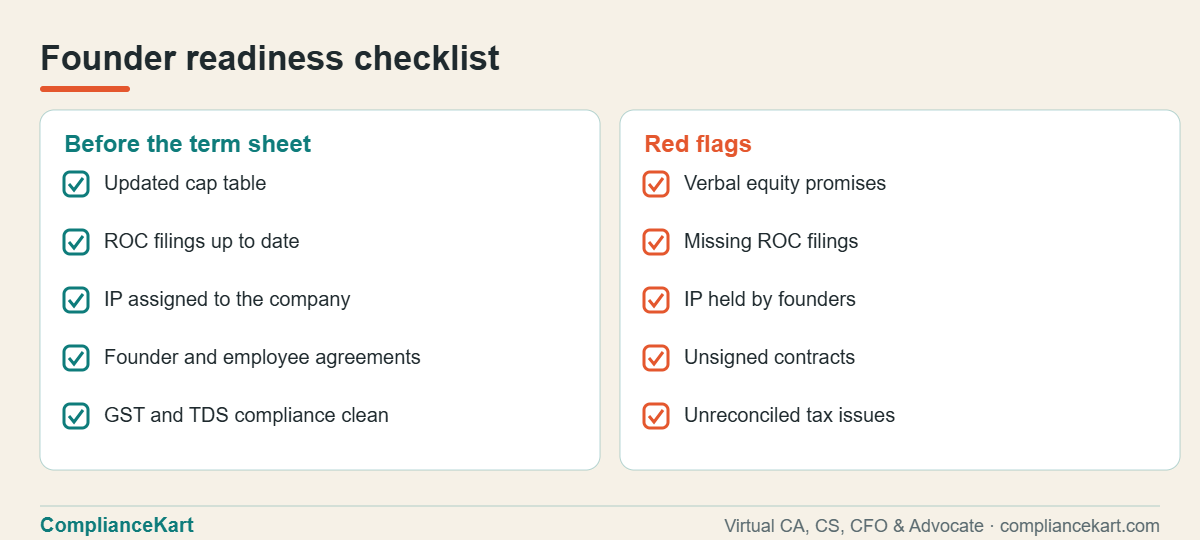
Match founder holdings, ESOPs and convertible instruments with the register of members and ROC filings. A mismatch is one of the first diligence findings. If ownership between founders is not documented, put it in a founders’ agreement; see shareholders agreement basics and contract drafting for startups.
2. Term sheet
A term sheet is usually non-binding except for clauses such as confidentiality and exclusivity. Review valuation, investment amount, liquidation preference, anti-dilution, board seats, vesting and information rights before signing.
3. Due diligence and data room
| Area | Documents investors usually ask for |
|---|---|
| Corporate | Certificate of incorporation, MOA and AOA, registers, ROC filings, board and shareholder resolutions |
| IP | Trademark filings, IP assignment agreements, open source and licence records |
| Contracts | Customer and vendor contracts, NDAs, employment and consultant agreements |
| Tax and finance | Financial statements, GST and TDS returns, income tax returns, any notices |
| People | ESOP plan, offer letters, PF and ESI compliance (confirm applicability) |
4. Valuation and allotment
- Issue of shares to investors is typically through a preferential allotment or private placement under the Companies Act, 2013 (sections 62 and 42), with shareholder approval by special resolution and filing of Form PAS-3 within the prescribed time after allotment.
- A registered valuer’s report is generally required for preferential allotments, and issue to non-residents must meet FEMA pricing norms (confirm).
- Angel tax on share premium received by unlisted companies has been abolished from a later assessment year, but confirm applicability to your transaction with a tax professional.
5. Foreign investment
If an overseas investor invests, shares must be allotted within the time prescribed under FEMA rules from receipt of funds, and the investment must be reported to the RBI through the prescribed portal and form within the stipulated time (confirm the current timelines and form). See our guide on foreign founders and NRIs starting a company in India.
Common mistakes
- Raising money on a handshake without documenting the terms.
- Allotting shares before the approvals and valuation are in place.
- Missing PAS-3 and foreign investment reporting deadlines.
- Leaving IP in a founder’s personal name.
Funding readiness for Hyderabad startups
Hyderabad’s founders in Hitech City, Gachibowli and Kondapur typically meet angels, accelerators and venture funds. The legal readiness work is the same for everyone, and doing it early saves weeks at closing.
Why work with ComplianceKart
ComplianceKart is a boutique practice bringing Chartered Accountants, Company Secretaries and advocates under one roof. Think of a multi-speciality hospital: you walk in with one concern, and the physician, the radiologist and the surgeon coordinate on your case instead of you running between three clinics. Fundraising readiness works the same way, because it touches company law, tax, banking and contracts at once, and a single coordinated team keeps those pieces consistent.
We do not guarantee approvals or timelines, since those depend on the regulator and on your documents. What we can do is prepare the filings carefully, tell you what is likely to be queried and keep you informed at each step.
Talk to us: WhatsApp 99595 36391 | Call 9959536391 | team@compliancekart.com | compliancekart.com
Frequently asked questions
Is a term sheet legally binding?
Generally not in full, but exclusivity and confidentiality clauses can be binding.
Do I need a valuation report?
Usually yes for preferential allotments, and FEMA pricing norms apply to non-residents.
What is PAS-3?
The return of allotment filed with the Registrar after shares are issued.
Can I raise money without incorporating a company?
Equity investment requires a company or LLP structure. Incorporate first.
Do I need DPIIT recognition to raise funds?
No, but it can help with tax and other benefits. See DPIIT recognition.
Sources
- Ministry of Corporate Affairs: Companies Act, 2013 (sections 42 and 62); RBI FEMA regulations on foreign investment.
This article is general information as on 16 October 2026 and is not advice on your specific facts. Rules, fees, thresholds and portals change, so confirm current requirements on the official source before acting.
Need this done for your business?
Send us one message. A CA, CS or Advocate replies within a working day — no forms, no obligation.