Contract Drafting for Startups: The 7 Agreements That Protect Your Equity, IP and Cash
The 7 agreements a startup needs, the Indian law behind each clause, and the drafting mistakes that cost founders equity, IP and cash.
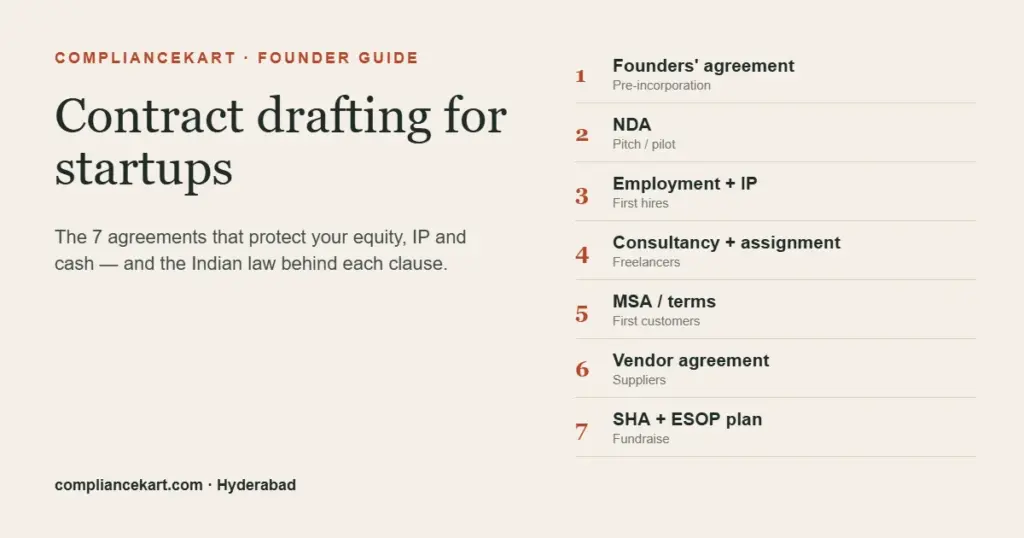
Two co-founders in Hitech City split equity 50:50 on a WhatsApp call. Eighteen months later one leaves, keeps half the company, and the code a freelancer wrote turns out to belong to the freelancer. Nothing illegal happened. Nothing was written down.
Contract drafting for startups is how founders decide, in advance, who owns what, who pays when, and what happens when things go wrong. Indian law fills every gap you leave with a default rule, and those defaults rarely favour the founder. This guide maps the seven agreements a startup needs, the statutory rule behind each key clause, and the drafting mistakes we see most often.
Why contract drafting matters more for a startup
A large company can absorb a bad contract. A startup cannot, because its only assets are usually equity, intellectual property and a handful of customer relationships. Three points of Indian law make careful drafting non-negotiable:
- Defaults decide silent contracts. Under the Copyright Act, 1957, a freelancer who writes your code or designs your logo is generally its first owner unless they assign it to you in writing (Sections 17 to 19).
- Some clauses are void however you draft them. Section 27 of the Indian Contract Act, 1872 voids agreements restraining a lawful trade or profession. A non-compete that bites after an employee leaves is generally unenforceable.
- Penalty figures are not automatic. Under Section 74, courts award reasonable compensation up to the stated amount, not the stated amount itself. The Supreme Court confirmed this in Kailash Nath Associates v. DDA (2015).
The 7 agreements every startup needs, by stage
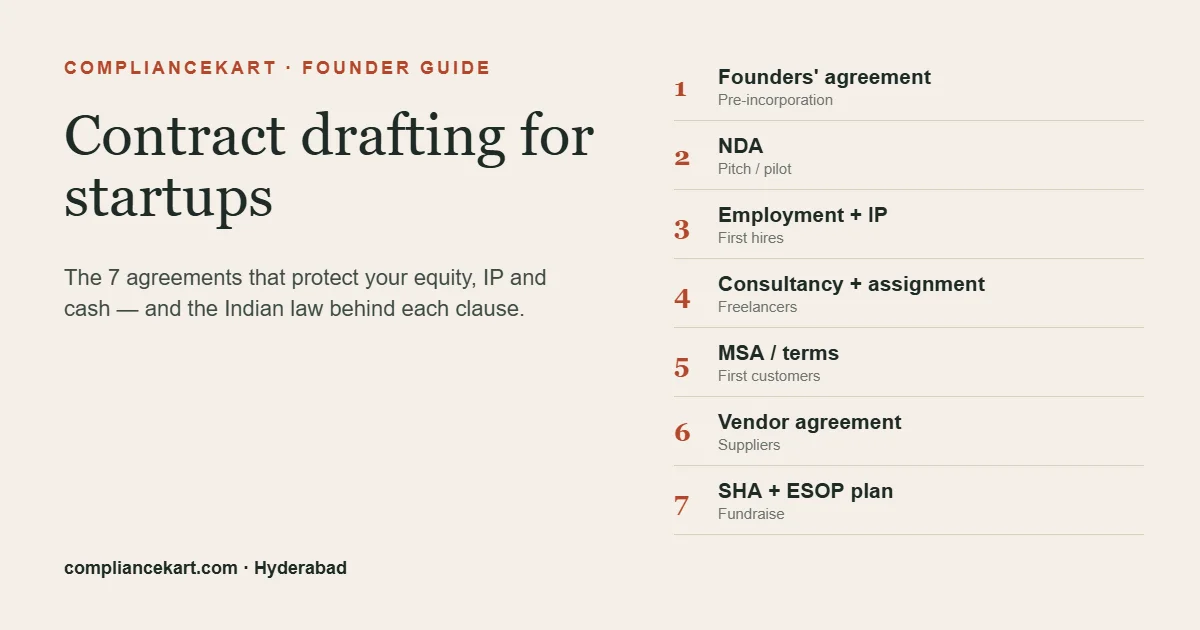
| Stage | Agreement | What it must settle |
|---|---|---|
| Before incorporation | Founders’ agreement | Equity split, vesting, roles, IP brought in, exit and deadlock |
| Before any pitch or pilot | Non-disclosure agreement (NDA) | What is confidential, permitted use, duration, return of data |
| First hires | Employment agreement | Role, IP assignment, confidentiality, notice, in-term non-compete |
| Freelancers and agencies | Consultancy / service agreement | Deliverables, written IP assignment, payment milestones |
| First customers | Master service agreement or terms of service | Scope, SLAs, liability cap, payment terms, termination |
| Suppliers and vendors | Vendor agreement | Price, delivery, acceptance, GST responsibility, warranties |
| Fundraise | Shareholders’ agreement and ESOP plan | Investor rights, transfer restrictions, option pool, vesting |
Our detailed guide on the shareholders’ agreement covers the fundraise stage in depth, and our note on deeds and legal drafting covers property, lease and partnership documents.
Clause by clause: the law that decides the outcome
1. IP assignment — write it, sign it, specify it
For employees working under a contract of service, Section 17(c) of the Copyright Act makes the employer the first owner of work created in the course of employment, unless the contract says otherwise. Freelancers and agencies are different: their work stays theirs until assigned. Sections 18 and 19 require the assignment to be in writing, signed, and to identify the rights, duration and territory. An invoice and a payment receipt do not transfer ownership.
2. Non-compete and non-solicit — draft what courts enforce
The Supreme Court upheld a restraint operating during employment in Niranjan Shankar Golikari v. Century Spinning (1967), and refused to enforce a post-employment restraint in Superintendence Company of India v. Krishan Murgai (1980). Practical approach: keep exclusivity during the term, and rely on confidentiality and IP clauses after it. A post-exit non-compete may still deter, but do not build your protection on it.
3. Liquidated damages — a ceiling, not a guarantee
Courts treat a liquidated damages figure as the maximum recoverable, and expect it to be a genuine pre-estimate of loss. Draft the reasoning behind the number into the contract, and keep evidence of actual loss.
4. Payment terms — the MSME rule overrides your contract
If your startup buys from a micro or small enterprise registered under the MSMED Act, 2006, Section 15 caps the agreed credit period at 45 days from acceptance. Section 16 makes late payment carry compound interest with monthly rests at three times the RBI bank rate. If you are the registered enterprise, draft your invoices and contracts to rely on this. See the benefits of MSME registration.
5. Stamp duty — unstamped is not void, but it is a problem
On 13 December 2023, a seven-judge bench of the Supreme Court held in In Re: Interplay between Arbitration Agreements and the Indian Stamp Act that an unstamped or insufficiently stamped agreement is not void. It is, however, inadmissible in evidence until duty and any penalty are paid. Stamp your agreements when you sign them; paying later at a dispute stage costs more and delays relief.
6. Dispute resolution — choose the forum before the dispute
An arbitration clause should name the seat, the number of arbitrators and the rules. For small-value founder and vendor disputes, a clause naming Hyderabad courts or a short arbitration process saves months. When a dispute does arise, read our guide on sending or replying to a legal notice.
7. E-signing — valid for most, not all, documents
Section 10A of the Information Technology Act, 2000 confirms a contract is not unenforceable merely because it was concluded electronically. The Act’s First Schedule excludes powers of attorney, trusts, wills and contracts for sale or conveyance of immovable property. Those still need physical execution and, where required, registration.
Common drafting mistakes founders make
- Downloading a foreign template. US-style “work for hire” and broad non-competes do not translate into Indian law.
- Equal equity with no vesting. A co-founder who leaves in month six keeps everything.
- No IP clause with freelancers. The single most common gap we find in due diligence.
- Unlimited liability to enterprise customers. Cap liability at fees paid over a defined period.
- Leaving GST silent. State whether prices are inclusive or exclusive of GST and who bears it if credit is denied.
- Signing before incorporation, in a personal name. Execute in the company’s name once it exists, or ratify pre-incorporation contracts.
- Never reviewing. Contracts signed at the seed stage rarely suit Series A terms.
Contract drafting for Hyderabad startups
Founders in Hitech City, Gachibowli, Kondapur and the Financial District often work with enterprise clients, global capability centres and overseas investors from day one. That means contracts that must survive procurement review, cross-border data clauses and investor due diligence. Get the entity right first — see company registration in Hyderabad — then sign every material contract in the company’s name.
Why work with ComplianceKart
A startup contract sits where contract law, tax, company law and IP meet. ComplianceKart is a boutique practice bringing CAs, CSs and advocates under one roof. Think of a multi-speciality hospital: the surgeon, the anaesthetist and the cardiologist look at the same patient before the operation. Here, the advocate drafts the clause, the CA checks its GST and tax effect, and the CS aligns it with your Articles and filings — before you sign.
We draft, review and update founders’ agreements, NDAs, employment and consultancy contracts, customer and vendor agreements, and shareholders’ agreements. We do not promise outcomes in any dispute; we make sure your paper says what you meant.
Have a contract to draft or review? WhatsApp us · Call 9959536391 · team@compliancekart.com
Frequently asked questions
Is a verbal agreement valid in India?
Yes, most contracts can be oral under the Indian Contract Act, 1872. Proving the terms is the problem, which is why written contracts matter.
Is an unstamped agreement invalid?
No. The Supreme Court held on 13 December 2023 that it is not void, but it cannot be admitted in evidence until stamp duty and any penalty are paid.
Can I stop an employee from joining a competitor after they leave?
Generally not. Section 27 voids post-employment restraints. You can protect confidential information, IP and client data through specific clauses.
Who owns code written by a freelancer?
The freelancer, unless they assign it to you in a signed written agreement that meets Sections 18 and 19 of the Copyright Act.
Are e-signed contracts valid?
Yes for most commercial contracts under Section 10A of the IT Act. Powers of attorney, trusts, wills and immovable property sale contracts are excluded.
Do I need a founders’ agreement if we have Articles of Association?
Yes. Articles bind the company and members, but vesting, roles and exit terms between founders are usually better set in a founders’ or shareholders’ agreement aligned with the Articles.
Sources
- Kailash Nath Associates v. DDA (2015) — Supreme Court Reports
- Seven-judge bench on unstamped agreements, 13 Dec 2023 — Trilegal summary
- MSMED Act Sections 15–16 — SCC Online
Sign the right paper first
Every hour spent on a contract before signing saves weeks after a dispute. Start with the founders’ agreement and IP assignments, stamp what you sign, and review your contracts at every funding round.
This article is general information, not legal advice for your specific facts.
Need this done for your business?
Send us one message. A CA, CS or Advocate replies within a working day — no forms, no obligation.