GSTR-9 and 9C for FY 2025-26: Who Files, What Is Optional and the 31 December 2026 Deadline
GSTR-9 and 9C for FY 2025-26: who must file, mandatory vs optional tables, due date 31 Dec 2026 and late fee. A guide for Hyderabad businesses.
A Hyderabad founder closes March 2026 with a ₹6 crore turnover, a sales team in Gachibowli, and one big question: “Do I file only GSTR-9, or GSTR-9C as well?” With Notification 05/2026-Central Tax dated 26 October 2026 reshaping the instructions for both forms, it is the right question to ask.
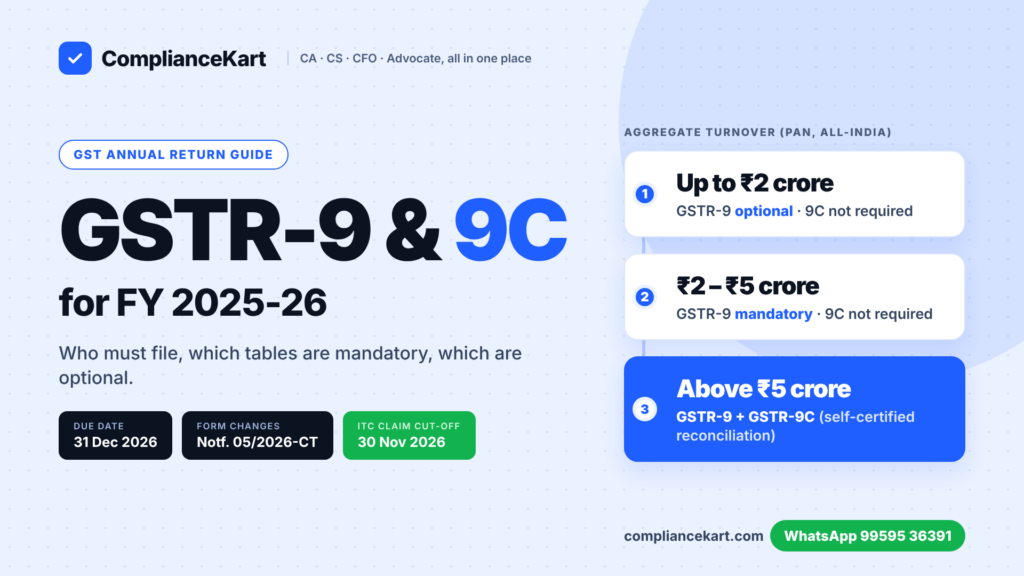
Short answer: GSTR-9 is the annual GST return and GSTR-9C is the reconciliation statement. For FY 2025-26, GSTR-9 is optional up to ₹2 crore aggregate turnover and mandatory above it. GSTR-9C is required above ₹5 crore and is self-certified. The due date is 31 December 2026.
What the 2026 notification changes
Notification No. 05/2026-Central Tax (G.S.R. 919(E)), dated 26 October 2026, amends the instructions to FORM GSTR-9 and FORM GSTR-9C for FY 2025-26 onwards. In substance, it carries forward the table-level relaxations earlier allowed for FY 2023-24 and FY 2024-25. Most reporting stays unchanged. Form changes in the notification come into force on 1 November 2026 unless stated otherwise.
Who must file: turnover limits
Aggregate turnover is computed on a PAN basis across all GSTINs, all-India.
| Aggregate turnover (FY 2025-26) | GSTR-9 | GSTR-9C |
|---|---|---|
| Up to ₹2 crore | Optional (exempt under Notification 15/2025-CT, 17 Sept 2025) | Not required |
| Above ₹2 crore to ₹5 crore | Mandatory | Not required |
| Above ₹5 crore | Mandatory | Mandatory (self-certified; Rule 80(3)) |
Composition taxpayers file GSTR-9A. Casual taxable persons, non-resident taxable persons, input service distributors and persons deducting or collecting tax at source (Sections 51 and 52) do not file GSTR-9.
GSTR-9 for FY 2025-26: mandatory vs optional tables
| Tables | Reporting | Status |
|---|---|---|
| 4A–4G, 4I–4L | Outward supplies, advances, reverse charge, credit/debit notes and amendments | Mandatory |
| 5A–5C1 | Zero-rated supplies and supplies where recipient pays tax | Mandatory |
| 5D–5F | Exempted, nil-rated and non-GST supplies | Mandatory. “Exempted” and “nil-rated” may be clubbed in 5D; non-GST shown separately in 5F |
| 5H–5K | Credit/debit notes and amendments for 5A–5F | Optional; may be clubbed into 5A–5F |
| 6A, 6A2 | ITC per GSTR-3B; net ITC of the year | Auto-populated / auto-calculated |
| 6A1 | Preceding-year ITC claimed in current-year 3B | Mandatory |
| 6B–6D | ITC on inward supplies, RCM | Mandatory. “Inputs” and “input services” may be clubbed; capital goods shown separately |
| 6E–6M | Imports, ISD, Rule 37/37A, TRAN-1/2 and other ITC | Mandatory |
| 7A–7G | ITC reversals (Rules 37, 37A, 38, 39, 42, 43, Section 17(5)) | Mandatory, reported separately |
| 8A–8K | ITC reconciliation | Mandatory |
| 9 | Tax payable and paid | Mandatory |
| 10–11 | Outward liability of FY 2025-26 shown/reduced in FY 2026-27 up to 30 Nov 2026 | Mandatory |
| 12–13 | ITC of FY 2025-26 reversed/availed in FY 2026-27 up to 30 Nov 2026 | Mandatory; do not net off 12 and 13 |
| 15–16 | Demands, refunds, inward supplies from composition/deemed supply/job work | Optional |
| 17 | HSN summary of outward supplies | Mandatory: 6-digit for turnover above ₹5 crore (all supplies); 4-digit for B2B supplies below ₹5 crore |
| 18 | HSN summary of inward supplies | Optional |
Always cross-check this classification against the latest form instructions on the GST Portal before filing.
GSTR-9C for FY 2025-26: mandatory vs optional tables
| Tables | Reporting | Status |
|---|---|---|
| 5A | Turnover as per audited financial statements | Mandatory |
| 5B–5N, 5O | Adjustments to turnover | Mandatory; may be clubbed into 5O |
| 7A–7F | Reconciliation of total vs taxable turnover | Mandatory |
| 9A–9Q | Reconciliation of tax paid | Mandatory |
| 12A–12D | ITC: books vs GSTR-9 | Mandatory |
| 14 | Expense head-wise ITC reconciliation | Optional |
The rate change that complicates FY 2025-26
From 22 September 2025, most goods and services moved to the 5% and 18% rates, with 40% for specified items, folding in the earlier 12% and 28% slabs. For FY 2025-26, therefore:
- Split sales at 21/22 September 2025 and report each rate on its own line in Tables 4 and 5.
- Credit notes raised after the change for earlier supplies follow the original supply’s rate.
- In Table 17, an HSN code that changed rate needs two lines: pre- and post-22 September.
- If software was updated mid-year, rerun the HSN summary by date range and add the results.
Illustration (assumed numbers, not a real case): ₹80 lakh at 12% (till 21 September) gives ₹9.6 lakh tax; ₹1.2 crore at 18% (from 22 September) gives ₹21.6 lakh. Total ₹2 crore turnover, ₹31.2 lakh tax. Table 4 should show both lines, not a blended rate.
ITC: the 30 November 2026 cut-off
Under Section 16(4) of the CGST Act, ITC for FY 2025-26 can be claimed up to 30 November 2026 (or the date of filing the annual return, if earlier). GSTR-9 cannot be used to claim ITC missed in GSTR-3B. Any short-paid output tax is paid via Form DRC-03 with interest before filing.
Due date and late fee
GSTR-9 and GSTR-9C for FY 2025-26 are due on 31 December 2026. Late fee under Section 47(2) is charged per day, per GSTIN:
| Aggregate turnover | Per day (CGST + SGST) | Cap |
|---|---|---|
| Up to ₹5 crore | ₹50 (₹25 + ₹25) | 0.04% of turnover in the State/UT |
| ₹5 crore to ₹20 crore | ₹100 (₹50 + ₹50) | 0.04% |
| Above ₹20 crore | ₹200 (₹100 + ₹100) | 0.5% |
Where GSTR-9C is required, the fee continues until it is filed as well. Non-filing can also trigger a GSTR-3A notice under Section 46.
Common mistakes to avoid
- Treating the ₹2 crore exemption as per-GSTIN; it is PAN-wise, all-India.
- Reporting 6A1 credit under 6H (or the reverse).
- Using 2B-based Table 8A as an entitlement; it is a comparison figure.
- Leaving 8C blank, which distorts 8D.
- Showing one blended rate for the whole year.
- Netting Tables 12 and 13.
- Filing GSTR-9C before the audited financials match your books.
A mismatch between GSTR-9 and GSTR-3B is a reconciliation item, not proof of wrongdoing. Record the reason, correct what can still be corrected and keep the working file.
Hyderabad lens
Many Hyderabad SMEs, from startups near Hitech City and Kondapur to service and trading businesses around Gachibowli, Kokapet and the Financial District, run several GSTINs under one PAN or move from the ₹2 crore to the ₹5 crore band in a single year. Check the combined PAN turnover before deciding on GSTR-9C. Our note on GST circulars 257 to 264 of 2026 covers other recent GST changes.
Why work with ComplianceKart
Think of a multi-speciality hospital: the general physician, the surgeon and the pathologist work from one file, so you are not carrying reports between clinics. ComplianceKart is a boutique practice bringing CAs, CSs and advocates under one roof, so your GST reconciliation, ROC position and any notice response are handled together.
Get help with GST return filing on WhatsApp · Email team@compliancekart.com · Call 9959536391
FAQs
Is GSTR-9 mandatory for FY 2025-26?
Yes, where aggregate turnover exceeds ₹2 crore. Up to ₹2 crore it is optional.
Who must file GSTR-9C?
Taxpayers with aggregate turnover above ₹5 crore. It is self-certified; a CA certificate is not required.
What is the due date?
31 December 2026, subject to any extension notified by the Government.
Can I claim missed ITC through GSTR-9?
No. The Section 16(4) cut-off for FY 2025-26 is 30 November 2026, and GSTR-9 cannot be used to claim credit.
Which tables are optional?
In GSTR-9: 5H–5K (separate reporting), 15, 16 and 18. In GSTR-9C: Table 14.
What happens if I file late?
Section 47(2) late fee applies per day, subject to a cap by turnover.
Sources
- CBIC Notification 05/2026-Central Tax (G.S.R. 919(E)), 26 October 2026 — cbic-gst.gov.in
- Notification 15/2025-Central Tax, 17 September 2025; Notification 07/2023-Central Tax (late fee)
- CGST Act, 2017: Sections 16(4), 44, 46, 47(2); CGST Rules, 2017: Rule 80
- GST Portal — gst.gov.in
This article is for general information and is not legal or tax advice. Verify current law before acting.
Need this done for your business?
Send us one message. A CA, CS or Advocate replies within a working day — no forms, no obligation.