Invest in US Stocks from Hyderabad: What You Will Pay, and What You Must Disclose
Hyderabad investor in US stocks? Understand LRS, 20% TCS, capital gains tax, Form 67 and Schedule FA disclosure, with tips for Kondapur and Hitech City.
A software professional near Hitech City receives a bonus, opens the international tab on her broking app and buys a few US shares. Months later she files her return, and the US holding appears nowhere in it. That omission, not the investment, is what creates trouble.
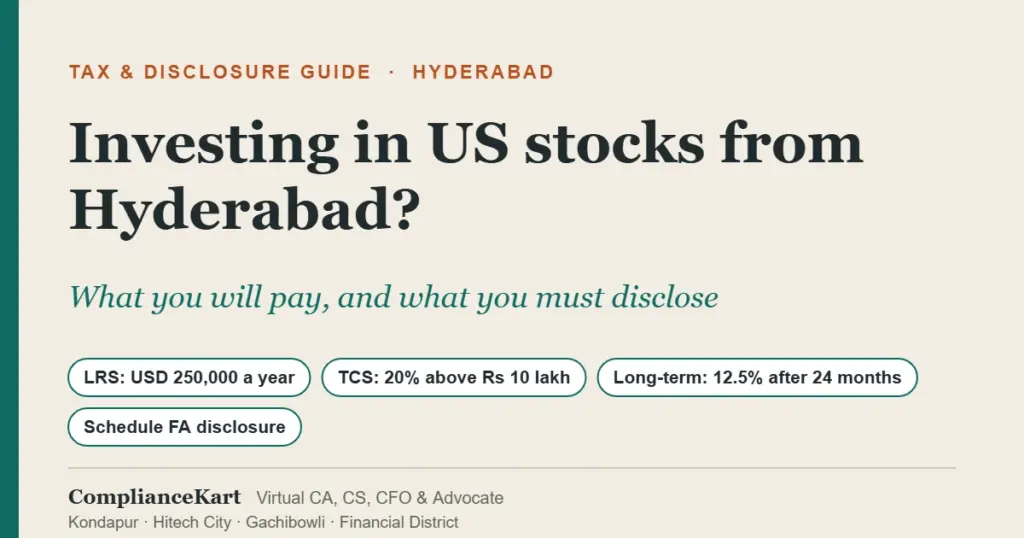
Short answer: A Hyderabad resident (like any resident individual in India) can invest in US stocks through the Liberalised Remittance Scheme (LRS), up to USD 250,000 per financial year. Tax collected at source (TCS) may apply on the remittance, gains and dividends are taxable in India, and every holding must be disclosed in the income tax return, even a loss-making one.
This guide is written for investors in Hyderabad, from Kondapur, Hitech City and Gachibowli to the Financial District. It covers the routes, costs, tax rates and disclosure schedules, with worked numbers.
How can a Hyderabad resident invest in US stocks?
There are three routes.
- GIFT City-based Indian brokers. In October 2026, Zerodha launched US stock investing in beta, routed through BSE’s India INX Global Access at GIFT City, with the securities held through a US brokerage partner. It reports access to up to 2,000 US companies and about 1,000 ETFs, fractional investing from USD 1, and funding by netbanking only. Groww, Upstox and Angel One were reported to have received IFSCA approval in June 2026.
- A foreign brokerage account. You remit funds through an authorised dealer bank and handle foreign tax forms and records yourself.
- Indian funds investing overseas. You invest in rupees with no LRS, TCS or foreign account. Several such funds have restricted fresh inflows, so check availability.
Routes 1 and 2 use your LRS limit. Eligibility differs by platform; Zerodha’s page, for example, states that only resident individual accounts qualify, and not joint accounts, HUFs, companies or NRIs.
What does it cost?
| Cost | Position reported by the platforms |
|---|---|
| Brokerage (Zerodha) | 0.1% of trade value, capped at USD 10 per order, plus 18% GST on brokerage |
| Regulatory fees | IFSCA turnover fee of 0.005% and US transaction fees on sells |
| Currency conversion | Often the largest cost. Zerodha reports a negotiated markup of 0.5% to 1.2% over the RBI reference rate; another platform reports typical bank markups of 3% to 5% |
| TCS on remittance | See below (a prepayment of tax, not an extra cost) |
Compare the conversion markup before choosing a platform. It applies on the way in and the way out.
LRS and TCS: how much is collected upfront?
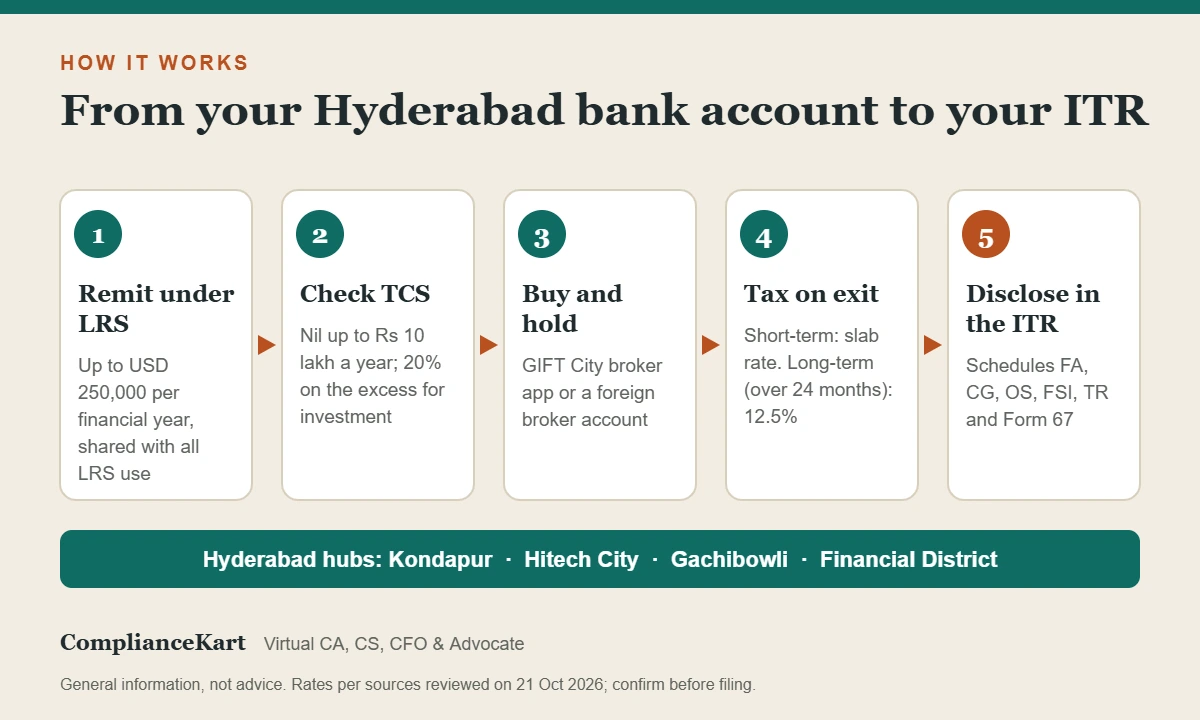
For FY 2026-27, TCS on LRS remittances for investment and most other purposes is nil up to Rs 10 lakh in a financial year and 20% on the amount above it, under section 394 of the Income-tax Act, 2025 (earlier section 206C(1G)). The threshold was Rs 7 lakh earlier. Lower rates apply to education and medical remittances, which do not usually concern an investor.
Example (illustrative): You remit Rs 15 lakh in the year and have no other LRS remittance. TCS = 20% x Rs 5 lakh = Rs 1,00,000.
TCS is not an additional tax. It shows in Form 26AS and AIS and is adjusted against your tax liability or refunded after you file your return. The cash-flow cost is real, so plan the remittance in tranches and consider your tax position before a large transfer.
Tax on gains from US stocks
Under the India-US tax treaty, capital gains on US shares by an Indian resident are taxed in India. Foreign shares are not covered by the concessional regime for listed Indian equity, so the following applies:
| Holding period | Character | Rate |
|---|---|---|
| Up to 24 months | Short-term | Normal slab rate |
| More than 24 months | Long-term | 12.5% without indexation |
Surcharge and 4% cess are extra. Gains are computed in rupees, with cost and sale proceeds converted at the SBI telegraphic transfer buying rate prescribed in Rule 115 of the Income-tax Rules; the relevant date differs by item, so check it when computing.
Examples (illustrative, surcharge ignored):
- Long-term gain of Rs 5,00,000: 12.5% = Rs 62,500; with 4% cess = Rs 65,000.
- Short-term gain of Rs 2,00,000 for a person in the 30% slab: Rs 60,000; with cess = Rs 62,400.
Losses can be set off under the usual rules for the relevant head and character of gain, and carry-forward needs a return filed by the due date.
Tax on US dividends
Dividends are taxable in India at your slab rate. The US withholds tax on dividends to Indian residents, reported by the platforms at 25% under the treaty, provided the investor has furnished the US form for non-US persons.
Example (illustrative): Dividend of USD 100, at Rs 85 per dollar = Rs 8,500. US tax withheld = USD 25 (Rs 2,125). Indian tax at 30% = Rs 2,550 before cess. Foreign tax credit of Rs 2,125 is available, so the additional Indian tax is about Rs 425 plus cess. The credit is limited to the lower of foreign tax paid and Indian tax on that income, and is claimed by filing Form 67.
Why disclosure matters more than the tax
The tax on a modest portfolio is manageable. The penalty for not reporting is not.
| Where | What to report |
|---|---|
| Schedule FA | Every foreign asset held at any time during the calendar year, with peak and closing value and sale proceeds. Reported on a calendar-year basis, not the financial year |
| Schedule CG | Capital gains on sale of the US shares |
| Schedule OS | Dividend income, in rupees |
| Schedule FSI | Income arising outside India and tax paid there |
| Schedule TR | Summary of foreign tax relief claimed |
| Form 67 | Filed on or before the return due date to claim foreign tax credit |
Two practical points. First, a return form that does not accommodate foreign assets, such as ITR-1, cannot be used; you will need ITR-2 or ITR-3. Second, the Income-tax Act, 2025 applies from 1 April 2026, but returns for FY 2025-26 are still governed by the 1961 Act, so check which forms and section numbers apply to your return year.
Consequences of non-disclosure. The Black Money (Undisclosed Foreign Income and Assets) and Imposition of Tax Act, 2015 provides for a penalty of Rs 10 lakh for failing to furnish foreign asset information in the return, and heavier tax and penalty for undisclosed foreign assets. Since 1 October 2024, non-disclosure of foreign assets other than immovable property with aggregate value up to Rs 20 lakh is shielded from penalty and prosecution. Foreign account information also reaches the department through international information exchange.
Past omissions. Budget 2026 proposed the Foreign Assets of Small Taxpayers Disclosure Scheme (FAST-DS), a limited window for small taxpayers with unreported foreign assets. Eligibility, payments and dates are set by the official notification, which should be read before relying on the scheme.
Other points to consider
- FEMA. Remittances must stay within LRS and its conditions, and sale proceeds should be repatriated within the timelines under FEMA rules.
- US estate tax. Non-US persons holding US-situs assets can be exposed to US estate tax above a low exemption (reported as USD 60,000, at rates of 18% to 40%). Consider this in estate planning.
- Records. Keep contract notes, annual statements, dividend statements and remittance advices. Schedule FA needs peak-value data that many apps do not show in one place.
- Gifts and family. Remittances for investment in a family member’s name raise gift and clubbing questions.
Hyderabad investors: practical points
Hyderabad’s technology and finance employers in Kondapur, Hitech City, Gachibowli and the Financial District mean many residents hold foreign equity in more than one way: US stocks bought through an app, and RSUs or ESOPs granted by a global employer. Both belong in the same return.
- Residential status decides reporting. Schedule FA applies to resident taxpayers. Income tax is a central levy, so the rates and rules are the same across India, but a recently returned NRI should confirm status before filing.
- Use your bank trail. LRS remittances go through your authorised dealer bank with a purpose declaration. Keep the remittance advice, as it supports both the TCS credit and the cost of acquisition.
- Employer stock plans. Foreign RSUs and ESOPs held in an employer plan account are foreign assets to be reported in Schedule FA, in addition to any US stocks you bought yourself. Their tax treatment on vesting and sale should be computed separately.
- Evening trading hours. Zerodha’s page lists US market hours as 7:00 PM to 1:30 AM IST during US daylight saving time (until 31 October 2026) and 8:00 PM to 2:30 AM IST otherwise, so orders usually fall after the working day.
- Reconcile before filing. Match TCS in Form 26AS and AIS with your remittance advices, and gather calendar-year peak and closing values for Schedule FA.
Why work with ComplianceKart
ComplianceKart is a boutique practice bringing Chartered Accountants, Company Secretaries and advocates under one roof. Think of a multi-speciality hospital: the problem is seen by the right specialist, and the specialists coordinate instead of leaving you to carry reports between clinics. A US stock portfolio touches tax, FEMA and, at times, notice or penalty questions, and one coordinated team can handle remittance planning, return preparation with the right schedules, Form 67 filing, and responses to departmental communication. The support is delivered virtually, so investors in Kondapur, Hitech City and across Hyderabad can work with the team without travelling. No outcome, saving or refund is guaranteed.
Next step: WhatsApp us | team@compliancekart.com | 9959536391
FAQs
How much can I invest in US stocks from India?
Up to USD 250,000 per financial year under LRS, shared with all your other LRS remittances.
Is TCS charged on every US stock purchase?
TCS applies to LRS remittances above Rs 10 lakh in a financial year at 20% for investment purposes. It is adjustable against your tax liability.
Do I need to report US stocks if I made no profit?
Yes. Schedule FA requires reporting of foreign assets irrespective of gain or loss.
Can I claim the 25% US dividend tax in India?
A foreign tax credit may be claimed by filing Form 67 and reporting in Schedule TR, subject to the limits described above.
Is the GIFT City route different for tax?
The platform route changes the broker and custody arrangement. The Indian tax and disclosure analysis described here is generally the same for a resident individual, but confirm for your platform.
Do Hyderabad residents pay any Telangana tax on US stock gains?
No separate state income tax applies. Income tax is a central levy, so the rates and disclosure rules are the same for a resident in Hyderabad as elsewhere in India.
Can an NRI use these platforms?
Zerodha states that only resident individuals are eligible. NRIs are governed by different rules.
Disclaimer
This article is for general information only and is not tax, legal, investment or financial advice. Tax rates, thresholds, schemes and procedures change, and the position described here is based on publicly available sources as of 21 October 2026. ComplianceKart is not a SEBI-registered investment adviser, and nothing here recommends buying or selling any security. Investing in foreign securities carries market, currency and regulatory risk. Please obtain advice specific to your facts before acting.
Sources: Zerodha US Stocks; Inc42 report on the launch; Groww guide.
Need this done for your business?
Send us one message. A CA, CS or Advocate replies within a working day — no forms, no obligation.