How Foreign Companies Can Set Up an Indian Subsidiary in Hyderabad: Legal and Tax Checklist
Foreign company planning an Indian subsidiary in Hyderabad? A legal, FEMA and tax checklist for setting up near Hitech City, Gachibowli and Financial District.

A software company in Singapore has signed its first Indian client and wants a team near Hitech City or the Financial District. The first question from its board is simple: what does it take to set up an Indian subsidiary, and what must we keep filing afterwards?
Short answer: most foreign companies set up a private limited company in India, owned wholly or mainly by the parent. You need to confirm the Foreign Direct Investment (FDI) route for your sector, incorporate with at least one resident director, bring in capital through banking channels, report the share allotment to the Reserve Bank of India (RBI), and then meet Companies Act, Foreign Exchange Management Act (FEMA) and tax compliances every year.
Step 1: confirm the FDI route
Most sectors allow 100 per cent foreign ownership under the automatic route, without prior government approval. Some sectors have caps or need approval, and a few are prohibited. Investment from countries sharing a land border with India (Press Note 3 of 2020) needs government approval. In March 2026 DPIIT eased this to allow non-controlling stakes of up to 10 per cent through the automatic route, subject to conditions and FEMA notification, so check the current position for your shareholding.
Step 2: legal setup checklist
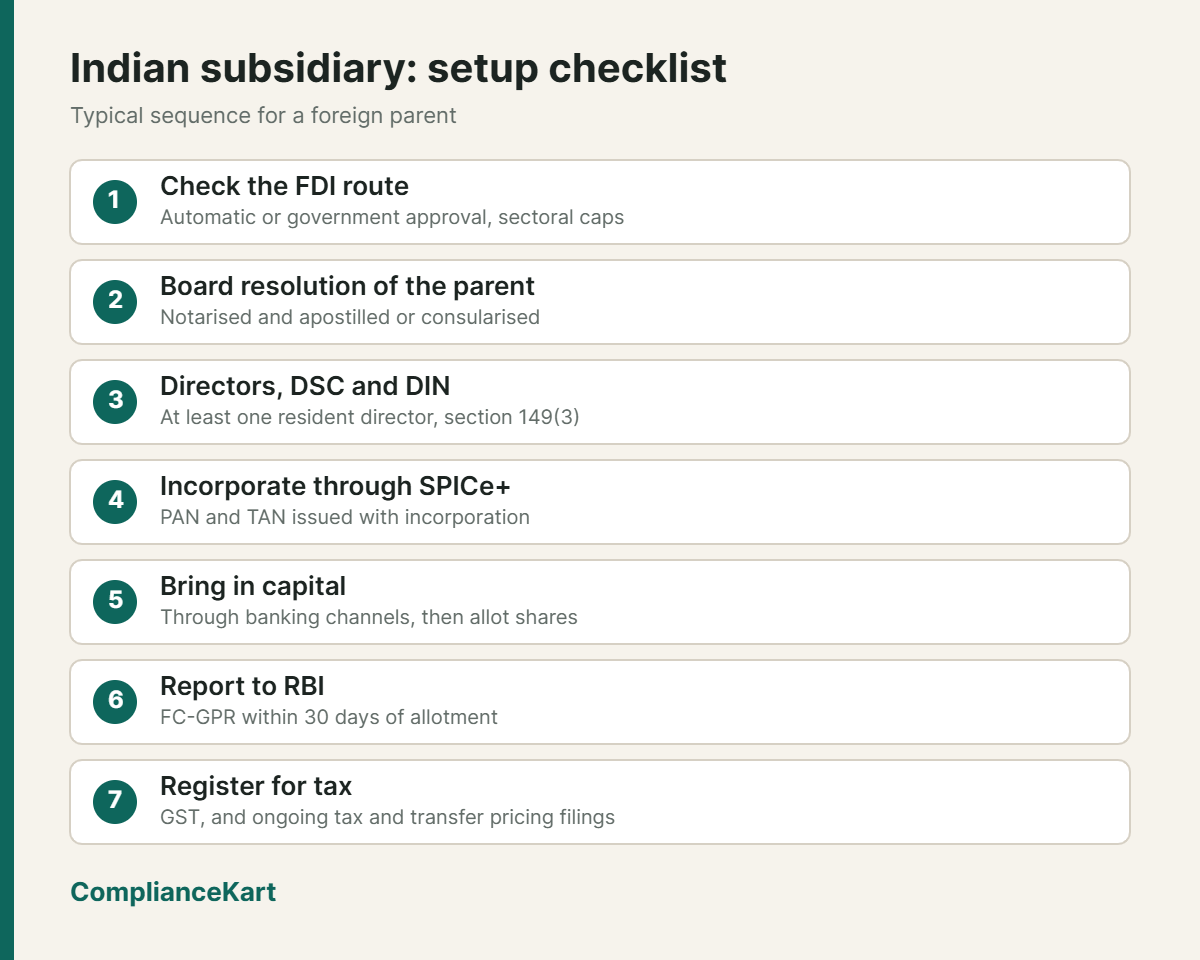
Parent company documents usually need notarisation and an apostille (or consular attestation for non-Hague countries). Each foreign director needs a Digital Signature Certificate (DSC) and a Director Identification Number (DIN). For a full walkthrough of the corporate steps, read subsidiary of a foreign company in Hyderabad: from board resolution to FC-GPR.
Need help with this? Speak to the ComplianceKart team: call 9959536391 or WhatsApp us.
Step 3: FEMA reporting
| Filing | When |
|---|---|
| FC-GPR (issue of shares to a non-resident) | Within 30 days of allotment, through the authorised dealer bank on the FIRMS portal |
| Annual return on Foreign Liabilities and Assets (FLA) | By 15 July every year |
| FC-TRS (transfer of shares between resident and non-resident) | When such a transfer happens, within the prescribed time |
Step 4: tax checklist
An Indian subsidiary is a domestic company for income tax, which is often the key reason to choose it over a branch. A branch is taxed as a foreign company.
| Point | Position |
|---|---|
| Concessional regime for domestic companies | 22 per cent plus 10 per cent surcharge and 4 per cent cess, about 25.17 per cent effective (section 115BAA of the 1961 Act; the Income-tax Act, 2025 applies from tax year 2026-27) |
| Foreign company (for example, a branch) | 35 per cent plus applicable surcharge and cess |
| Transactions with the parent | Transfer pricing rules apply, with an accountant’s report where required |
| Indirect tax | GST registration where the turnover threshold or other conditions apply |
| Withholding | TDS on payments such as royalties, fees and dividends to the parent, subject to the tax treaty |
Step 5: annual company law compliance
The subsidiary files financial statements (AOC-4) and its annual return (MGT-7) every year, holds board meetings and an AGM, and keeps director KYC current. Missing these has real consequences, explained in our guide on common non-compliances for private limited companies.
Why Hyderabad
Hitech City, Gachibowli and the Financial District host many global capability centres and technology companies, which makes talent, office space and service providers easy to find for a new subsidiary.
Why work with ComplianceKart
ComplianceKart is a boutique practice bringing Chartered Accountants, Company Secretaries and advocates under one roof. Company law, tax and regulatory filings overlap, and a gap in one shows up as a problem in another. Think of a multi-speciality hospital: the right specialists look at your case together, so you are not running between clinics. We work with founders and businesses across Hyderabad, including Hitech City, Gachibowli and Kondapur.
Frequently asked questions
Can a foreign company own 100 per cent of an Indian subsidiary?
Yes, in sectors that allow 100 per cent FDI under the automatic route, subject to the FDI policy.
Does the subsidiary need an Indian director?
At least one director must be resident in India, meaning a stay of at least 182 days in the previous calendar year under section 149(3).
When is FC-GPR filed?
Within 30 days of allotting shares to the foreign parent.
Is the subsidiary taxed as an Indian company?
Yes. It is a domestic company and can choose the concessional regime if it meets the conditions.
What is the FLA return?
An annual return to the RBI on foreign liabilities and assets, due by 15 July each year.
General information as of October 2026, not legal or tax advice.
Need this done for your business?
Send us one message. A CA, CS or Advocate replies within a working day — no forms, no obligation.