Common Non-Compliances for Private Limited Companies: Penalties and Examples
Missed AOC-4, MGT-7 or DIR-3 KYC? See private limited company non-compliance penalties under the Companies Act, with worked examples.
Last reviewed: 9 October 2026. Law in force as on that date.
Private limited company non-compliance rarely starts with anything dishonest. A missed filing with the Registrar of Companies (ROC) is enough. The late fee starts the next day and never stops growing, a director’s DIN can be deactivated, and after three years of silence the directors can be disqualified for five years.
The short answer: the most common non-compliances of a Private Limited Company are late AOC-4 and MGT-7 filings, an AGM not held on time, too few board meetings, a missed director KYC (DIR-3 KYC), INC-20A not filed after incorporation, and MSME-1 not filed. Under the Companies Act, 2013, each carries a late fee, a penalty, or both. The table below puts the law, the amount and a practical example side by side.
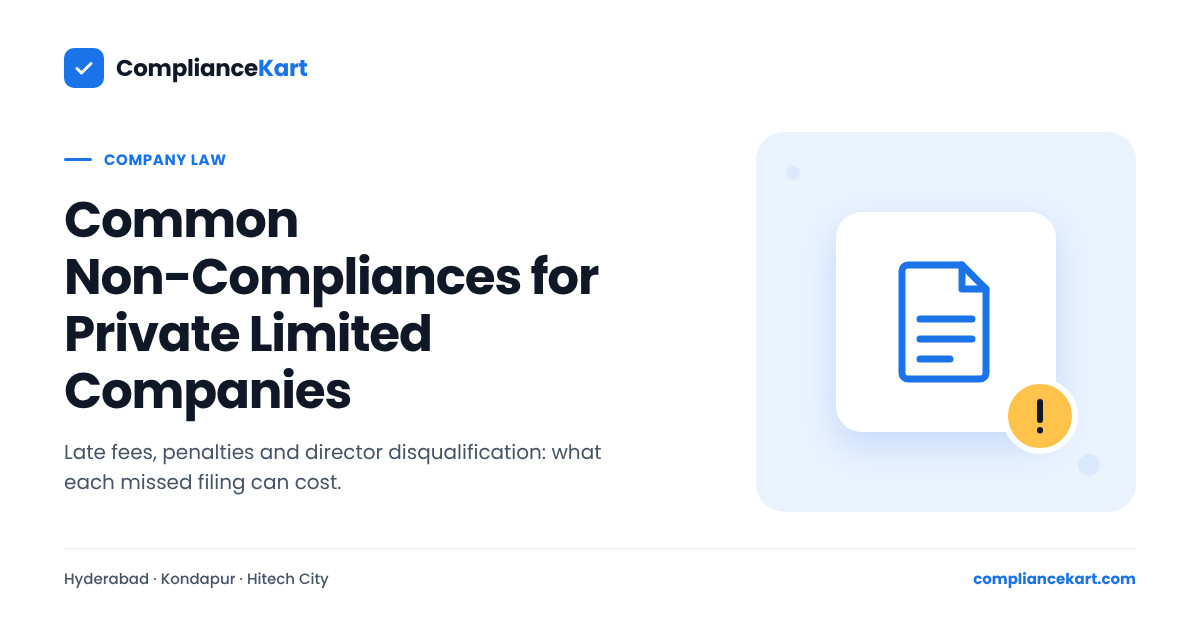
Private limited company non-compliance penalties: the ready reckoner
Every Private Limited Company must file its financial statements and annual return, whatever its turnover. Those two filings account for most of the penalty exposure. Every private limited company non-compliance listed below has its own section and amount. Amounts are statutory maximums under the Companies Act, 2013 (as amended) and the Rules in force.
| Non-compliance | Law and due date | Late fee / penalty | Example |
|---|---|---|---|
| AOC-4 (financial statements) filed late or not filed | Section 137. Within 30 days of the AGM. | Late fee of ₹100 per day, with no upper cap. Penalty of ₹10,000 plus ₹100 per day: up to ₹2 lakh on the company; up to ₹50,000 on each MD, CFO or other director held responsible. | AGM on 30 Sep 2026 makes AOC-4 due on 30 Oct 2026. Filing on 27 Feb 2027 means a late fee of ₹12,000. |
| MGT-7 / MGT-7A (annual return) filed late or not filed | Section 92. Within 60 days of the AGM. | Late fee of ₹100 per day, no upper cap. Penalty of ₹10,000 plus ₹100 per day: up to ₹2 lakh on the company and up to ₹50,000 on each officer in default. | For the same 30 Sep 2026 AGM, MGT-7 is due on 29 Nov 2026. |
| AGM not held on time | Sections 96 and 99. Within 6 months of the financial year end; first AGM within 9 months of the first year end; no more than 15 months between AGMs. | Fine of up to ₹1 lakh, plus up to ₹5,000 for every day the default continues. | A company with a 31 March year-end that has not held its AGM by 30 September. |
| Board meetings fewer than required | Sections 173 and 172. Four meetings a year, with no gap above 120 days. OPCs, small and dormant companies: at least one meeting in each half of the year, with 90 days between them. | ₹50,000 on the company and each officer in default, plus ₹500 per day for continuing failure. Maximum ₹3 lakh for the company and ₹1 lakh for each officer. | Only two meetings held in the year, or a 150-day gap between two meetings. |
| DIR-3 KYC not filed by a director | Rule 12A of the Appointment and Qualification of Directors Rules. By 30 September every year. | DIN is deactivated. ₹5,000 to reactivate. | A director holding a DIN on 31 March 2026 who has not filed by 30 Sep 2026. |
| INC-20A (commencement of business) not filed | Section 10A. Within 180 days of incorporation. | ₹50,000 on the company. ₹1,000 per day on each officer in default, up to ₹1 lakh. Strike-off proceedings also possible. | See worked example 3 below. |
| Registered office change not intimated, or name and address not displayed | Section 12. Give notice of the change to the Registrar (Form INC-22) within 15 days of the change. | ₹1,000 per day of default, up to ₹1 lakh. | Office shifted from Madhapur to Gachibowli and the ROC record still shows the old address. |
| MSME-1 not filed | Section 405. Half-yearly, by 30 April and 31 October, where dues to MSME suppliers exceed 45 days. | ₹20,000 plus ₹1,000 per day of continuing failure, subject to a maximum of ₹3 lakh. | ₹8 lakh owed to an MSME vendor for more than 45 days at 30 September: report it by 31 October. |
| Three continuous years without filing financial statements or annual returns | Sections 164(2)(a) and 248. | Directors disqualified for 5 years. The company becomes exposed to strike-off. | No AOC-4 or MGT-7 for FY 2023-24, 2024-25 and 2025-26. |
Other ROC forms, such as INC-22, ADT-1, DPT-3 and PAS-3, carry additional fees that are a multiple of the normal filing fee, rising with the delay. Since 1 July 2022 the multiple rises with the delay, up to 12 times the normal fee for delays beyond 180 days, and a higher fee applies to repeat delays on INC-22 and PAS-3.
The annual calendar that decides everything
Most penalties above are triggered by one date: the AGM. Once it is held, AOC-4 is due in 30 days, MGT-7 in 60 days and ADT-1 (if an auditor is appointed) in 15 days. Hold the AGM late and every date behind it slips with it. For a company with a 31 March year-end, the usual cycle looks like this.
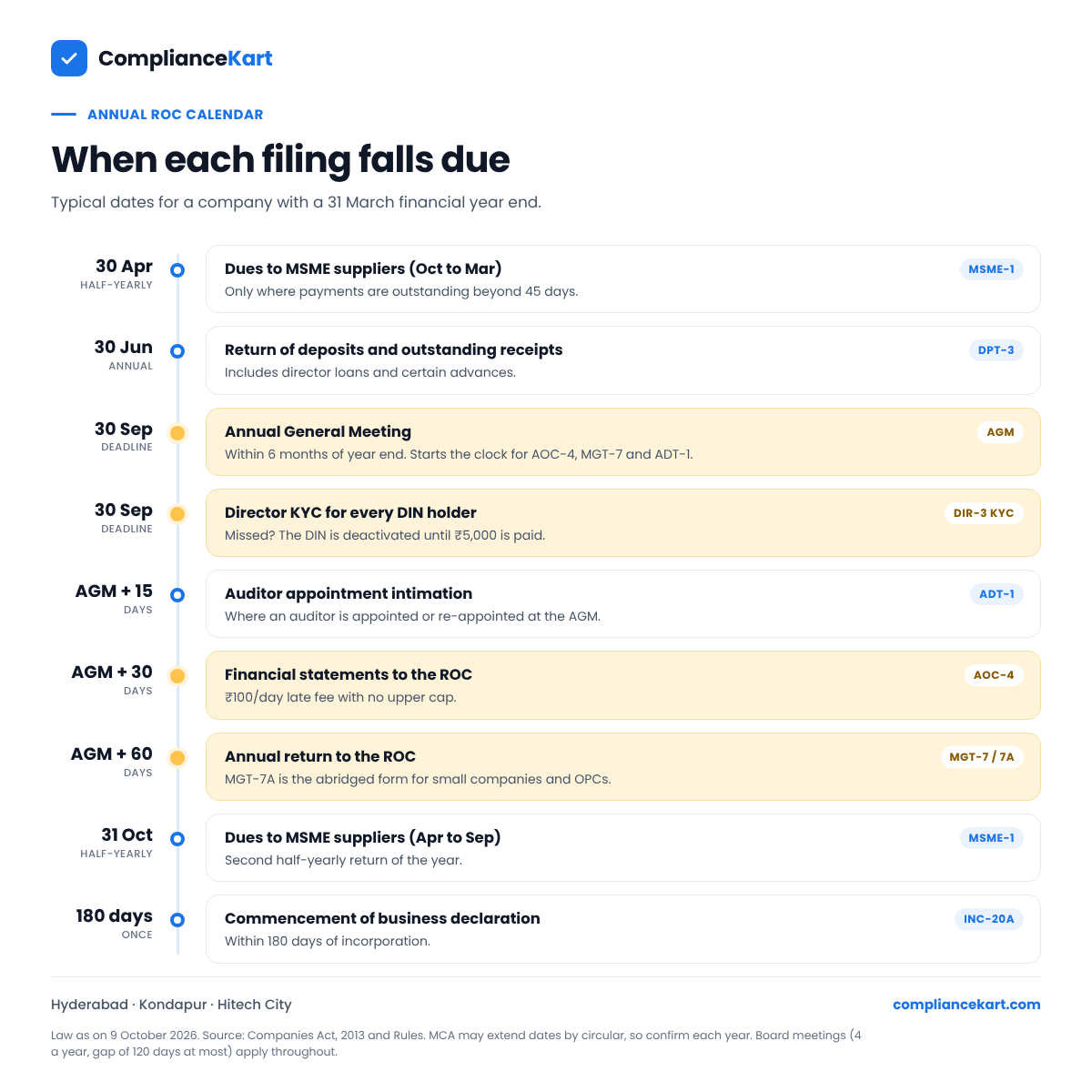
Due dates are sometimes extended by MCA circulars, so confirm each year. Our annual ROC compliance calendar for startups and the October 2026 compliance due dates are kept current.
Three worked examples
Example 1: AOC-4 and MGT-7 filed 120 days late
Assumptions: March year-end; AGM held on 30 September 2026; AOC-4 due 30 October 2026 and MGT-7 due 29 November 2026; both filed 120 days after their due dates; day count is approximate. Penalties are imposed through adjudication, so the figures show the maximum exposure.
| Item | Working | Amount |
|---|---|---|
| Late fee on AOC-4 (paid at the time of filing) | 120 days × ₹100 | ₹12,000 |
| Late fee on MGT-7 (paid at the time of filing) | 120 days × ₹100 | ₹12,000 |
| Penalty on the company, section 137(3) | ₹10,000 + (120 × ₹100) | ₹22,000 |
| Penalty on the company, section 92(5) | ₹10,000 + (120 × ₹100) | ₹22,000 |
| Total exposure for the company | ₹68,000 | |
| Penalty on each officer in default | ₹22,000 under each section (cap ₹50,000 each) | ₹44,000 each |
The late fee is automatic and has no cap, so a delay of two years would cost ₹73,000 per form in late fees alone. The penalty is separate and is capped.
Example 2: A director who misses DIR-3 KYC
A director holding a DIN on 31 March 2026 must complete KYC by 30 September 2026. If the date is missed, the DIN shows as “Deactivated due to non-filing of DIR-3 KYC”. Until the director pays ₹5,000 and files the KYC, the DIN cannot be used on MCA filings, which can hold up any filing that needs that director’s signature.
Example 3: INC-20A filed after the 180 days
A company is incorporated on 1 February 2026. The 180 days end on 31 July 2026. If the declaration is filed on 31 October 2026, the delay is 92 days. The company faces ₹50,000, and each officer in default faces ₹1,000 × 92 = ₹92,000 (the cap is ₹1 lakh). If no declaration is filed at all, the ROC can also begin proceedings to remove the company’s name from the register.
How a small default snowballs
Penalties are only the first layer. The bigger risk is the chain that follows continuous default.
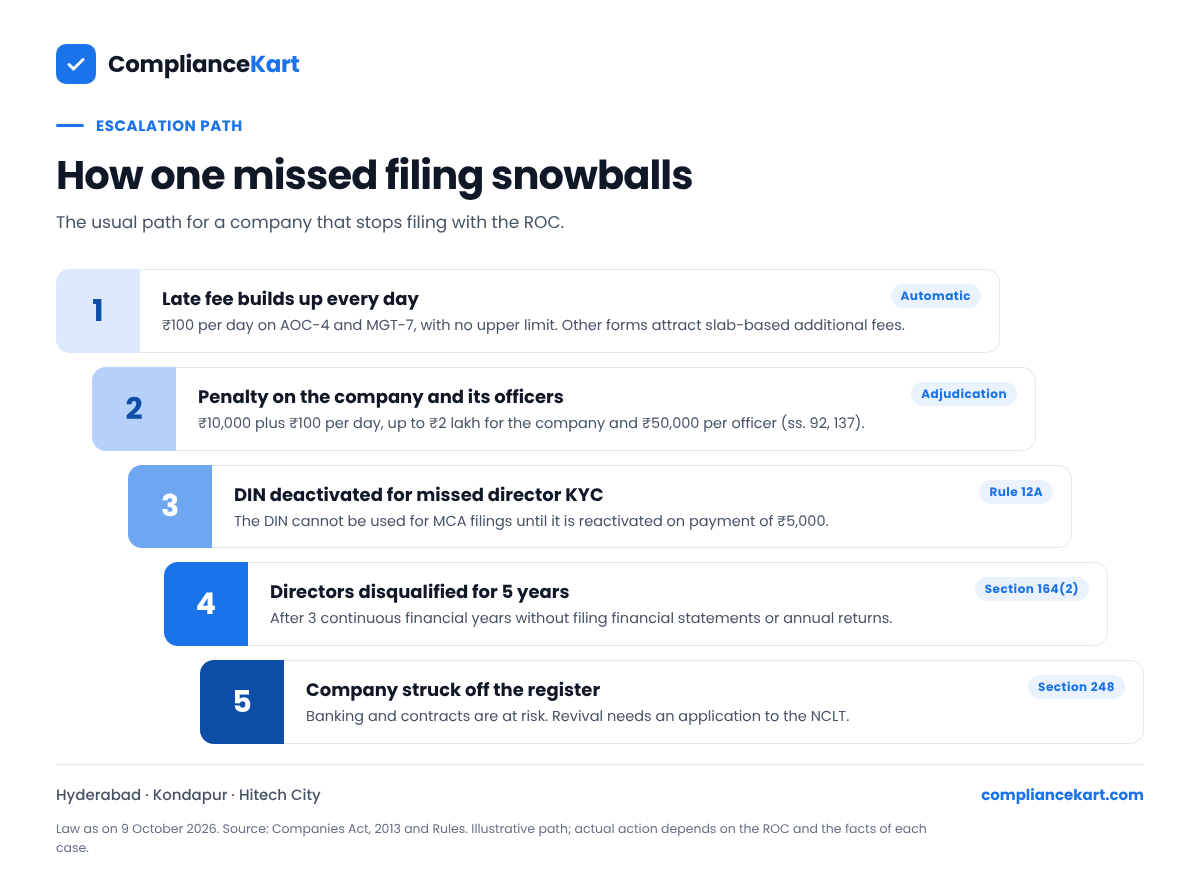
- Late fees build up automatically on AOC-4 and MGT-7.
- Penalty can be imposed on the company and its officers.
- DIN deactivation follows a missed DIR-3 KYC.
- Disqualification under section 164(2)(a): directors of a company that has not filed financial statements or annual returns for three continuous financial years are disqualified for five years from the date of default. The disqualified director cannot be re-appointed in that company or appointed in any other company during this period.
- Strike-off under section 248: the ROC can remove a company’s name from the register after notice. Revival requires an application to the NCLT.
Relief for small companies, OPCs and start-ups
Section 446B provides lesser penalties for One Person Companies, small companies, start-up companies and producer companies. Where the Act prescribes a penalty, it is limited to half the specified amount, subject to a maximum of ₹2 lakh for the company and ₹1 lakh for an officer in default. A start-up here means a private company recognised as a start-up by DPIIT. This relief applies to penalties, not to the ₹100 per day additional fee levied on the filing, and it does not apply to the fines under section 99.
Beyond the Companies Act
ROC compliance is only one track. GST returns, TDS, income-tax returns, payroll dues and statutory registers carry their own late fees and interest, and those are not covered in the table above. Our guides on common compliance mistakes founders make and TDS a startup must deduct cover them. A director loan can also trigger a DPT-3 filing, which is easy to miss.
Why private limited company non-compliance slips in Hyderabad’s growing companies
For founders and finance heads in Hitech City, Gachibowli, Kondapur and the Financial District, the ROC calendar can easily end up with whoever has time in a fast-growing team. The usual failure is simple: the AGM is postponed, every date behind it slips, and the gap can surface only when a bank, investor or due-diligence team asks for a filing. A change of office is another common trigger. If you have moved within Hyderabad, see our guide on changing a registered office in Hyderabad.
A simple checklist to stay compliant
- Fix the AGM date at the start of the financial year and work backwards from it.
- Schedule four board meetings a year, with no gap of more than 120 days (small companies and OPCs have a lighter requirement).
- File AOC-4 and MGT-7 before the deadline, even when the company has no turnover.
- Ask every director to complete DIR-3 KYC before 30 September.
- For a new company, file INC-20A within 180 days of incorporation: INC-20A filing in Hyderabad.
- Review supplier ageing each half-year to check whether MSME-1 applies.
Why work with ComplianceKart
ComplianceKart is a boutique practice that brings Chartered Accountants, Company Secretaries and advocates under one roof. Think of a multi-speciality hospital: a patient does not have to chase separate clinics for the scan, the diagnosis and the procedure, because the specialists work from one file. Your ROC filings, tax returns and any notice that follows are handled the same way, by professionals who can see the whole picture. We prepare the annual calendar, track due dates, handle ROC filings and help with the position where a default has already happened.
Frequently asked questions
What is the penalty for not filing AOC-4 and MGT-7?
A late fee of ₹100 per day with no upper cap is charged when the form is filed. Separately, the company can be penalised ₹10,000 plus ₹100 per day, up to ₹2 lakh, and each officer in default up to ₹50,000, under sections 137(3) and 92(5).
Do I need to file AOC-4 and MGT-7 if my company had no business?
Yes. Sections 92 and 137 apply to every company, whatever its turnover or activity. A company with no revenue still files financial statements and an annual return.
Can the ROC strike off a Private Limited Company for non-filing?
Section 248 allows the ROC to begin strike-off proceedings after notice, including where a company has not commenced business or is not carrying on business. Continuous non-filing for three financial years separately disqualifies its directors under section 164(2)(a).
My director missed DIR-3 KYC. How is the DIN reactivated?
The director files DIR-3 KYC on the MCA portal with the ₹5,000 fee. The DIN stays deactivated until that is done.
Is there any relief for start-ups and small companies?
Section 446B limits penalties for OPCs, small companies, DPIIT-recognised start-ups and producer companies to half the amount specified, with a ceiling of ₹2 lakh for the company and ₹1 lakh for an officer. It does not reduce the additional fee charged on the form.
Can past defaults be regularised?
Pending forms can be filed on payment of the additional fee. The penalty for past defaults is a separate matter decided through adjudication, so the approach depends on how long the default has run and what has been filed. Take advice on the facts of your company before responding to any ROC notice.
Official sources
- Companies Act, 2013 as amended (India Code): sections 10A, 12, 92, 96, 99, 137, 164, 172, 173, 248, 405 and 446B.
- Ministry of Corporate Affairs: DIR-3 KYC FAQs.
- PRS: Corporate Laws (Amendment) Bill, 2026. This Bill has been introduced in Parliament and proposes changes to the Companies Act. The figures in this article reflect the law in force on 9 October 2026 and will be updated if it is enacted.
Need help with ROC compliance?
If your company has missed a filing, or you want a calendar that runs itself, talk to us about ROC filings in Hyderabad. Call or WhatsApp 9959536391 or write to team@compliancekart.com. Outcomes depend on the facts and the position on record, so we start with a review of what has been filed.
This article is for general information on the law as on 9 October 2026 and is not advice on any particular company’s facts.
Need this done for your business?
Send us one message. A CA, CS or Advocate replies within a working day — no forms, no obligation.