Got a GST Notice in Hyderabad? How to Read and Reply to ASMT-10, DRC-01A & DRC-01
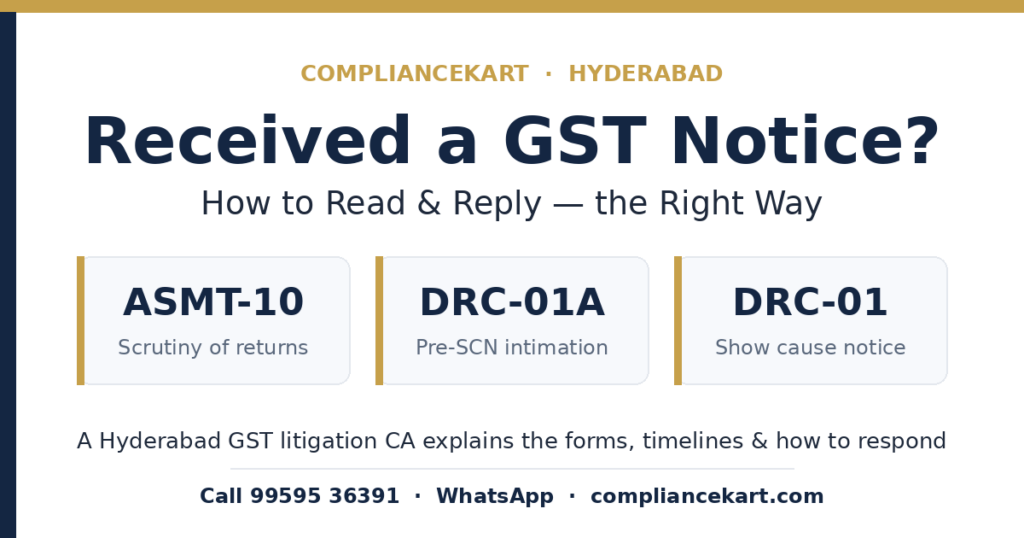
GST Notice ASMT 10 in Hyderabad: this ComplianceKart guide explains gst notice asmt 10 for startups and businesses – the key requirements, the process, and the practical points founders in Hyderabad most often get wrong.
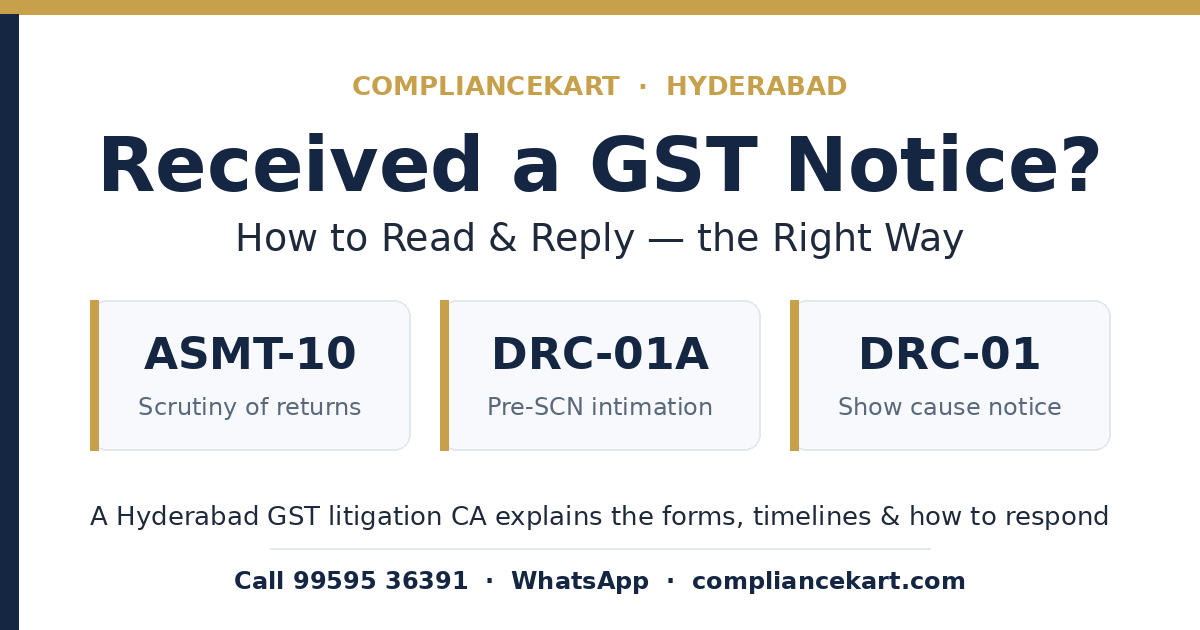
A GST notice landing on the portal is one of the most stressful moments for any business owner — and the instinct to either ignore it or panic-pay is exactly the wrong one. The good news: almost every GST notice is answerable, and the outcome usually turns on how you read the notice and how you reply within the timeline.
We handle these regularly for businesses across Hyderabad — traders in Kukatpally and Ameerpet, IT and services companies in HITEC City, Madhapur, Gachibowli and Kondapur, and manufacturers on the city’s outskirts. This guide explains the three forms founders see most — ASMT-10, DRC-01A and DRC-01 — what each one means, and exactly how to respond. (GST provisions and timelines change; always confirm the current position on the official GST portal before acting.)
Key takeaway: A GST notice is a conversation, not a verdict. Reading the exact form, fixing the deadline, and filing a reasoned reply on the correct form is what keeps a routine query from turning into a confirmed demand with interest and penalty.
The GST notice escalation ladder
Under GST there is a defined escalation ladder, and knowing where on the ladder your GST notice sits tells you what is at stake and how much room you have. A scrutiny observation is not the same as a confirmed demand; a pre-show-cause intimation is not the same as a show cause notice. Replying to the wrong stage — or missing a reply window — is what converts a simple question into a liability.
At a glance: the three GST notices compared
| Notice (Form) | Legal basis | What it means | You reply on | Typical window |
|---|---|---|---|---|
| ASMT-10 | Section 61 & Rule 99 | Scrutiny of returns — a discrepancy was found | ASMT-11 | ~30 days |
| DRC-01A | Rule 142(1A) | Pre-show-cause intimation of tax ascertained | DRC-01A Part B | As specified |
| DRC-01 | Section 73 / 74 / 74A | Summary of a formal show cause notice | DRC-06 | ~30 days |
ASMT-10 — scrutiny of returns (the early warning)
What it is: Form GST ASMT-10 is issued under Section 61 read with Rule 99 when the officer scrutinises your returns and finds a discrepancy — for example a mismatch between GSTR-1 and GSTR-3B, or between GSTR-3B and GSTR-2B input tax credit, or a ratio the system flags.
How you reply: You respond in Form GST ASMT-11, either accepting the discrepancy and paying (with interest) through DRC-03, or explaining with reasons and evidence why there is no shortfall. The reply is generally expected within 30 days (or the period specified in the notice).
Why it matters: ASMT-10 is your best opportunity. A clear, reconciled, evidence-backed ASMT-11 can close the matter here. If the officer is not satisfied — or you do not reply — the case escalates to a demand under Section 73 or 74. This is the cheapest GST notice to resolve, so treat it seriously.
DRC-01A — the pre-show-cause intimation
What it is: Form GST DRC-01A is an intimation of tax ascertained by the officer under Rule 142(1A), issued before a formal show cause notice. Part A sets out the officer’s view of the liability; Part B is where you record your response.
How you reply: You can either pay the ascertained amount (fully or partly) through DRC-03 and communicate it, or file Part B of DRC-01A stating your disagreement with reasons. Paying at this stage — where you agree — can save penalty exposure, because tax and interest paid before a show cause notice under Section 73 generally attract no penalty.
Why it matters: DRC-01A is a second off-ramp before litigation proper. A well-reasoned Part B can persuade the officer to drop or narrow the proposed demand. Engaging here, rather than waiting for the SCN, often produces the best commercial outcome on a GST notice.
DRC-01 — the summary of the show cause notice
What it is: Form GST DRC-01 is the summary of a show cause notice (SCN), issued along with a detailed SCN under Section 73 (cases not involving fraud, wilful misstatement or suppression) or Section 74 (cases involving fraud, etc.). For financial year 2024-25 onwards, a common provision — Section 74A — governs the timelines and process; the older 73/74 distinction applies to earlier periods. This is the formal start of an adjudication.
How you reply: You file your reply in Form GST DRC-06 within the time specified (commonly 30 days), attaching your legal grounds and documentary evidence, and you can seek a personal hearing. The adjudicating officer then passes an order (DRC-07 is the summary of the order).
Why it matters — the penalty mechanics: The stage at which you pay changes the penalty dramatically. Broadly, in a Section 73 (non-fraud) case, paying tax and interest before the SCN means no penalty, and paying within 30 days of the SCN also carries relief. In a Section 74 (fraud) case, reduced penalties apply for early payment — a lower percentage before the SCN, more within 30 days of the SCN, and the full penalty otherwise. Getting the timing and the characterisation (73 vs 74) right on a GST notice is worth real money — and is exactly where professional handling pays for itself.
Received any of these notices? Don’t reply blind — talk to a CA in Hyderabad who handles GST litigation. Call 99595 36391 or WhatsApp ComplianceKart before your reply deadline.
The GST notice reply checklist we run for every case
- Diarise the deadline first. The reply window (often 30 days) is the single most important fact — a strong case lost on limitation helps no one.
- Identify the exact provision and stage — Section 61 scrutiny, Rule 142(1A) intimation, or a 73/74/74A SCN. The reply strategy differs for each.
- Reconcile the numbers — GSTR-1 vs 3B, 3B vs 2B, ITC eligibility, RCM and turnover. Most discrepancies are reconciliation or timing issues, not real shortfalls.
- Check the procedure. Was the GST notice validly served? Is it vague or a “template” notice? Are limitation and jurisdiction in order? Procedural defects are legitimate grounds of defence.
- Decide: pay, contest, or partly both — a defensible commercial call, weighing interest and penalty exposure against the strength of your position.
- Reply on the correct form — ASMT-11, DRC-01A Part B, or DRC-06 — with evidence, and request a personal hearing where available.
Why founders across Hyderabad hand a GST notice to a specialist
GST adjudication rewards precision — the right form, the right grounds, the right evidence, filed on time. A weak or late reply narrows your options at the first appeal (APL-01) and all the way to the GST Appellate Tribunal. Whether you run a business in Kokapet, Nanakramguda, Kukatpally or the Financial District, having a CA firm near you that lives in GST litigation means your GST notice reply is built to defend, not merely to respond. We also cover the post-incorporation compliances and TDS obligations that, when missed, often trigger these notices in the first place.
Frequently Asked Questions
What is the difference between ASMT-10 and DRC-01?
ASMT-10 is a scrutiny notice under Section 61 flagging discrepancies in your returns, answered in ASMT-11. DRC-01 is the summary of a formal show cause notice under Section 73/74 (or 74A for FY 2024-25 onwards), answered in DRC-06. ASMT-10 is an earlier, less severe stage of a GST notice.
How long do I get to reply to a GST notice?
It depends on the notice, but replies to scrutiny (ASMT-11) and show cause notices (DRC-06) are commonly expected within 30 days, or the period stated in the notice. Always confirm the exact deadline on the notice itself, as it is critical.
What happens if I ignore a GST notice?
Non-response usually leads to escalation — a scrutiny observation becomes a show cause notice, and an unanswered SCN can result in an ex-parte demand order (DRC-07) with tax, interest and penalty, which you then have to contest on appeal. Replying on time is far cheaper.
Can I just pay the amount in DRC-01A to close it?
Where you agree with the liability, paying at the DRC-01A stage (via DRC-03) can be sensible and may avoid penalty in a Section 73 case. Where you disagree, you should file Part B with your reasons rather than pay. The right choice depends on the facts.
Do I need a professional to reply, or can I do it myself?
Simple reconciliation queries can sometimes be handled in-house, but characterisation (73 vs 74), procedural defences, limitation and penalty optimisation materially affect the outcome. For anything beyond a routine mismatch, professional handling of your GST notice is strongly advisable.
Facing a GST notice in Hyderabad? Reply with a specialist behind you.
ComplianceKart reads, strategises and drafts replies to every GST notice — ASMT-10, DRC-01A, DRC-01 and beyond — for businesses across Hyderabad, from HITEC City and Gachibowli to Kondapur and Kokapet, and represents them through adjudication and appeal. Call 99595 36391, WhatsApp us, or contact us — your Virtual CA · CS · Advocate.
Need expert help with GST Notice ASMT 10 in Hyderabad?
ComplianceKart’s chartered accountants advise startups and businesses across Hyderabad on gst notice asmt 10 and the related compliance that goes with it. For clear, defensible guidance on gst notice asmt 10 – and support if any notice or litigation follows – talk to the ComplianceKart team today.
Related reading
Need this done for your business?
Send us one message. A CA, CS or Advocate replies within a working day — no forms, no obligation.